


The value of your personal injury case depends largely on things like how bad your injuries were, how much your medical expenses cost, how much income you've lost due to injuries, and how seriously they have impacted your daily life. A sprained wrist that heals in a month and a spinal injury that ends a career are valued very differently. No two claims are the same, and no lawyer can honestly hand you a number at the start.
Etehad Law is a Beverly Hills personal injury firm led by Simon Etehad, who has represented injured plaintiffs since 1996. The firm's case results include a jury verdict of more than $11 million in an auto case and a $1.5 million policy-limits settlement for a T-bone crash, and clients have rated the firm 5.0 stars across 285 Google reviews. Cases are handled on contingency, so you pay no attorney fees unless the firm recovers compensation for you. If you were hurt in an accident, schedule a free consultation to talk through what your claim may be worth.
Below, we walk through how settlements are calculated in California, what pushes a claim's value up or down, and what you can do now to protect it.
How Much Is the Average Personal Injury Settlement?

There's no one average settlement figure that will tell you how much your case is worth. The amount turns on your injuries, your treatment costs, your lost wages, how long recovery takes, and how strong the evidence of fault is.
Two people involved in the same kind of accident can turn out very differently. One leaves with some bruising and ends up needing a few weeks of physical therapy. The other needs surgery, misses six months of work, and lives with pain that never fully goes away. Limits on insurance policies matter too because the limits set by the other party who is at fault often serve as an important practical limit on how much you can collect from them directly without going after personal assets of that party.
The CDC tracks national costs related to injuries using the WISQARS Cost of Injury tool; this tool estimates healthcare costs, missed work time and losses in quality of life. Those numbers show how costly injuries are for everyone. They are not settlement averages, and they won't predict your case.
Both online settlement calculators and the big numbers that lawyers put in attorney ads have the same flaw. They cannot account for any disputes about fault, gaps in your treatment, or the limits on the insurance policy of the other driver. A personal injury attorney who reviews your information will be able to give you a much more realistic range.
What Factors Determine How Much Your Personal Injury Case Is Worth?
The main factors are injury severity, medical expenses, lost income, pain and suffering, fault, and available insurance. Lawyers sort those into economic damages, which are financial losses you suffer, and also other damages that deal with physical and emotional suffering.
Severity and Type of Injury
Severity matters more for value than almost anything else. Soft tissue injuries that heal in a few weeks usually mean relatively small medical expenses and a short interruption in your life. Fractures, a traumatic brain injury, or a spinal cord injury are a different category.
Serious injuries usually require surgery, months of therapy and assistance for daily things. When an injury causes permanent impairment, the claim also has to account for future medical care, lost earning capacity, and pain that continues for years.
Medical Expenses and Future Treatment
The biggest component of financial damage usually relates to medical bills. These would include ambulance rides, visits to emergency rooms, hospital stays, surgeries, prescription medications, physical therapy and any other treatment related to an accident. If doctors think you will need continued care beyond this accident, then that future cost should be part of your claim as long as there is supporting medical evidence.
A 2024 CDC study found that people treated in an emergency department for a nonfatal injury averaged about $5,800 in medical spending and $1,690 in lost work over the following year, according to the CDC's injury economics summary. For people who end up in the hospital, medical bills came to $52,250 on average and also resulted in $7,820 in lost wages. These are population figures, not settlements, but they show how quickly costs climb as injuries get worse.
Keep track of your medical records, itemized bills, treatment plans and receipts. If you're not sure who pays your medical bills after an accident while the claim is still pending, clear things up sooner rather than later, otherwise unpaid bills start to mount up. In serious cases, a treating physician or life care planner may estimate what future treatment will cost.
Lost Wages and Reduced Earning Capacity
Injuries can affect income long after an accident happens. Lost wages include any paychecks and benefits that you missed out on during your time of recovery. If an injury that is long term stops you from going back to your previous job or working full hours, then that injury claim can include lost earning potential too.
Your pay stubs, tax returns and a letter from your employer confirming your time off are necessary basic proof. Future losses are harder to pin down, and vocational or economic experts are often brought in to compare what you would have earned with what you can realistically earn now.
Pain and Suffering
A lot of what an injury takes from you never shows up on a bill. Non-economic damages compensate for physical pain, emotional distress, anxiety, lost sleep, and the activities you can no longer enjoy. Someone injured in a serious car accident may be very nervous behind the wheel for months or may have to give up sports that they've played for a long time.
The worth of those damages depends on how serious the results are, how long they last and how well you have backed them up with medical records and personal accounts. We explain the common ways lawyers estimate this number in the calculation section below.
Liability and Available Evidence
Liability refers to determining who is legally responsible for something. Strong evidence showing negligence on the part of the other side makes you stronger in negotiations. When fault is disputed, the insurer has a reason to offer less.
Police reports, photographs, videos, witness testimony and expert opinions all contribute to establishing what occurred. Your medical records link the accident to your injuries. Insurance companies scrutinize past health issues and any lapses in treatment; that's why consistent medical treatment is so important to the value of a claim.
If you were partly at fault, California's comparative negligence rule reduces your recovery by your share of the blame but doesn't wipe it out. We go into more detail later on how that works.
Insurance Coverage and Available Compensation
There is still a limit when strong cases come up against insurance policies. Under California law, Bodily Injury Liability Minimum Coverage is set at $30,000 per person and $60,000 per accident as noted by the California DMV. Those minimums doubled under the state's new auto insurance rules. If the at-fault driver carries only the minimum and your losses come to $150,000, that policy will pay no more than $30,000 for your injuries.
That's why lawyers look for every other source of income: another party who is also at fault, insurance from an employer if their employee was working at the time of accident, umbrella insurance or uninsured or underinsured motorists coverage. If you get into an accident where the other driver has very little or no insurance, it would be good to read about California's uninsured motorist laws. Damage to vehicles typically is dealt with as a separate claim for insurance purposes even if they were all involved in the same accident.
What Types of Compensation Can You Recover?
If someone else's negligence caused your injuries, you can seek compensation for both your financial losses and the personal harm you've suffered. What's available depends on the specifics of your situation and the evidence for each loss. Here are the major categories under California law:
- Costs for medical bills and future treatments. This includes care that you have already received along with what your doctors think you will need in the future such as further surgeries and long-term physical therapy.
- Income lost and reduced earning ability. You can recover income you missed while recovering, plus the gap in future earnings if the injury limits the work you can do.
- Pain and suffering. This compensates for the physical pain of the injury and of the treatment that followed.
- Emotional distress and loss of enjoyment of life. Anxiety, depression, sleep problems, and the loss of hobbies or family activities all fall here.
- Property damage and out-of-pocket expenses. Vehicle repairs, a rental car, mileage to medical appointments, and home modifications are examples.
- Punitive damages, where available. These are rare. Under California Civil Code § 3294, you have to prove by clear and convincing evidence that the defendant acted with malice, oppression, or fraud. A drunk driver who causes a crash is one situation where they may come up.
How Is a Personal Injury Settlement Calculated?

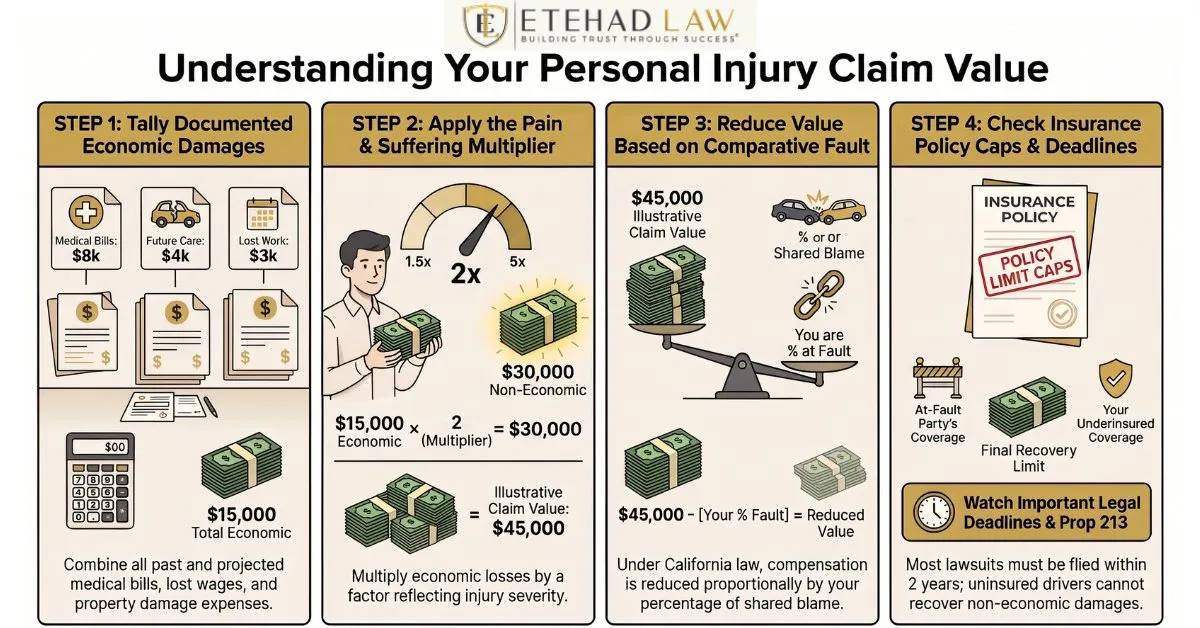
There's no formula that spits out the value of every case, but most valuations follow the same basic sequence. They begin by calculating documented losses and then add an estimate for non-economic harm. Then they adjust for fault and insurance as well.
1. Calculate Economic Damages
Economic damage is what you can prove through documentation. Add up your past medical bills, the projected cost of future treatment, wages you've lost, any projected loss of future income, and out-of-pocket costs such as prescriptions, travel to appointments, and property damage. Pay stubs, bills, receipts and letters from employers all back up each number.
When it comes to future medical bills and loss of earning capacity, it's generally important to get an expert opinion, particularly if the injury is permanent. That's usually where most of the value is found in a serious case.
2. Estimate Non-Economic Damages
Sadness, emotional pain and loss of enjoyment of life don't come with a receipt. Insurance companies and lawyers often start using a scaling method; they multiply economic damages by some number usually between 1.5 and 5. They increase that number when there are more serious or long-lasting injuries. If there are $20,000 in economic damages and you multiply that by 2, then the estimate for non-economic damages would come to $40,000.
Some people use an approach where a certain dollar amount is assigned for each day that you spend living with the injury. Neither method is written into California law and a jury is not bound by either one. These are guidelines that help shape negotiations.
3. Account for Liability and Insurance Coverage
The total from the first two steps isn't necessarily what you'll receive. If you share some of the blame, then you recover less based on what percentage you share. If the at-fault party's insurance is smaller than your damages, the policy limit may cap what you can collect from that source.
Disputes over whether the accident caused your injuries, or whether you needed all the treatment you received, can also pull the number down. An attorney considers those risks before giving you a realistic range.
Practical Example: Calculating a Potential Settlement
Another driver runs a red light and crashes into you. You get treatment for a broken wrist and will need several more months of therapy. You also end up missing three weeks of work. The table below shows how a rough valuation could come together, using a multiplier of 2.
| Type of damages | Estimated amount |
|---|---|
| Past medical bills | $8,000 |
| Future medical expenses | $4,000 |
| Lost wages | $3,000 |
| Total economic damages | $15,000 |
| Estimated pain and suffering (2 times economic damages) | $30,000 |
| Illustrative total claim value | $45,000 |
The economic damage comes to $15,000. The multiplier adds $30,000 to the valuation for non-economic damages for a preliminary value of $45,000. If you were found 20% at fault, that figure would drop to $36,000. And if the other driver carried only the $30,000 minimum, you'd need to look to your own underinsured motorist coverage for the rest. To learn more about how this works in accidents check out our guide for car accident settlements.
This is an illustration, not a forecast. Your actual settlement could be higher or lower depending on the evidence, how your recovery goes, and how the insurer responds.
Can You Still Recover Compensation If You Were Partly at Fault?
Yes. In California you can still get compensation even if you were mainly at fault thanks to pure comparative negligence. The California Supreme Court adopted that rule in Li v. Yellow Cab Co. (1975). Recovery is reduced because you share responsibility. If your claim is worth $50,000 and you're found 20% responsible, you can recover $40,000.
That is more forgiving compared to many states. Some bar recovery once you're 50% or 51% at fault, and a handful bar it if you contributed to the accident at all. In California, someone who was 70% at fault can still recover 30% of their damages.
Expect the insurance company to push your share of fault as high as it can, because every percentage point saves it money. Reports of accidents, photos, witness accounts, and data from vehicles all contribute to setting things right. Don't assume that you have no claim just because you've made a mistake.
One California rule surprises folks. Under Proposition 213 (Civil Code § 3333.4), a driver who was uninsured at the time of the crash generally can't recover non-economic damages like pain and suffering, even if the other driver was entirely at fault. There is an exception for an uninsured owner who was not driving if the person at fault gets convicted of driving under the influence for this particular accident. You can still recover losses including medical bills and lost income.
How Do You Know If an Insurance Settlement Offer Is Fair?
A fair offer covers the full scope of what the injury has cost you, given the strength of your claim and the money actually available. An offer that pays this month's medical bills can still fall well short if you've lost income, need more treatment, or are still in pain.
Before responding, review carefully whether everything in your claim matches what is offered. Does it cover treatment you've had and treatment you'll still need? Does it factor in lost wages and any lasting impact on your ability to work? Does it measure the real pain you're experiencing and the way the injury has altered your everyday life? Does it reflect the evidence on fault and the policy limits in play? Adjusters know how to settle claims at the lowest possible level and this guide to dealing with insurance adjusters details what tactics you should be wary of.
Timing matters too. Some injuries take weeks or months to be completely diagnosed and complications can appear long after an accident happens. If you decide to settle before your doctors have an idea of what your recovery looks like, you may wind up paying out of pocket for any further treatment.
Read the release before you sign. A settlement almost always requires you to give up all further claims against the other party for that accident. Once it's final, you usually can't go back for more money, even if your medical costs keep rising. A personal injury lawyer can look at an offer and tell you if that amount is reasonable.
How Long Does It Take to Determine Your Personal Injury Case's Value?

That depends a lot on how well you recover medically. A straightforward claim with a minor injury usually settles pretty quickly within a few weeks or months. Cases involving severe injuries, disputes about who is at fault or large future medical expenses drag on for longer. Most lawyers want you to reach Maximum Medical Improvement, which is the point when your doctors can give an outlook for the future of your condition before they set a final figure on the claim.
The table below breaks down what usually speeds up or slows down that process. If you want a bigger look at the full timeline of the lawsuit, check out how long a personal injury lawsuit takes in California.
| Factor | How it affects the timeline |
|---|---|
| Injury severity | Minor injuries with a predictable recovery can be valued sooner. Serious or permanent injuries take longer to assess. |
| Medical treatment and recovery | Your attorney needs your records and prognosis to estimate full value. Ongoing treatment makes early estimates less reliable. |
| Disputed liability | Gathering police reports, witness statements, and expert evidence on fault takes additional time. |
| Future medical expenses and lost income | Long-term care or reduced earning capacity frequently requires input from medical, vocational, or financial experts. |
| Insurance company response | Adjusters take time to review evidence and coverage, and requests for more documents can delay the process. |
| Settlement negotiations | Clear liability and damages can lead to a quick settlement. Disagreements can mean longer talks or a lawsuit. |
| Legal deadlines | In California, you generally have two years from the injury to file a lawsuit, and only six months to file a claim against a government agency. Missing a deadline can end your case. |
How Can a Personal Injury Lawyer Help Determine Your Case's Worth?
Figuring out what a case is worth takes more than adding up bills. A lawyer considers fault, the full scope of your injuries, both present and future losses and every relevant insurance policy that might compensate you.
The work begins by looking into how the accident occurred. That can mean pulling police reports, tracking down video, interviewing witnesses, and in some cases hiring an accident reconstruction expert. The point is to show who is at fault and also to foresee any arguments that you share the blame elsewhere.
Next comes the damages side. Your lawyer collects medical records, bills, financial statements and receipts to build out the economic side of the claim. When an injury is permanent, medical and financial experts may be needed to project the cost of future care and lost income. Your personal account of how the injury impacts your daily life along with supporting evidence backs up the non-economic component.
A lawyer also hunts for coverage beyond the obvious policy, including other at-fault parties and your own uninsured or underinsured motorist coverage. Knowing the real pool of available money keeps your expectations grounded and shapes how the case is pursued.
When the insurer makes an offer, your attorney can compare it to the evidence, push back on arguments that your injuries were minor or unrelated, and explain the costs and risks of filing suit. Most cases end up settling anyway, but knowing when a case should go to trial helps ensure that the number offered is fair. If cost is a concern, here's a breakdown of what a personal injury lawyer costs on a contingency fee.
What Should You Do to Protect the Value of Your Personal Injury Claim?
How you handle things in the weeks that follow an accident matters a lot for proving who is at fault, documenting what you've lost, and negotiating too. Some very easy habits make a big difference.
See a doctor as soon as possible, even if you feel fine. Some injuries like concussions and soft tissue damage do not show signs immediately. Afterward, stick to your treatment plan, keep your doctor's appointments and fill your prescriptions. Having a consistent medical record is one of the strongest pieces of evidence in any injury claim.
Keep every bill and receipt: hospital invoices, prescriptions, therapy, mileage to appointments. Also, if you're absent from work, save your pay stubs and ask your employer for a letter that details the days off and loss of pay. These records are the backbone of your economic damages.
Document the accident and record your recovery. Take photos of the scene, the vehicles, and your injuries. Get the names and phone numbers of witnesses. Keep a simple journal of your pain levels, the things you can't do, and the events you've missed. It may feel tedious, but those notes help prove damages that bills alone can't capture. Be careful online, too. Insurers check claimants' accounts, and posting on social media can undercut your claim.
Be careful about insurance companies, including your own. Adjusters may ask for a recorded statement or a broad medical authorization early on. Stay focused on the facts, don't speculate about who is at fault and don't minimize your injuries. Speak to a lawyer before signing anything or accepting any offer.
Make sure to keep an eye on the clock. Generally in California, the statute of limitations for personal injury is two years after the date of the injury under Code of Civil Procedure § 335.1. If a city, county, or state agency was involved, you generally have only six months to file a government claim under Government Code § 911.2. Getting a lawyer involved early helps preserve evidence before it disappears.
What Is Your Personal Injury Case Worth?
In reality, what matters most is the nature of your injuries, how much medical treatment you incur, the loss of income you suffer and how your daily life has been affected by the accident. Insurance limits and California's rules on fault and uninsured drivers shape the final number too. An average figure or an online calculator can't tell you where your case falls.
For 30 years Simon Etehad has been representing people who have been injured in California. Our team can review your records, explain what's driving the value of your claim, and tell you whether an offer on the table is fair. Contact Etehad Law for a free consultation.
Frequently Asked Questions
These are the questions we hear most often about settlement amounts, medical bills, attorney fees, and filing deadlines.
How Much Is a Personal Injury Case Worth for Minor Injuries?
Cases with minor injuries usually settle for less, especially when recovery is quick, medical bills are low, and there are no lasting effects. The final amount will still depend on documented losses, physical pain and suffering, proof that someone is at fault and what kind of insurance is available.
How Much Is a Personal Injury Case Worth If I Need Surgery?
Surgery usually increases a claim's value, because it brings higher medical bills, a longer recovery, more lost work, and often future care. The final number will depend on how serious the injury is, what your long-term prognosis looks like, how strong the evidence shows who is at fault, and also the limits under the insurance policy.
Does the Amount of My Medical Bills Determine My Settlement?
Medical bills are a major part of economic damage costs but they don't determine the total value altogether. Your settlement can also include lost income, future medical costs, pain and suffering, and emotional distress.
How Much of a Personal Injury Settlement Will I Keep After Attorney Fees and Expenses?
It depends on the terms of your fee agreement, case costs involved, and any liens that have to be settled out of the final settlement amount. Most personal injury lawyers work on contingency, taking an agreed percentage of the recovery and nothing if there's no recovery. Read the agreement closely and ask how costs and liens are handled before you sign.
Can I Estimate My Personal Injury Case's Value Without a Lawyer?
You can get a rough idea by adding up your documented losses and considering how serious your injuries are and what future care you may need. A lawyer takes into account things that calculators can't deal with such as disputes over who is responsible for an accident, limits of insurance coverage, and factors like Proposition 213 specific to California rules.
How Long Do I Have to File a Personal Injury Claim?
In California, you generally have two years from the date of the injury to file a personal injury lawsuit. Claims against a government agency have a much shorter deadline, usually six months for the initial claim. There are some exceptions like those related to minors; you should speak with a lawyer promptly to double check when your deadline is.
Legal Disclaimer: This article is for informational purposes only. This is not legal advice and will not create any attorney-client relationship. The amount and result of an injury claim depends on the specifics involved, applicable laws, what evidence is available and whether there's insurance coverage. Past performance and settlement examples don't guarantee similar results in any future case. If you need advice specific to your situation, talk to an experienced personal injury lawyer. Contact Etehad Law to discuss your legal options.
You may also like
 Personal Injury
Average Brain Injury Settlement in California
Discover key factors that influence brain injury settlements in California and learn what to expect in your case. Read more for essential…
Read More » Expert Opinion
Top 5 Myths About Personal Injury Cases – Debunked
If you've been injured in an accident, you may have heard myths about personal injury cases that could prevent you from seeking…
Read More »Simon P. Etehad Named to 2027 Southern California Super Lawyers
Etehad Law founder Simon P. Etehad has been selected to the 2027 Southern California Super Lawyers list, his seventh consecutive year and…
Read More »
