


The settlement amounts for dog bites in California vary quite a lot. They depend on how badly the person was hurt, the medical bills, lost wages, permanent scarring, emotional distress, and how much insurance the dog owner carries. A minor bite that heals in a few weeks might settle for a modest sum. A case involving deep wounds, nerve damage, reconstructive surgery, or lasting trauma can be worth much more.
At Etehad Law, our attorneys have spent 30 years representing injured people across Los Angeles and have handled over 2,000 cases. We understand how an attack by a dog impacts families physically, emotionally, and economically. We stand up and fight for compensation that fully covers all these different aspects. If a dog bit you or your child, schedule a free consultation with our team.
This guide covers how dog bite settlements are valued in California, what pushes the number up or down, and what damages you can claim. We also cover California's strict liability law, insurance coverage, filing deadlines, and when it makes sense to bring in a dog bite attorney.
How Much Is the Average Dog Bite Settlement in California?

There is no reliable statewide average for dog bite settlements in California. The ranges that you find online are typically based on specific selected cases, marketing materials from law firms or insurance data; they do not come from a full record of every settlement. Treat them as rough context, not a promise. What your claim is worth comes down to your injuries, your medical costs, lost income, scarring, emotional harm, and the insurance available.
Insurance data gives a sense of scale. According to Insurance Information Institute (Triple-I) data in 2025, insurers paid out 28,450 claims related to dog bites and other injuries related to dogs on average costing $65,450 per claim. California topped the country in number of claims at 2,830 claims, averaging $81,789 each. These numbers include other dog-caused injuries, such as fractures from being knocked down, and they measure insurer payouts, not lawsuit settlements. They highlight how much these injuries cost. They can't say for sure how much any one particular case is worth.
What matters most is the injury itself. A bite that needs basic care and heals cleanly usually settles for less than an attack involving deep or multiple wounds, infection, nerve damage, or a long stay in the emergency room. Serious injuries often lead to surgery, physical therapy, and follow-up care, and every one of those costs adds to the claim. Long-term scars or disfigurements add more value because the victim endures pain along with emotional costs and changes of appearance over many years. Someone who needs reconstructive surgery after a severe attack has a very different claim from someone whose wound closes in three weeks.
Handling claims related to kids needs special care too. Children get bites frequently on the face, and noticeable scars stand out as they develop into adults. Their claims may need to cover future surgeries, counseling, and other long-term needs that doctors can't fully predict right after the attack. The same goes for adults who have serious injuries such as permanent nerve damage or injuries that need frequent surgery. In both cases, settling before you fully understand your injuries can mean important actual costs go uncovered.
What Factors Affect Dog Bite Settlement Amounts?
Insurance adjusters and attorneys look at the same core questions when they value a dog bite claim: how badly you were hurt, what it has cost you, how long the effects will last, and what happened during the attack. Each of these factors moves the number quite a lot.
- Severity and location of the bite: Deep wounds, multiple bites, nerve damage, infection, and injuries to the face, neck, or hands generally increase a claim's value.
- Current and future medical costs: ER visits, medication, wound care, surgery, physical therapy, and follow-up appointments all count, along with treatment you will need later.
- Permanent scarring and disfigurement: Visible scars, especially on the face, carry lasting physical and emotional consequences that affect confidence and quality of life.
- Lost wages and earnings potential: Time away from work counts. If an injury prevents you from going back to work or limits what work you can do in the future, that is a loss too.
- Pain and suffering: The pain of the attack and the recovery, plus any ongoing discomfort or physical limits.
- Emotional distress: Anxiety, fear of dogs, trouble sleeping, and post-traumatic stress, particularly when a doctor or therapist has documented them.
- The victim's age: Children's injuries can shape their development, appearance, and emotional health for years.
- Available insurance: The owner's homeowners or renters policy, along with its limits and exclusions, often sets a practical ceiling on what can be collected.
- The victim's own conduct: Under California's pure comparative negligence rule, provoking the dog can reduce your recovery by your share of fault but does not wipe it out.
The dog's history can also come up. Prior attacks or displays of aggression show what transpired and identify who is responsible. Under California's dog bite statute, though, an owner can be held strictly liable even if the dog had never shown aggression before.
What Types of Compensation Can You Recover After a Dog Bite?
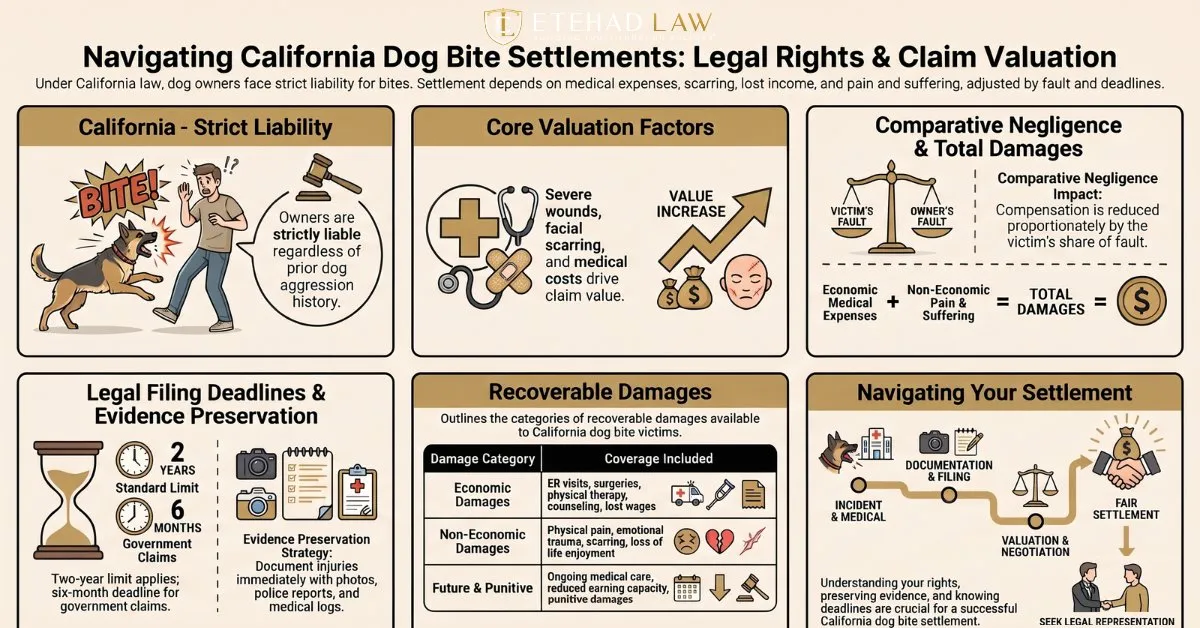
Victims of dog bites in California can pursue various types of damages, depending on the injuries and long-term consequences. Most fall into economic and non-economic categories, and some cases include future losses or punitive damages. Here is the breakdown of what each category contains as described in the table.
| Type of compensation | What it covers |
|---|---|
| Economic damages | Losses you can document with bills and records: ER treatment, hospital stays, surgery, medication, wound care, reconstructive procedures, physical therapy, counseling, lost wages, and other out-of-pocket costs. |
| Non-economic damages | Losses without a price tag: physical pain, emotional distress, anxiety, psychological trauma, permanent scarring, disfigurement, and loss of enjoyment of life. |
| Future damages | Costs from injuries that need ongoing care: future appointments, additional reconstructive surgery, continued therapy, medication, and reduced earning capacity. |
| Punitive damages | Extra damages meant to punish and deter malice, oppression, or fraud. A dog bite alone does not qualify. |
Punitive damages are unusual in cases involving dog bites. Under California Civil Code Section 3294, the victim has to prove by clear and convincing evidence that the defendant acted with malice, oppression, or fraud. An owner who knowingly kept a dangerous dog around people despite serious, known threats might meet that standard, depending on the facts. Simple negligence, or strict liability for the bite alone, is not enough for punitive damages.
Most claims use elements from multiple categories. A person with facial injuries might recover for emergency care, reconstructive surgery, lost income, pain, emotional distress, and future procedures all at once. An attorney is able to distinguish every applicable category and collect records to back each one up.
Who Is Responsible for a Dog Bite in California?
In most cases, the dog's owner is responsible. Under California Civil Code Section 3342, an owner is liable when their dog bites someone in a public place or while the person is lawfully on private property. The victim does not have to prove the dog had bitten anyone before or that the owner knew it was dangerous. If a dog bites a delivery driver walking up to the front door, the owner can be held responsible even if the dog has never bitten anyone.
The statute applies to public spaces like sidewalks, parks and streets. It also covers private property, including the owner's own home and yard, as long as the victim had a legal right to be there. People who have been invited, customers, delivery people, and service providers typically qualify. Someone who enters private property unlawfully does not get the same protection, so whether the victim had permission to be there can become a central issue.
Owners have some defenses. The main thing is trespassing. The statute allows for an exception specifically for police and military dogs as well. A government agency may not be liable under Section 3342 when its dog bites while defending itself from harassment or provocation, or while helping an officer apprehend a suspect, investigate a crime, execute a warrant, or protect someone. That exception comes with its own conditions, including a requirement that the agency have a written policy on using the dog.
Provocation is another common defense that people use. If someone teases, hits, or bullies a dog, the owner will say that person provoked the biting incident. Even so, under California's comparative negligence rule, victims typically receive less compensation rather than none at all. We explain how that works below in the section on comparative negligence.
A landlord can sometimes be liable for a tenant's dog, but liability does not follow just from owning the property. California courts, starting with Uccello v. Laudenslayer (1975) 44 Cal.App.3d 504, require proof that the landlord knew about the dog's dangerous behavior and had the power to fix the problem, for example by ending the lease or requiring the dog's removal, but did nothing. A landlord who knew a tenant's dog had repeatedly attacked people could face a claim. A landlord who knew nothing about the dog's dangerous behavior usually would not.
Does California Have a One-Bite Rule for Dog Attacks?

No. Some states follow a "one-bite rule," which lets an owner off the hook unless the dog had bitten someone before or the owner knew it was dangerous. California replaced that rule with strict liability under Civil Code Section 3342. A first bite counts.
To win a claim under the statute, the victim generally needs to show four things: the defendant owned the dog, the dog bit them in a public place or while they were lawfully on private property, they were harmed, and the bite was a substantial factor in causing that harm. California's civil jury instructions (CACI No. 463) also make clear that an owner is liable no matter how carefully they restrained or guarded the dog. A leash, a fence, or a "beware of dog" sign does not change that.
Strict liability only covers bites, though. If a dog knocks someone down, jumps up at them, or starts chasing them towards traffic then usually that person will have to file a claim for negligence. That means showing the owner knew or should have known the dog was dangerous, or failed to take reasonable steps to prevent a foreseeable injury. California courts still allow these common-law claims when an injury falls outside the bite statute.
Does Homeowners Insurance Cover Dog Bite Claims?
Usually, yes. Most homeowner and renter insurance policies provide liability coverage that will pay for injuries caused by the policyholder's dog, along with related legal expenses. Coverage still depends on the policy's wording, exclusions, limits, and the facts of the attack.
According to the Insurance Information Institute, these policies typically carry liability limits of $100,000 to $300,000. If a claim settles for $200,000 and the policy limit is $100,000, the insurer generally pays only up to $100,000. The owner is personally on the hook for the remainder.
Some insurance companies limit coverage based on breed of dogs or on individual histories of dogs. A policy may exclude dogs that have bitten someone before, or deny a claim if the owner hid the dog's history when buying or renewing coverage. Others need training or specific safety precautions. Owning a certain breed does not automatically void coverage, so the actual policy language has to be checked.
If the owner has no insurance or not enough, then the victim may have to go after the owner directly or look for other coverage like umbrella insurance. An attorney can track down every policy that might apply, review the limits and exclusions, and make sure no source of payment gets missed.
How Is a Dog Bite Settlement Calculated?
There's no formula that insurance companies plug your bills into directly. Settlement value gets built step by step, starting with hard costs and adding the harder-to-measure losses on top. Here is how that usually works.
- Sum up economic damages: Use documented bills, receipts, and pay records to document financial losses. These include ER treatment, hospital stays, medication, wound care, surgery, reconstructive procedures, physical therapy, counseling, and lost wages. Future medical costs and reduced earning capacity count too, when evidence supports them. California jury instructions regarding medical expenses and lost earnings (CACI Nos. 3903A and 3903C) consider both past and future losses.
- Assess non-economic damages: Next, look at the physical and emotional toll: pain, mental suffering, emotional distress, scarring, disfigurement, and loss of enjoyment of life. There's no set formula for these. It depends on how intense and long this suffering lasts and how well that suffering has been documented. CACI No. 3905A names these as recoverable non-economic damages.
- Gather the evidence: Medical records contain details about injuries, diagnoses, treatments, and anticipated recoveries. Pictures taken right after the attack and continuing during the healing process show how severe the injuries and scarring are. Hospital invoices, pharmacy receipts, and therapy bills prove the costs, and employment records prove missed income. Expert opinion may be necessary to explain upcoming surgery or long-term psychological care.
- Consider scars and also psychological treatment: Lasting effects often drive the biggest part of a claim. Permanent scars on the face can involve plastic surgery, cosmetic treatments and specialized medical care, and visible disfigurement also affects confidence and relationships, which is compensable. Victims who develop anxiety, a fear of dogs, or post-traumatic stress may need counseling. Treatment expenses amount to economic losses and the actual suffering endured also constitutes non-economic damages.
- Estimate the total: With the evidence in hand, both categories are added together. Below is a hypothetical claim for a serious bite that results in permanent scars.
| Type of damage | Illustrative amount |
|---|---|
| Emergency treatment, hospital bills, and medication | $15,000 |
| Reconstructive surgery and future medical expenses | $25,000 |
| Physical therapy and psychological treatment | $10,000 |
| Lost wages | $10,000 |
| Pain, suffering, and emotional distress | $40,000 |
| Permanent scarring and disfigurement | $50,000 |
| Estimated total damages | $150,000 |
These figures are for illustration only. They are not an average California settlement and don't predict any outcome. Value depends on the evidence, the injuries sustained, and future needs.
- Adjust based on comparative fault: If the victim shares some blame, the total is reduced by their percentage of fault. If the person in this example were found 20% responsible for provoking the dog, the $150,000 would drop by $30,000, to $120,000.
How Does California's Comparative Negligence Law Affect Dog Bite Settlements?
California follows pure comparative negligence rules. A dog bite victim can recover compensation even if they partly caused the attack, but the award shrinks by their percentage of fault. Insurance companies frequently invoke this rule; they argue that victims provoked dogs, ignored warnings, or otherwise brought bites upon themselves.
The rule comes from the California Supreme Court's 1975 decision in Li v. Yellow Cab Co. (13 Cal.3d 804), which threw out the old all-or-nothing system. Before Li, any fault on the victim's part could bar recovery entirely. Fault is now divided proportionately.
Victims get closely scrutinized in dog bite cases. Teasing or hitting a dog, entering property without permission, or ignoring clear warnings can all be raised. But approaching or petting a dog does not make someone responsible for being bitten, and the facts have to be looked at carefully before anyone assigns fault. This table shows how varying percentages of faults impact a claim worth $100,000.
| Total damages | Victim's share of fault | Reduction | Potential recovery |
|---|---|---|---|
| $100,000 | 10% | $10,000 | $90,000 |
| $100,000 | 20% | $20,000 | $80,000 |
| $100,000 | 40% | $40,000 | $60,000 |
| $100,000 | 60% | $60,000 | $40,000 |
Even a victim found 60% at fault can still collect the share owed by the other party. Still, the percentage matters. An attorney can counter weak claims that you provoked something and can also minimize the blame you should take if the evidence shows that someone else is responsible.
How Long Does It Take to Settle a Dog Bite Claim in California?

There is no fixed time frame. A simple claim with clear liability, well-documented injuries, and finished treatment can settle fairly quickly. Cases with severe injuries, permanent scarring, reconstructive surgery, disputed fault, or more than one insurance policy take longer.
Severity of injuries is the biggest factor. Someone with a minor bite who recovers quickly can add up their losses early. Someone who needs surgery or long-term therapy frequently has to wait for doctors to determine if further procedures will be necessary. Settling before then risks leaving future medical bills unpaid.
Disputes slow everything down. If the owner or insurer claims the victim provoked the dog or was trespassing, the case may require animal control reports, witness interviews, records of prior complaints, and a close review of the medical evidence. Disagreements about coverage and claim value add time.
California doesn't publish an official average settlement timeline for dog bite claims, so be skeptical of any precise estimate you find online. Don't rush to accept an early offer just to get things over with. Wait until you fully understand your prognosis and the full cost of the injury.
If negotiations stall, the next step is a personal injury lawsuit. Litigation involves discovery, depositions, expert testimony, mediation, and possibly trial. Cases can settle at any point along the way, but a lawsuit adds time. An attorney can tell you if an insurance company's offer is reasonable and whether it makes sense to sue them.
What Evidence Can Help Maximize Your Dog Bite Settlement?
Evidence shows exactly how the attack happened, who is responsible, how much harm you suffered, and how much this incident has cost you. Collect it early. Injuries heal and witnesses become harder to find.
Start with photographs. Take photos right after getting attacked and continue taking them as you heal; this way you document marks from bruises, swelling, infections and any scarring that remains. Photograph the scene as well, including gates, fences, broken leashes or restraints, and any warning signs.
Make sure to keep all medical records: notes from emergency room visits, doctor reports, diagnoses, prescriptions, surgical reports and therapy notes. These tie your treatment directly to the attack. Keep pay stubs, letters from your employer, documentation about days you were absent from work, receipts for medical bills, and expenses related to travel for doctor's visits as proof that you have suffered financial losses.
Find out the names and phone numbers of people who witnessed either the attack itself or what happened afterward. Request copies of animal control and police reports, which often identify the owner, describe the dog's behavior, and record witness statements. Records of past complaints or attacks involving the same dog can help, especially in negligence claims where the owner's knowledge matters. Having vaccination records for dogs helps establish ownership and is important for health care too. Find out which insurance company the homeowner or renter has and also learn about their policy limits.
The California Courts Self-Help Guide lists the same types of evidence that support a case for personal injuries such as photos, medical bills, doctor reports, witness statements and police reports.
How Long Do You Have to File a Dog Bite Lawsuit in California?
Under Code of Civil Procedure Section 335.1, most people who get bitten by dogs in California have two years from when they were hurt to file a lawsuit. Miss that deadline and you can lose the right to sue, even if you were still negotiating with the insurance company. This is covered more fully in our guide to California personal injury statute of limitations.
Children get more time. Under Code of Civil Procedure Section 352, the clock is usually paused until the child turns 18, so in a typical claim against a private dog owner the two years start on the child's 18th birthday. There are exceptions depending on the facts involved and who exactly is being sued, so parents shouldn't think that every deadline will wait for them.
Claims against a government agency move much faster. If a police dog or another government-owned dog is involved, or a public agency is otherwise responsible, the Government Claims Act generally requires you to file an administrative claim within six months of the injury (Government Code Section 911.2). The agency typically has 45 days to respond. If it rejects the claim, you usually have six months from the date the rejection notice is mailed to file suit.
It's important to speak to a lawyer early because deadlines depend on the age of the person attacked, who is at fault, and how the attack took place. An attorney makes sure deadlines are met and nothing is submitted late.
When Should You Hire a Dog Bite Lawyer?
If a bite causes serious injuries, permanent scarring, nerve damage or ongoing treatment, you should consult a lawyer. These cases involve large medical bills, lost income, emotional trauma, and future care that's hard to value on your own. A lawyer makes sense if the owner refuses responsibility, the insurance company contests the claim, or someone else says you provoked the dog.
An attorney can investigate the attack, collect medical records, pull animal control and police reports, interview witnesses, and preserve evidence before it disappears. They can identify everyone who may be liable, including a landlord in some cases, and track down every homeowners, renters, or umbrella policy that could pay.
They can also put a full value on the claim, covering medical bills, lost wages, future treatment, scarring, pain, and emotional distress, and bring in medical experts when long-term effects need explaining. If you're curious about how much your claim might be worth, this guide on how much a personal injury case is worth is a good place to start.
Above all, a lawyer handles matters with the insurance company for you. They push back if an insurance company underestimates how seriously you were hurt; they negotiate for a settlement that reflects your actual losses and go to court if the offer isn't fair.
Need Legal Help After a Dog Bite in California?
Dog bites can cause issues that last long after the wound has healed. Even a small bite can turn into an infection, leave a mark, or instill lasting fears and anxieties. Seek medical care right away and stick to your treatment plan. Also keep detailed records of everything. That protects both your health and your claim.
Surgery, therapy, loss of income and ongoing medical bills can put stress on a family for months or years. California law gives dog bite victims the right to pursue compensation, but proving responsibility and valuing the full claim takes careful work.
If you or someone you love was hurt in a dog attack, Etehad Law can help. Our lawyers bring 30 years of experience to every case. We'll look at what has happened, estimate how much your claim is worth and show you what comes next. The consultation is free and there are no attorney fees charged unless we succeed in recovering something for you. Contact Etehad Law today to talk about your dog bite case.
Frequently Asked Questions About Dog Bite Settlement Amounts
People who get bitten by dogs in California often have the same questions about compensation, liability and insurance as well as deadlines. Here are short answers to the ones we hear most.
What Is the Average Dog Bite Settlement in California?
There's no verified statewide average for California dog bite settlements because every case is different. Insurance data shows California dog bite claims averaged $81,789 in 2025, but that figure reflects insurer payouts, not lawsuit settlements.
How Much Compensation Can I Get for a Dog Bite?
It depends on how serious your injuries are, your medical bills, lost wages, scarring, pain, and emotional distress. Insurance limits, who is liable, and any share of fault also affect the final amount.
Can I Sue a Dog Owner If Their Dog Has Never Bitten Anyone Before?
Yes, California Civil Code Section 3342 makes owners strictly liable when their dogs bite someone in a public place or someone lawfully on private property. You don't have to prove the dog had attacked before or shown aggression.
What Happens If a Dog Bites a Child in California?
A child can receive compensation for medical expenses, pain and suffering, emotional distress and permanent scars. A parent or guardian usually brings the claim on the child's behalf, and special rules often extend the filing deadline.
Can I Get Compensation for Permanent Scarring From a Dog Bite?
Yes, you can claim compensation for scarring and disfigurement, including the physical and emotional impact. The claim also covers plastic surgery as well as cosmetic procedures and future treatments if there is supporting evidence.
Does Homeowners Insurance Cover Dog Bite Settlements?
Usually. Most homeowners and renters policies cover dog bite liability through personal liability coverage. Policy limits along with breed exclusions and prior incidents of biting can determine if an insurer pays out and how much they pay.
Can I Receive Compensation If I Provoked the Dog?
Yes, in most cases. California's pure comparative negligence rule lets you recover even if you contributed to the attack, but your compensation is reduced by your percentage of fault.
How Long Does a Dog Bite Settlement Take in California?
There's no set timeline. Simple claims can settle quickly, while cases with serious injuries, ongoing treatment, or disputed fault take longer. If it goes to court, expect it to drag on even longer.
Legal Disclaimer: This article is for general information and educational purposes only and is not intended as legal advice. Reading this does not establish an attorney-client relationship with Etehad Law and it may not deal with your specific case facts. Laws and procedures in California can change. If you get injured from an attack by a dog, contact a qualified personal injury lawyer licensed in California for advice on your rights and options.
You may also like
 Personal Injury
What to Do After a Motorcycle Accident in California
Learn what to do after a motorcycle accident in California, from seeking medical care and gathering evidence to protecting your legal rights.
Read More » Personal Injury
How Much Is My Personal Injury Case Worth?
How much is my personal injury case worth? Discover how to accurately assess the value of your personal injury case.
Read More » Personal Injury
Average Brain Injury Settlement in California
Discover key factors that influence brain injury settlements in California and learn what to expect in your case. Read more for essential…
Read More »
