


In California, a personal injury lawsuit typically takes between 6 months and 2 years to resolve. Minor injuries with clear liability may settle in 3 to 6 months, while serious injuries and complex cases run 12 to 18 months or longer. Cases that go to trial can take 2 to 3 years or more.
For more than 30 years, Etehad Law has helped injured people across California pursue full and fair compensation after car accidents, truck collisions, slip-and-fall injuries, and other serious personal injury cases. Our Beverly Hills personal injury attorneys understand how insurance companies delay claims and how to move a case efficiently toward settlement or trial. If you were hurt by someone else’s negligence, reach out to us today for a free consultation and trusted legal guidance.
This article walks through the typical timeline, California’s statute of limitations, the factors that speed up or slow down a case, and how to evaluate a settlement offer.
Key Takeaways
Most California personal injury lawsuits resolve in about 6 months to 2 years, and roughly 95% settle before trial. You generally have two years from the date of injury to sue under Code of Civil Procedure §335.1, but only six months to present an administrative claim against a government entity under Government Code §911.2, and medical malpractice follows a separate deadline under CCP §340.5. Injury severity, disputed liability, insurance-company delay, and court backlogs drive the timeline, so start medical care, preserve evidence, and calendar every deadline early.
Typical timeline for a personal injury lawsuit in California

No two cases move at the same pace, but most follow a predictable arc. The pre-litigation phase, which covers investigation and demand-letter preparation, often runs around six to eight months. Once a lawsuit is filed, the litigation phase averages around two years from start to finish. Roughly 95% of personal injury cases settle out of court, so many claims never reach a courtroom at all.
The table below breaks the core stages into duration and description, so you can set realistic expectations for your injury claim.
| Stage | Duration | Description |
| Filing the complaint | 1 to 2 months to prepare | Initial consultations and investigations gather medical records, police reports, and witness statements before a formal lawsuit begins. |
| Discovery phase | 6 to 12 months | Both sides exchange interrogatories, take depositions, and consult expert witnesses; this is usually the longest phase. |
| Negotiation and settlement | 1 to 3 months, often longer | Insurance negotiations follow a demand letter; the insurer often responds within about 30 days. |
| Trial and verdict | The trial lasts approximately 4 days to 2 weeks | If no settlement is reached, a trial may occur 12 to 24 months after filing; complex cases run longer. |
Duration also tracks injury severity. Minor injuries often resolve in 3 to 6 months, and simpler minor injury cases may settle within six to nine months. Moderate cases usually take 6 to 12 months. Serious injuries that need extensive medical treatment commonly run 12 to 18 months or more.
Filing the complaint
A personal injury lawsuit officially begins when your attorney files a complaint and issues a summons to the defendant. Before that, initial consultations and investigations take 1 to 2 months while your team gathers the evidence that supports your claim. Filing a lawsuit does not stop the statute-of-limitations clock; only the complaint itself counts.
Discovery phase
The discovery phase is where each side builds its case through the formal discovery process. Lawyers send interrogatories, request documents, and take sworn testimony during depositions. They also interview witnesses and present evidence that supports liability and damages. Because this stage runs through the court system and involves both parties, it can stretch several months and significantly extend a complex case.
Negotiation and settlement
Most cases settle before trial, often after both sides reach a realistic view of value at mediation. After a demand letter goes out, insurance negotiations begin, and insurance adjusters review the file. The insurer typically responds within about 30 days, and then counteroffers move back and forth. Once medical treatment is documented and future costs are clear, the insurer usually makes a fair settlement offer.
Trial and verdict
If negotiations fail, the case proceeds toward a trial and a verdict. The county’s California Superior Court will schedule hearings, set trial dates, and manage motions filed by both sides. Before trial, attorneys file motions, including motions in limine, that shape the evidence the jury hears. Because court calendars and court availability vary by county, a court case can wait months for an open slot. Jury selection then begins the trial itself, and the choice between settlement and verdict carries different risks and timelines than a negotiated deal.
Statute of limitations for personal injury lawsuits in California

California law sets a firm deadline for filing an injury lawsuit. Under Code of Civil Procedure section 335.1 (CCP 335.1), you generally have two years from the date of injury to file suit, which is California’s statute of limitations for most personal injury claims. The clock runs from the date of the accident caused by another’s wrongful act or negligence. Property damage, such as a wrecked vehicle, gets a longer three-year window under CCP § 338.
Claims against government entities follow a much shorter path. If a city, county, or state agency caused your injury, you must present an administrative claim within six months under Government Code section 911.2. Miss that six-month government claim deadline, and you generally need a late-claim application within one year under Gov. Code § 911.4. Public entity claims are unforgiving, so treat any government defendant as urgent.
Missing California’s statute of limitations usually bars your claim entirely, no matter how strong it is. A few situations change the math. Medical malpractice claims have a three-year statute of limitations from injury or a one-year statute of limitations from discovery, whichever comes first, under CCP § 340.5 and MICRA. For minors, the deadline is generally tolled until age 18, and the discovery rule can delay when the clock starts.
Because deadlines move fast, early legal representation protects your options. An experienced attorney can calendar every date and file before time runs out. Speaking with a Beverly Hills personal injury attorney soon after an accident keeps your claim alive and preserves key evidence while it still exists.
Factors that influence how long a personal injury lawsuit takes
Several factors decide whether your case wraps up quickly or drags on. Injury severity, disputed liability, court backlogs, and expert witnesses all shape the calendar. Some you can influence; others depend on the court system and the other side.
Medical evidence complexity
Complex medical evidence takes time to gather and interpret. Serious injuries often require ongoing care, so attorneys wait until you reach maximum medical improvement before valuing the claim. Maximum medical improvement means no further recovery is expected, and it can take 3 to 12 months to reach. Settling before then risks leaving future medical expenses uncovered. Detailed medical records and medical bills document the physical pain and emotional distress you have endured.
“The biggest mistake I see is settling before a client reaches maximum medical improvement,” says Simon P. Etehad, Esq., Managing Partner at Etehad Law. “You cannot value a claim until you know the full extent of the injury. Waiting those extra months is often what protects a client’s future medical care.”
Liability issues
When fault is clear, cases move faster. Clear liability, like a rear-end collision, lets negotiations start early. Disputed liability is the opposite: it triggers accident reconstruction, extra witness work, and expert analysis of the accident scene. Multiple parties and multiple defendants also slow things down, because fault must be apportioned among them. Comparative fault can further complicate and reduce a payout.
Insurance company practices
Insurance companies drive much of the timeline. Under California’s Fair Claims Settlement Practices Regulations, an insurer must acknowledge a claim within 15 days, accept or deny it within 40 days of receiving proof of the claim, and pay an agreed settlement within 30 days (10 CCR §§ 2695.5, 2695.7). Even so, insurance companies may delay claims by requesting additional evidence or running their investigations. When an insurance company refuses a fair figure, insurance negotiations stall, and the case can head to court.
“Insurers count on people getting impatient,” says Simon P. Etehad, Esq. “A well-documented file with clear liability is the fastest way to move a claim. When the paperwork is airtight, there’s far less room for delay.”
Some insurers use bad-faith delay tactics, which can support a separate claim. Strong evidence counters these stalls. Expert witnesses, including medical specialists and accident reconstruction analysts, often review vehicle data, and the black box in your car can confirm speed, braking, and impact. Under Cal. Rules of Court, Standard 2.2, courts aim to dispose of 75% of unlimited civil cases within 12 months, 85% within 18 months, and 100% within 24 months. But Los Angeles County keeps crowded court schedules and packed court calendars, even with its 2025 push to move civil cases to trial within a year. That congestion pushes trial dates back by months.
How to speed up your personal injury lawsuit in California
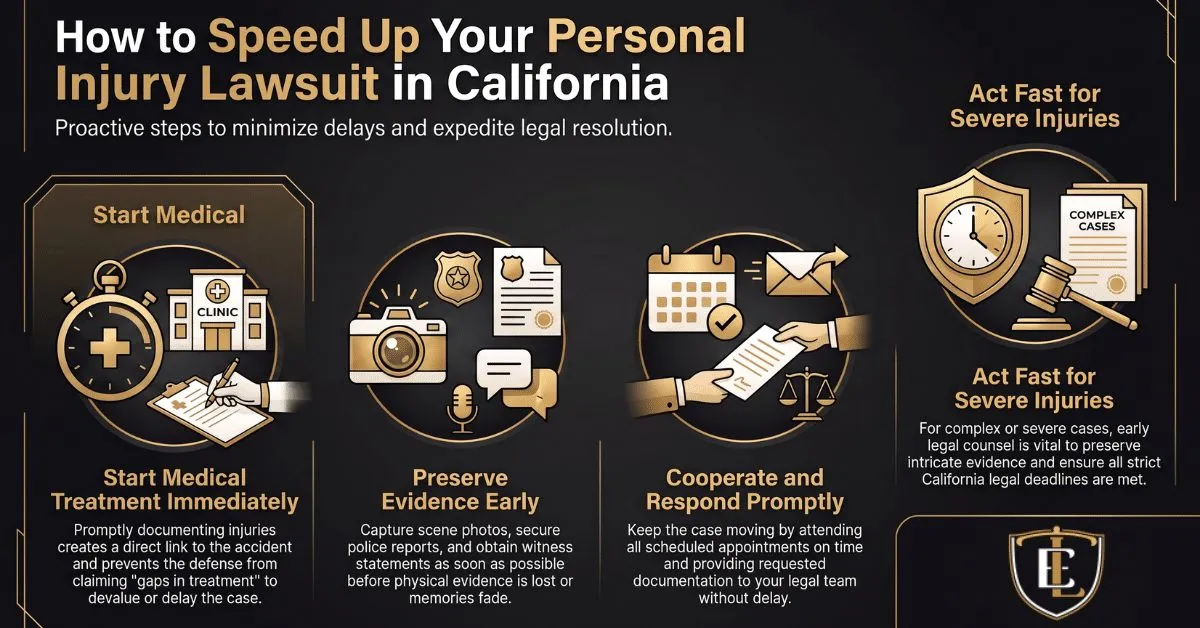
You cannot control the court system, but you can remove friction from your case. A few smart habits help your case move forward and avoid delays.
Start medical treatment right away and keep every record. Timely care documents your injuries and links them to the accident. Gaps in treatment let the defense attorney argue that you were not badly hurt.
Preserve evidence early. Photos from the accident scene, police reports, and witness statements fade fast, so gather them before memories blur. Prompt evidence preservation protects the crucial evidence your claim depends on.
Please cooperate with your attorney and respond promptly to insurance adjusters. Provide documents, attend appointments, and follow your legal strategy. Missed deadlines and slow replies are among the most common causes of unnecessary delays.
Acting fast matters most with severe injuries. The reasons for getting a brain injury attorney on time apply to any serious claim: early counsel preserves evidence and protects deadlines.
Common types of personal injury cases in California and their typical durations
Duration depends heavily on the type of case. Below are common personal injury cases in California and how long each usually takes.
A car accident injury claim is the most common. California car-accident settlements often close in 3 to 9 months when liability is clear and injuries are moderate. A serious car accident with disputed fault can take a year or more.
Slip-and-fall and premises liability claims hinge on proving the property owner knew about the hazard. These often run 6 to 12 months, longer when the owner denies notice.
Brain injuries sit at the serious end. Because symptoms evolve, a brain injury attorney in Beverly Hills usually waits for maximum medical improvement, so these cases often take 12 to 24 months or more.
Burn injuries also take time, since scarring, grafts, and ongoing care must stabilize before settlement. Our Los Angeles burn injury attorneys typically see 1-to-2-year timelines for severe burns.
Soft tissue injuries, such as whiplash, sprains, and strains, move fastest. A soft tissue injury lawyer can often resolve these in a few months once treatment ends.
The table below summarizes typical durations by case type. Treat these as ranges, not promises, because every claim turns on its own facts.
| Case Type | Typical Duration |
| Soft tissue injuries | A few months to 6 months |
| Car accidents (clear liability) | 3 to 9 months |
| Slip and fall / premises liability | 6 to 12 months |
| Serious injuries / disputed liability | 12 to 18 months+ |
| Brain and burn injuries | 12 to 24 months or more |
| Government-entity claims | Add a 6-month pre-claim step |
Why settlement values vary, and how to evaluate an offer
There is no standard price for an injury. Value depends on medical bills, lost wages, future medical expenses, and the severity of pain, since nerve damage or permanent impairment raises the stakes. Economic damages cover hard costs; non-economic damages cover pain and suffering and emotional distress. Because no two cases are alike, we do not quote a “typical” amount. Etehad Law has recovered $100M+ for clients, including an $11 million jury verdict (Past results do not guarantee a similar outcome.), yet your case turns on its own facts.
The goal is fair compensation. A fair settlement should cover all of it: past and future medical care, lost income, and non-economic harm. Ask whether the offer accounts for ongoing treatment and reduced earning capacity. If it does not, it probably is not a fair settlement offer yet.
You still have legal options if a car accident settlement is taking too long. Your attorney can send a follow-up, file a formal lawsuit to apply pressure, or pursue a bad-faith claim when an insurer stalls in bad faith. Filing suit often speeds a stalled negotiation, because it forces the insurer onto the court’s schedule.
After you sign the release, the insurer generally issues the settlement check to your attorney’s client trust account within about 30 days. Settlement disbursement to you usually follows within 2 to 6 weeks, though a medical lien or subrogation claim can add 1 to 6 months. Because personal injury lawyers work on a contingency fee, attorney fees only come out of the final recovery.
Ready to talk to a Beverly Hills personal injury attorney?
Knowing the typical timeline helps you plan, stay patient, and avoid costly mistakes. A prepared case with strong evidence and firm deadlines moves faster and settles for more. That is why injured Californians turn to a team that has handled thousands of claims and knows how to keep pressure on the insurer.
Etehad Law, APC has recovered $100M+ for clients, including an $11 million jury verdict, and we offer free consultations with no fee unless we recover. Our Beverly Hills personal injury lawyers have guided thousands of injured clients through this exact timeline. Contact us today to protect your deadlines and start your free consultation.
Frequently asked questions
Injured accident victims ask us these questions every week, and our experience across 2,000+ cases (Past results do not guarantee a similar outcome.) lets us answer them accurately.
How Long Does a Personal Injury Lawsuit Take in California?
Most personal injury cases resolve in 6 months to 2 years, with many settling within 12 to 18 months. Minor injuries can close in 3 to 6 months, while complex cases may take 2 to 3 years or longer.
What Is the Statute of Limitations for a Personal Injury Claim in California?
You generally have two years from the date of injury under CCP § 335.1. An injured person suing a government entity must present a claim within six months, so deadlines can be much shorter.
How Long Does a Car Accident Settlement Take in California?
A straightforward injury claim in California from a car accident often settles in 3 to 9 months. Disputed liability or serious injuries can push it past a year.
Why Do Personal Injury Cases Take So Long to Settle?
The legal process depends on medical treatment, evidence gathering, and the insurer’s pace. Attorneys wait for maximum medical improvement so the claim reflects full damages, which protects your fair compensation.
How Long Does an Insurance Company Have to Respond to a Claim in California?
Under state regulations, an insurer must acknowledge a claim within 15 days and accept or deny it within 40 days of receiving proof. Once a settlement is agreed, it must pay within 30 days.
What Should I Do if My Settlement Is Taking Too Long?
Ask your attorney to follow up, and consider filing a formal lawsuit to pressure the insurer. When an insurer stalls unfairly, the litigation process and a possible bad-faith claim can move things along.
Should I Accept the Insurance Company’s First Settlement Offer?
Usually not. A first offer rarely covers future medical expenses, lost wages, and non-economic damages. Let an experienced attorney evaluate whether it is truly a fair settlement offer before you sign.
Can I Still File a Claim if My Accident Was Over a Year Ago?
Often yes, because the injured party usually has two years from the date of injury to file. Even so, evidence fades, so contact an attorney quickly to seek compensation while your claim is strong.
Does Going to Trial Take Longer Than Settling?
Yes. A trial can add a year or more, since court calendars and court availability control the schedule. Even so, trial is sometimes the only path to fair value when an insurer refuses to negotiate.
Legal Disclaimer
This advertisement is the responsibility of Etehad Law, APC. Responsible Attorney: Simon P. Etehad, Esq. This article is for general information only and is not legal advice. Reading it does not create an attorney-client relationship. Every case is different; consult a licensed California attorney about your specific situation. Past results do not guarantee a similar outcome, and no outcome is ever guaranteed.
You may also like
 Accident and Injury
 California Personal Injury Statute of Limitations
Learn the California statute of limitations for personal injury claims, key filing deadlines, exceptions, and why you should act quickly.
Read More » Expert Opinion
 What is a Vehicle Black Box and How Can It Help Your Case?
Uncover the role of your car black box in legal cases. Insights from Personal Injury Attorney in Beverly Hills await. Check to…
Read More » Expert Opinion
 Will Posting on Social Media Tank Your Case?
How social media posts can affect a legal case, the dos and don'ts while a claim is open, and what insurers look…
Read More »
