

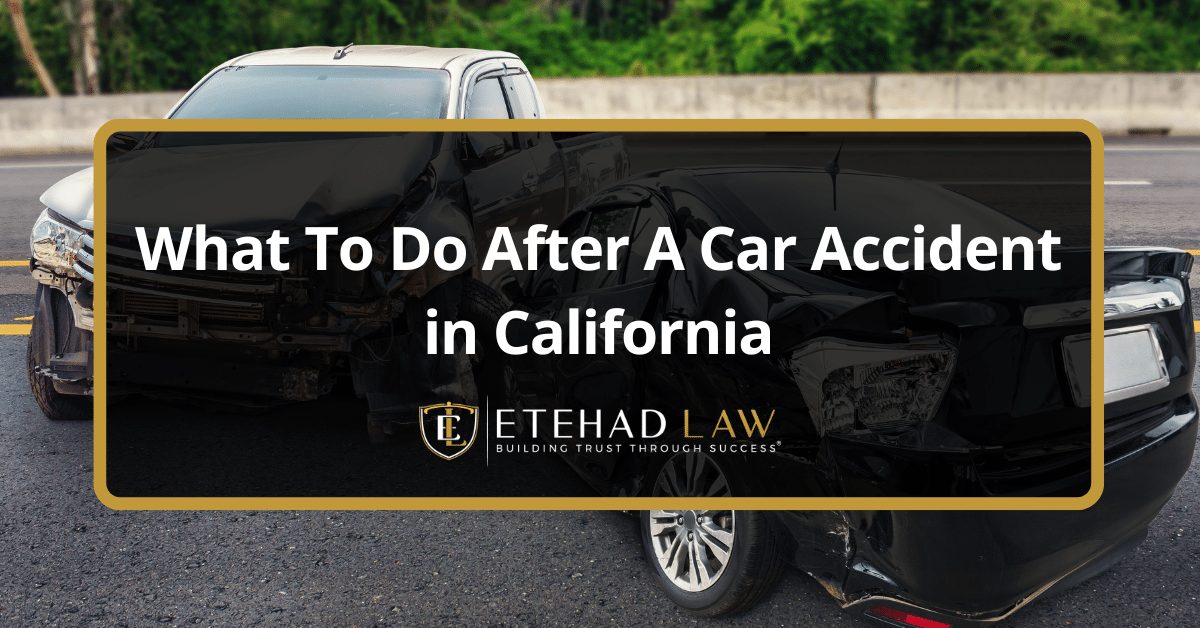
After a car accident in California, your first priorities are safety, documentation, and a prompt medical evaluation. California Vehicle Code sections §20002, §20003, and §20008 require every driver to stop, exchange information, and report a crash that causes injury, death, or property damage above $1,000. The decisions you make in the first hour after a collision often decide whether you recover full compensation or walk away with a fraction of what your claim is worth.
For more than 30 years, Etehad Law has stood beside California injury victims after motor vehicle crashes across Los Angeles and Beverly Hills. Our car accident lawyers handle rear-end collisions, hit-and-run cases, and multi-vehicle wrecks throughout Southern California. Contact us today for a free consultation.
This guide walks through every stage that follows a crash: the accident scene, medical care, the insurance claim, a possible lawsuit, and the two-year California deadline that quietly controls your rights.
Key Takeaways
Stop at the scene, check for injuries, and call 911 before you do anything else. Photograph the vehicles, the road, and every document, then see a doctor the same day even if you feel fine. California is a fault-based state, so the driver who caused the crash and their insurer pay for the harm. You generally have two years to file a personal injury lawsuit under Code of Civil Procedure §335.1, and only ten days to file an SR-1 report with the DMV under Vehicle Code §16000. Report the crash promptly, keep every medical and repair record, and speak with a car accident attorney before you give any recorded statement or accept a first settlement offer.
Immediate Steps to Take After a Car Accident

The first thirty minutes after a crash shape the rest of the case. Working through a clear order of operations keeps you safe, preserves evidence, and protects your claim. Follow the six steps below before anyone leaves the accident scene.
Step 1: Check for Injuries and Ensure Safety First
Stop your vehicle, take a breath, then check yourself, your passengers, and anyone else involved for injuries. If a person cannot move or is bleeding, do not pull them from a vehicle unless fire or another immediate danger forces it. Turn off the ignition, and if you carry a first-aid kit, use it only within your training. Safety always comes before paperwork.
Step 2: Call 911 and Turn On Hazard Lights
Call 911 or the local police, then switch on your hazard lights to warn oncoming traffic. The dispatcher can send paramedics and an ambulance if anyone is hurt. A responding officer creates a police report, which becomes one of the strongest pieces of evidence in any later insurance claim. Ask the officer for the report number before you leave, and note the officer’s name and badge number.
Step 3: Move Vehicles Out of Traffic If It Is Safe
If the vehicles still run and no one is seriously injured, move them to the shoulder or a nearby side street before police arrive. Leaving cars in an active lane invites a second collision. If a vehicle cannot be moved, stay well clear of traffic and wait behind a barrier or guardrail until help arrives.
Step 4: Exchange Information With the Other Drivers
Collect the full name, phone number, and driver’s license number of every driver, along with each insurance company name and policy number, vehicle registration, make, model, and license plate. Photograph each document rather than copying it by hand. If a driver refuses to share information, record the license plate and describe the driver to the responding officer. Avoid discussing fault while you exchange details.
Step 5: Document the Scene With Photos and Notes
Take photos of the scene from several angles before anything moves. Capture vehicle damage, skid marks, debris fields, traffic signals, road signs, lane markings, weather, and the time and location. Collect names and numbers from any witnesses standing nearby, because a statement taken at the scene is far more reliable than one gathered weeks later. A short voice memo describing what happened while it is fresh can also help your attorney reconstruct the crash.
Step 6: Report the Accident and Contact a Lawyer
Report the crash to your own insurer within the window your policy requires, then speak with a personal injury lawyer before you file a claim with the other driver’s insurance company. Our Los Angeles car accident attorneys send evidence-preservation letters within hours of a call, locking down the official police report and any nearby surveillance footage before it is overwritten. Early legal guidance keeps a small mistake from becoming a costly one.
California Law Requirements After a Car Accident
California is a fault-based state. The at-fault driver and their insurer are responsible for the harm they cause. Under the California Supreme Court’s decision in Li v. Yellow Cab Co. (1975) 13 Cal.3d 804, the state follows a pure comparative negligence rule. A driver who is partly at fault can still recover, but the award is reduced by that driver’s percentage of fault. The underlying duty to drive with reasonable care comes from Civil Code §1714, which makes each person responsible for injuries caused by their own lack of ordinary care.
Several Vehicle Code sections set the duties you owe at the scene. Section §20002 applies to property-damage-only crashes: stop, share your information, and leave a written note if the other owner is not present. Section §20003 applies when someone is injured or killed: stop, render reasonable aid, and exchange your driver’s license, insurance, and vehicle details. Section §20008 requires a written report to the police or California Highway Patrol within 24 hours when a crash causes injury or death.
There is also a separate DMV requirement that catches many drivers off guard. Under Vehicle Code §16000, you must file an SR-1 report with the California DMV within 10 days if the crash injured anyone or caused property damage above $1,000. You can find the form and instructions on the California DMV traffic accident page. Missing this filing can lead to a suspended license even when the crash was not your fault.
Why You Should See a Doctor Even If You Feel Fine
See a doctor after every crash, even when you feel fine at the scene. Adrenaline and shock mask serious injuries for hours and sometimes days. Whiplash, concussions, soft-tissue tears, and internal bleeding often produce no symptoms for 24 to 72 hours, and neck or back pain frequently surfaces the next morning. A brain injury can show up as a headache, confusion, or nausea long after you leave the scene.
A same-day evaluation creates the medical record that ties your injuries to the crash. Without that paper trail, an insurance company will argue the pain came from something unrelated. Document every visit, every prescription, and every physical-therapy session, and tell each provider that the symptoms started with the collision.
Gaps in treatment are the single biggest tool an adjuster uses to reduce a claim. A two-week pause in care lets the insurer argue that the injuries either healed or never existed. Keep your appointments, follow the treatment plan, and if cost is a concern, ask your attorney about providers who treat on a lien until the case resolves.
How to Handle Insurance Claims After a Car Accident

Notify your own insurer within a few days of the crash. Most California policies require prompt reporting as a condition of coverage, so calling early protects your benefits even after a minor collision. Stick to the basic facts — when, where, who, and what — and avoid guessing about fault or speed.
When the at-fault driver’s adjuster calls, politely decline a recorded statement and refer them to your attorney. You have no legal obligation to give one, and adjusters use recorded quotes to lock in a version of events that limits the payout. If the crash was not your fault, your medical bills can be paid through the other driver’s liability coverage, your own MedPay, or your uninsured and underinsured motorist coverage under Insurance Code §11580.2 when the at-fault limits run short. The Insurance Information Institute explains how UM and UIM coverage fills that gap.
For property damage, gather repair estimates from a shop you trust and document the full repair cost before you authorize any work. Confirm rental-car coverage while your vehicle is in the shop. If the carrier declares the car a total loss, it must pay the actual cash value — the market value at the time of the crash, not the cost to replace it with a new car.
If an insurer drags out a valid claim, denies it without a reasonable basis, or lowballs a serious injury, that conduct can cross into bad faith. California Insurance Code §790.03 lists unfair claim-settlement practices, and the California Department of Insurance accepts consumer complaints about carriers that break those rules. The table below sums up what to do and what to avoid when you deal with any adjuster.
| Do This | Avoid This | Why It Matters |
|---|---|---|
| Notify your own insurer within a few days | Waiting weeks to report the crash | Late notice can void coverage under most California auto policies |
| Stick to facts you saw and know firsthand | Speculating about fault or speed | Guesses get quoted back against you during the claim |
| Route the other insurer to your attorney | Giving a recorded statement to the other driver’s insurer | You have no obligation, and adjusters lock in damaging quotes |
| Log every call, date, name, and claim number | Relying on memory for what was promised | Written records prevent later disputes over the file |
| Have a lawyer review any offer first | Accepting the first settlement offer | First offers routinely fall below the value of real medical bills |
| State facts to the officer and adjuster | Apologizing or admitting fault at the scene | A casual “I’m sorry” can shift liability under comparative negligence |
Understanding Car Accident Lawsuits and Your Legal Options

Most California car accident cases settle without a trial. You file a lawsuit when the insurer refuses fair compensation, when your injuries exceed the policy limits, or when the other side disputes who caused the crash. Whether the dispute settles or goes to court often turns on timing — our guide on when to sue after a car accident explains how those deadlines interact with settlement talks.
Common causes of these lawsuits include distracted driving, impaired driving, speeding, and negligence by commercial carriers. An experienced Beverly Hills car accident attorney investigates the crash, sends preservation letters for traffic-camera and dashcam footage, and assembles the damages file while the evidence is still fresh.
California divides accident damages into two categories. Economic damages cover measurable losses: medical bills, lost wages, future medical care, and property damage. Non-economic damages cover pain and suffering, emotional distress, and loss of enjoyment of life. Under Civil Code §1431.2 (Proposition 51), each defendant pays non-economic damages only in proportion to that defendant’s share of fault, which makes identifying every responsible party important in a multi-vehicle crash.
One question clients often forget to ask is whether a settlement is taxable. As a general rule, compensation for physical injuries is not taxed, while interest and most punitive damages are — the IRS Publication 4345 explains how settlement proceeds are treated. A short conversation with your attorney and a tax professional before you sign keeps the net recovery clear.
Compensation is calculated from the full picture of your losses, not just the emergency-room bill. Economic damages can include the cost of future surgeries, ongoing therapy, medication, mobility equipment, and lost earning capacity if an injury keeps you from returning to the same work. Non-economic damages account for chronic pain, sleep loss, anxiety behind the wheel, and the activities you can no longer enjoy. Keeping a short daily journal of pain levels and missed activities gives your attorney concrete detail to present, which tends to carry more weight than a general statement that you were in pain.
Evidence disappears quickly, so start collecting it on day one. The first 30 days matter most, because surveillance footage from most businesses is overwritten within 7 to 30 days and vehicle data can be lost once a car is repaired or scrapped.
As Simon P. Etehad, Esq., founding attorney at Etehad Law, puts it, “The strongest car accident cases are built in the first week, not the last. The evidence that wins a claim is often gone before the pain even peaks.”
California Statute of Limitations for Car Accident Claims
The statute of limitations for a California personal injury claim is two years from the date of the crash under Code of Civil Procedure §335.1. File suit within that window, or a court will almost certainly dismiss the case no matter how strong it is.
Claims against a government entity — a city vehicle, a county truck, or a Caltrans contractor — run on a much tighter clock. Government Code §911.2 requires a written government tort claim within six months of the crash, and the agency then has 45 days to respond before you can file a lawsuit.
A few situations change the deadline. If the injured person is a minor, the two-year clock pauses until the child’s 18th birthday and then runs for the full two years. If an injury was not discovered right away, the delayed-discovery rule may extend the start date. Because these exceptions are narrow and fact-specific, confirm your deadline with an attorney rather than assuming you have more time.
Special Considerations for Different Types of Accidents
Not every crash follows the same legal path. The type of collision changes the evidence you need, the parties who may be responsible, and the strategy for recovery.
A minor crash with no apparent injuries still requires an information exchange and, if damage tops $1,000, an SR-1 filing with the DMV. Get a police report anyway, because injuries that seem minor at the scene sometimes surface days later.
A hit-and-run triggers Vehicle Code §20001, and fleeing the scene of an injury crash is a felony. If you are the victim, call 911, photograph any debris the other car left behind, and check nearby businesses for cameras. When the at-fault driver is never identified, your uninsured motorist coverage can still provide a recovery.
Truck crashes add federal layers. Hours-of-service rules, electronic logging data, and maintenance records all come into play, and that data overwrites quickly, so a Los Angeles truck accident attorney sends spoliation letters early. Motorcycle crashes tend toward severe injuries and carry a bias among some adjusters and juries; a Beverly Hills motorcycle accident attorney counters that bias with helmet evidence, speed analysis, and road-design review.
Rideshare crashes deserve special mention because coverage depends on what the driver was doing at the moment of impact. When an Uber or Lyft driver is logged in and carrying a passenger or heading to a pickup, California law requires a $1 million third-party liability policy, which can apply whether you were the passenger, the other driver, or a pedestrian. When the app is off, only the driver’s personal auto policy applies. Screenshots of the trip and the driver’s app status help establish which layer of coverage is in play.
Common Mistakes to Avoid After a Car Accident
Small early decisions cost real money later. The mistakes below are the ones we see most often, and each one is avoidable.
Leaving the Scene
Leaving the scene of an injury crash is a felony under Vehicle Code §20001. Even at a fender-bender, stay and exchange information. Driving off can lock your name into the report as the fleeing driver.
Admitting Fault at the Scene
A casual apology at the curb gets quoted back during the insurance claim. Stick to facts when you speak with law enforcement and any adjuster, and leave the fault analysis to the investigation.
Skipping the Medical Visit
Adrenaline hides whiplash, concussions, and internal bleeding for hours or days. Skipping care creates a gap that adjusters use to deny a claim, so see a doctor the same day even if the symptoms feel minor.
Giving a Recorded Statement to the Other Driver’s Insurer
The other driver’s insurer has one goal: to lock in a version of events that limits its payout. You have no obligation to give a recorded statement, so decline and refer the request to your attorney.
Accepting the First Settlement Offer
First offers run below the real value of medical bills, lost wages, and pain and suffering. Once you sign the release, the claim closes for good, so have a lawyer review any offer before you accept it.
Missing the Two-Year Deadline
California gives most injury plaintiffs two years to file suit under Code of Civil Procedure §335.1, and government claims run on a six-month clock. Cases fall apart when a driver spends 22 months in treatment and calls a lawyer with eight weeks left.
Ready to Talk to a California Car Accident Lawyer?
A car accident in California sets off legal deadlines, insurance demands, and evidence challenges that move faster than most injured drivers expect. The right legal team protects your personal injury claim while you focus on healing. Waiting weeks for advice often means losing the strongest evidence.
Etehad Law has spent more than 30 years recovering compensation for car accident victims across California, and especially in Los Angeles and Beverly Hills. Our car accident lawyers work on a contingency fee — no upfront cost, and no fee unless we recover for you. Review our practice areas or contact us today for a free, confidential case review.
Frequently Asked Questions
Our personal injury team answers questions from California crash victims every day. The ones below come up most often. This is general information from Etehad Law, not legal advice for any specific case.
What Is the First Thing You Do After a Car Accident?
Check for injuries and call 911 before anything else. Safety and medical attention come first. Once help is on the way, turn on your hazard lights and move to a safer position if you can do so without risk.
What Should You Not Do After a Car Accident?
Do not leave the scene, admit fault, skip medical care, give a recorded statement to the other driver’s insurer, or accept the first settlement offer. Each of these mistakes can shrink or destroy an otherwise valid claim.
What Should You Not Say to Your Insurance Company After an Accident?
Do not speculate about fault, speed, or what the other driver was doing, and do not minimize your injuries by saying you feel fine, because symptoms often appear days later. Stick to the facts and route difficult questions to your attorney.
How Does Insurance Work When the Crash Is Not Your Fault?
When the accident is not your fault, the at-fault driver’s liability coverage pays your medical bills, lost wages, vehicle damage, and pain and suffering. Your own MedPay covers medical bills regardless of fault, and if the other driver is uninsured or underinsured, UM/UIM coverage under Insurance Code §11580.2 fills the gap.
What Should You Do After a Car Accident That Is Your Fault?
Stop, render aid, exchange information, and call 911 — the same scene duties apply whether or not you caused the crash. Notify your insurer promptly and avoid admitting fault outside of conversations with your lawyer. Under California’s pure comparative negligence rule, you may still recover for your own injuries even when you were partly at fault.
How Long Do I Have to File a Car Accident Claim in California?
You generally have two years from the date of the crash to file a personal injury lawsuit under Code of Civil Procedure §335.1. Claims against a government entity are much shorter — Government Code §911.2 requires a written claim within six months. Because exceptions exist for minors and late-discovered injuries, confirm your deadline with an attorney early.
Is California a No-Fault State for Car Accidents?
No. California is a fault-based, or tort, state. The driver who caused the crash and their insurer are responsible for the damages. California also follows pure comparative negligence, so a partially at-fault driver can still recover a reduced amount based on their share of fault.
Do I Have to Report a Car Accident to the DMV in California?
Yes, in many cases. Under Vehicle Code §16000, you must file an SR-1 report with the DMV within 10 days if the crash injured anyone or caused more than $1,000 in property damage. This is separate from any police report, and failing to file it can lead to a license suspension even if you were not at fault.
What Happens If the Other Driver Was Uninsured in California?
If the at-fault driver has no insurance or too little, your own uninsured/underinsured motorist coverage under Insurance Code §11580.2 can pay for your injuries and losses. This coverage is optional in California but strongly recommended, and it also applies in many hit-and-run cases where the other driver is never identified.
Can I Still Recover If I Was Partly at Fault for the Crash?
Yes. California uses pure comparative negligence, so you can recover even if you were mostly at fault. Your compensation is reduced by your percentage of fault — for example, if you are found 20% at fault, your award is reduced by 20%. An attorney can help push back on an insurer that inflates your share of the blame.
Legal Disclaimer
Etehad Law provides the information on this page for general informational purposes only, and it does not constitute legal advice. Reading this content does not create an attorney-client relationship. Past results do not predict or guarantee a similar outcome in any future case, and every car accident claim depends on its own facts, evidence, and applicable law. This page may be considered attorney advertising under California Rules of Professional Conduct 7.1 and California Business and Professions Code section 6157.2. The attorney responsible for this communication is Simon P. Etehad, Esq. (California State Bar No. 186449), Etehad Law, Beverly Hills, California. Etehad Law’s attorneys are licensed to practice law in the State of California, and this page is not a solicitation in any jurisdiction where the firm is not licensed. For advice about your specific car accident claim, contact a licensed California attorney.
You may also like
Simon P. Etehad Named to 2027 Southern California Super Lawyers
Etehad Law founder Simon P. Etehad has been selected to the 2027 Southern California Super Lawyers list, his seventh consecutive year and…
Read More » Accident and Injury
 The Dangers of Texting and Walking
How distracted walking causes pedestrian collisions, who is at fault in a pedestrian versus car accident in California, and what to do…
Read More » Accident and Injury
 What Happens After a Gunshot Wound?
Who can be held liable after a shooting, what you must prove in a California injury claim, and the compensation a gunshot…
Read More »
