


Most legal disputes never reach a courtroom, but some do. So when does a case go to trial? A case goes to trial when settlement talks break down and the parties still disagree about who is at fault or what the claim is worth. In California personal injury matters, that outcome is the exception, not the rule.
Key Takeaways
Fewer than 3% of California civil cases reach a verdict. A claim moves toward trial when the parties cannot agree on liability or value, usually after mediation and a mandatory settlement conference fail. You generally have two years from the injury to file (Code Civ. Proc. §335.1), and most civil cases take one to three years from filing to reach a courtroom.
This article is general information about California civil procedure and is not legal advice. Reading it does not create an attorney-client relationship. For guidance on your own situation, talk with a licensed California attorney.
If you are weighing a lawsuit or an insurance dispute, contact Etehad Law for guidance tied to your facts. With more than 30 years of experience, our attorneys help clients prepare for court and make informed choices at each stage of a case.
This guide walks through why California cases go to trial, the litigation timeline from complaint to verdict, the deadlines and settlement checkpoints set by the Code of Civil Procedure, and the specific factors that push an injury claim past settlement and into a courtroom.
Why Would a Case Go to Trial?
A case goes to trial when the parties cannot close the gap through negotiation, mediation, or a settlement conference. Say a plaintiff values their injuries at $900,000 and the insurer offers $70,000. That kind of spread is often too wide to bridge, and a judge or jury may have to decide who is right.
This is a hypothetical illustration only. Past results do not guarantee future outcomes, and the value of any claim depends on its own facts.
Civil and criminal cases reach trial for different reasons. A criminal case usually goes to trial when the defendant pleads not guilty and the prosecution has to prove guilt beyond a reasonable doubt. A California civil case, by contrast, turns on a lower standard, the preponderance of the evidence (CACI No. 200), and it heads to trial mainly when the sides disagree about liability, the extent of the injuries, or the dollar value of the harm.
Strategy drives a lot of these decisions. A plaintiff who believes the evidence supports a larger recovery may reject a low offer. A defendant who doubts the plaintiff can prove causation may refuse to pay. One tool shapes this calculus more than most clients expect: a statutory offer to compromise under Code of Civil Procedure §998. If a party rejects a §998 offer and then fails to beat it at trial, that party can be ordered to pay the other side’s expert-witness fees and certain costs. A well-timed §998 offer can end a case, or make going to trial a much riskier bet.
As Simon Etehad, Managing Partner at Etehad Law, puts it: “The decision to go to trial should rest on the strength of the evidence, the risk each side is taking, and the client’s long-term goals.” We tell clients to weigh every offer against those three things before turning it down.
How Likely Is It That a Case Will Go to Trial?
People tend to picture a courtroom showdown. The data says otherwise. The federal judiciary reports that roughly 1% of federal civil cases end in a trial. Most are resolved by settlement, dismissal, or motion long before opening statements.
State courts follow the same pattern. Research published by the American Judges Association found that under 3% of civil cases reach a trial verdict, meaning more than 97% wrap up some other way. California injury claims skew even further toward settlement, because trials carry real cost, delay, and uncertainty for both sides.
So which cases end up in the small slice that gets tried? Evidence is usually the deciding factor. When liability is clear and the medical records document the damages, an insurer has little reason to risk a verdict and settlement becomes likely. When the facts are genuinely in dispute, when witnesses contradict each other, or when the legal questions are unsettled, the odds of trial climb.
Comparative fault matters too. California follows pure comparative negligence under Li v. Yellow Cab Co. (1975) 13 Cal.3d 804, so a jury can assign a percentage of blame to the plaintiff and reduce the award accordingly. When the parties read that percentage very differently, the case is harder to settle and more likely to be tried.

The California Civil Litigation Timeline: Complaint to Trial
A California personal injury case does not jump from injury to courtroom. It moves through a set of stages, each governed by the Code of Civil Procedure and the California Rules of Court. Knowing the sequence tells you roughly where a trial sits, and how many off-ramps to settlement come first.
Filing the Complaint (and the Two-Year Deadline)
The case starts with a complaint. For most personal injury claims, you have two years from the date of injury to file under Code of Civil Procedure §335.1. Some claims run on different clocks: medical malpractice has its own limits, and a claim against a public entity requires a written government claim within six months under Government Code §911.2. Miss the deadline and the right to sue can be lost, so this date frames everything that follows.
The Defendant’s Answer
Once served, a defendant generally has 30 days to respond under Code of Civil Procedure §412.20. The response might be an answer that admits or denies each allegation, or a challenge to the complaint itself. This stage frames the dispute, and the issues the parties actually fight about here often decide whether the case can settle later.
Discovery
Discovery is where most of the work happens. The parties exchange documents, answer written questions, and take depositions under oath. In California, discovery generally has to be completed 30 days before the trial date, with discovery motions heard 15 days before, under Code of Civil Procedure §2024.020. By the close of discovery each side has a clear read on the evidence, which is exactly why many cases settle right after it ends.
Case Management and Mediation
Early on, the court holds a case management conference under California Rules of Court, rule 3.722, to set deadlines and a trial date. Many parties also try mediation, a voluntary process where a neutral third party helps them look for a resolution. Mediation is not binding, but it settles a large share of injury claims before anyone prepares for trial.
The Mandatory Settlement Conference
Shortly before trial, California courts commonly order a mandatory settlement conference under California Rules of Court, rule 3.1380. The parties, their attorneys, and someone with settlement authority meet with a judge or a volunteer settlement officer to make a last structured push to resolve the case. This is the final formal off-ramp. A case that survives the mandatory settlement conference without a deal is usually the one that actually gets tried.
Trial
If settlement fails, the case reaches trial. California courts try to move general civil cases to disposition within two years of filing under the Trial Court Delay Reduction Act (Government Code §68603) and its fast-track rules, though court congestion can stretch that out. A separate backstop, the five-year rule in Code of Civil Procedure §583.310, requires a case to be brought to trial within five years or face dismissal.
What Happens When a Case Goes to Trial?
Every case is different, but most California civil trials follow the same arc. Walking through it helps clients feel steadier about what is coming. Here is what a trial looks like, step by step.
Step 1: Jury Selection
A jury trial opens with jury selection, or voir dire. Each side questions prospective jurors about anything that might color their judgment, and can ask the court to excuse jurors for cause or by peremptory challenge. Not every case has a jury. In a jury trial the jury decides the facts and returns the verdict; in a bench trial the judge decides both. Californians have a constitutional right to a civil jury under article I, section 16, but a party has to demand a jury and post fees under Code of Civil Procedure §631 or the right is waived.
Step 2: Opening Statements
The plaintiff’s attorney speaks first, then the defense. Opening statements are not evidence. They give the jury a roadmap of what each side expects the testimony and exhibits to show, so jurors can follow the story as it unfolds.
Step 3: Presenting Evidence and Witness Testimony
The plaintiff carries the burden of proof in a civil case, so the plaintiff presents evidence first. Attorneys question their own witnesses on direct examination; the other side then cross-examines to test credibility and probe weak spots. If a witness said one thing in a deposition and something different on the stand, expect that gap to come up. Redirect examination can follow to clear up any confusion.
Long before a trial date is set, attorneys spend months building this record, gathering documents, interviewing witnesses, and lining up experts. Knowing how to prepare for your legal case can help you understand what this stage asks of you.
Step 4: Closing Arguments
After the evidence is in, each side sums up. Closing arguments tie the testimony together and explain why the jury should find for that party. The plaintiff usually goes first and often gets a short rebuttal, since the plaintiff bears the burden. This is the last chance to speak to the jury before deliberations.
Step 5: Jury Instructions and Deliberations
The judge then reads the jury its instructions, drawn largely from California’s Civil Jury Instructions (CACI). These spell out the law the jurors must apply and the standard they must use. In a California civil case, the jury does not have to be unanimous; a verdict needs the agreement of nine of the twelve jurors. If the jury cannot get there, the result may be a hung jury, which can lead to a retrial.
Step 6: Verdict and Post-Trial Proceedings
The verdict is read in open court. In a civil case the jury decides liability and sets damages. From there, the losing side can file post-trial motions or ask a higher court to review legal errors on appeal. Costs can shift here as well: a party who turned down a §998 offer and did worse at trial may end up covering the other side’s expert fees.
As Simon Etehad, Managing Partner of Etehad Law, explains, “Trials are won through preparation long before anyone walks into a courtroom.” We push to gather documents, preserve evidence, and ready witnesses as early in a case as possible.
How Long Until a Case Goes to Trial?
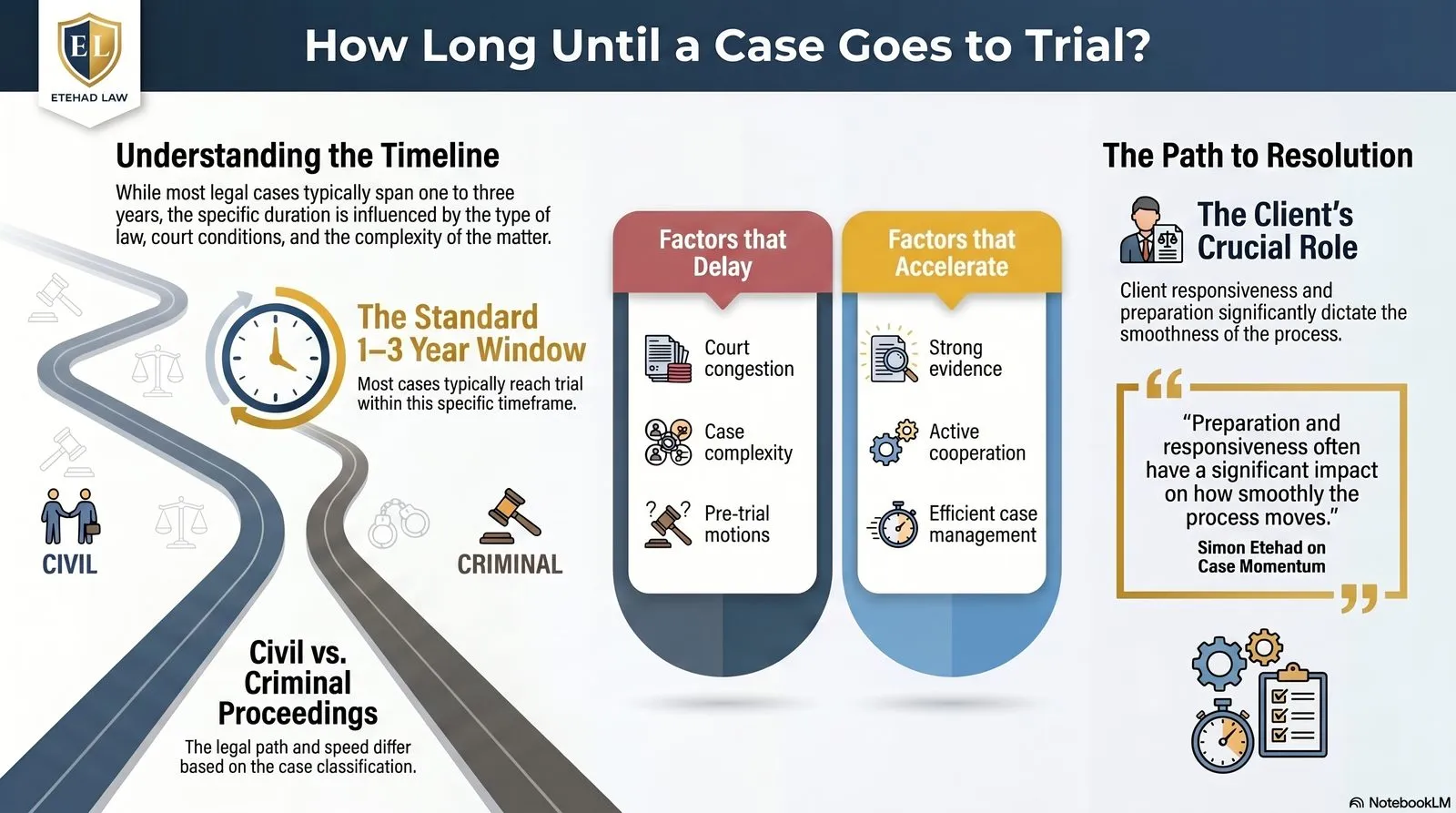
One of the questions we hear most is how long a case takes to reach trial. It depends on the type of case, the court’s calendar, and whether the parties settle first. Most California civil cases take between one and three years from filing to reach an actual trial.
Civil cases often run longer than clients expect. After the complaint is filed, the parties move through discovery, then the court may require mediation or a settlement conference before it will set a firm trial date. If those talks land a deal, the case never reaches a courtroom. If you are pursuing an injury claim, our guide on how long a personal injury lawsuit takes in California sets realistic expectations for each phase.
Criminal cases usually move faster, because defendants have constitutional speedy-trial rights that civil plaintiffs do not. Several things can stretch a civil timeline: court congestion is the common one, and complex cases with multiple defendants, competing experts, or mountains of records take longer to work up.
Pre-trial motions affect timing as well. A party may ask the judge to exclude certain evidence or dispose of a claim before trial. These motions can add weeks, but they also narrow what the jury will eventually hear.
Some factors speed things up. Strong evidence, cooperative parties, and tight case management all move a matter along. Clients shape the pace more than they realize. Responding quickly to document requests, keeping appointments, and staying in touch with your attorney all keep a case on track; delays on your end can push a trial date out.
As Simon Etehad, Managing Partner of Etehad Law, explains, “Every case follows its own timeline, but preparation and responsiveness usually decide how smoothly it moves.” We ask clients to stay engaged and raise questions the moment a concern comes up.
Trial vs. Settlement: Pros and Cons
Some clients want certainty and a faster resolution. Others will take on more risk for a shot at a better result. The table below lays out the trade-offs on each side to help you think it through with your attorney.
| Feature | Trial | Settlement |
|---|---|---|
| Timeframe | Can take months or years before reaching a verdict. | Often resolves much faster than a trial. |
| Cost | Usually involves higher legal fees, expert costs, and court expenses. | Generally costs less because lengthy court proceedings are avoided. |
| Control Over Outcome | A judge or jury decides the outcome. | Both parties keep control by negotiating the terms. |
| Publicity | Court proceedings are typically public record. | Settlement agreements can often stay private. |
| Certainty of Outcome | Outcomes are unpredictable and depend on the evidence and verdict. | Provides a known resolution and removes trial uncertainty. |
Neither choice is automatically the right one. A plaintiff with strong proof of liability may see real upside in a trial. A settlement, though, can cut stress, save time, and take an unfavorable verdict off the table. Talk both options through with an experienced California attorney before you decide.
What Cases Are the Most Likely to Go to Trial?
Most disputes settle, but a few categories reach a courtroom more often than the rest. Under the American Judges Association data, fewer than 3% of civil cases end in a trial verdict, so what sets the trial-bound minority apart is worth understanding.
Serious criminal charges carry higher trial rates than civil disputes. Cases involving violent crimes, large financial losses, or long prison exposure often proceed to trial because the stakes leave little room to compromise. When a defendant pleads not guilty and challenges the evidence, a judge or jury has to decide.
Contested personal injury claims also head to trial more often. A case with permanent injuries can end up before a jury when the parties are far apart on liability or value. Insurers tend to settle when the evidence clearly pins down fault and damages, and to dig in when it does not. If someone else’s negligence hurt you, understanding California personal injury law helps you weigh your options.
Disputes over policy limits and insurer conduct are another driver. When damages plainly exceed the available coverage, or an insurer refuses a reasonable within-limits demand, the case can turn on bad-faith questions under Insurance Code §790.03, and those fights are harder to settle quietly.
Medical malpractice cases often pit expert against expert over complicated clinical facts. Because the damages can be substantial and the science genuinely contested, neither side gives ground easily, so these claims reach trial more often than routine civil matters.
Business and contract disputes follow a similar logic when large sums are on the line. A fight over contract terms or lost profits can be hard to settle when each side reads the deal and the evidence in its own favor.
At Etehad Law, we handle personal injury cases that run from straightforward claims to hard-fought disputes. Many settle, but we build every file as though it will be presented to a judge or jury, because that groundwork tends to strengthen the settlement position too.

Need Trial Representation?
Most cases settle, but some disputes still need a judge or jury to sort out. The strength of the evidence, the complexity of the issues, and how far apart the parties sit all shape whether a trial becomes necessary.
At Etehad Law, we know the prospect of trial can feel heavy. With more than 30 years of experience, we have guided clients through each stage of the process, from pre-trial negotiations to closing argument.
If you are facing a case that may go to trial, do not wait to get advice. Contact us today to talk through your situation and how we can help protect your interests.
FAQs
If you still have questions about when a California case goes to trial, you are not alone. Below are answers to the questions clients ask us most.
How long do I have to file a personal injury lawsuit in California?
Most California personal injury claims carry a two-year deadline from the date of injury under Code of Civil Procedure §335.1. Some claims run differently. Medical malpractice has its own limits, and a claim against a city, county, or state agency requires a written government claim within six months under Government Code §911.2 before you can sue. Because missing the deadline can end a claim before it starts, the filing date shapes the whole timeline. If you are unsure which clock applies, ask a California attorney early rather than assuming you have two full years.
What are the stages of a California civil case before trial?
A civil case moves through a set sequence. It opens with a complaint, followed by the defendant’s answer, generally due within 30 days under Code of Civil Procedure §412.20. Next comes discovery, where the parties trade evidence and take depositions. Along the way the court holds a case management conference, and many parties try mediation. Shortly before trial, the court often orders a mandatory settlement conference. Each of these steps is a chance to resolve the case, which is why so few make it all the way to a verdict.
Why do most California personal injury cases settle instead of going to trial?
Settlement gives both sides something trial cannot: a known result. A trial carries expense, delay, and the real chance of losing, so when liability is clear and the damages are documented, an insurer usually prefers to pay a negotiated figure rather than gamble on a jury. Statutory tools reinforce this. An offer to compromise under Code of Civil Procedure §998 can shift costs onto a party who rejects a fair offer and then does worse at trial. All of that pressure explains why more than 97% of civil cases end without a verdict.
What is a mandatory settlement conference?
A mandatory settlement conference is a court-ordered meeting held shortly before trial under California Rules of Court, rule 3.1380. The parties, their attorneys, and someone with authority to settle sit down with a judge or a volunteer settlement officer to make a final structured attempt at resolution. Trial counsel is expected to attend prepared, with a settlement conference statement laying out the facts and the demand or offer. For many cases this is the last real off-ramp; a claim that clears the conference without a deal is often the one that actually gets tried.
How does a Code of Civil Procedure §998 offer affect whether my case goes to trial?
A §998 offer is a formal settlement offer with teeth. Under Code of Civil Procedure §998, if a party rejects the offer and then fails to beat it at trial, that party can be ordered to pay the other side’s post-offer expert-witness fees and certain costs. That risk changes the math on both sides. A plaintiff weighs whether a jury is likely to award more than the offer; a defendant weighs its exposure if the verdict comes in high. A well-calibrated §998 offer frequently pushes a case toward settlement rather than trial.
What factors make a personal injury case more likely to go to trial?
A few recurring factors push a claim toward a courtroom. Disputed liability is the biggest one; when the parties genuinely disagree about who caused the harm, a jury may have to decide. Severe or contested damages have the same effect, since more money means more incentive to fight. Coverage disputes matter too: when the losses exceed the policy limits or an insurer refuses a reasonable demand, bad-faith questions under Insurance Code §790.03 can arise. Sharp disagreement over comparative fault, and the aggressive use of §998 offers, round out the list of things that make trial more likely.
How long does it take for a civil case to reach trial in California?
Most California civil cases take one to three years from filing to trial. The courts set a target of disposing of general civil cases within two years under the Trial Court Delay Reduction Act (Government Code §68603) and the fast-track rules, but heavy court calendars can push that out. A separate limit, the five-year rule in Code of Civil Procedure §583.310, requires a case to be brought to trial within five years or risk dismissal. Complexity, the number of parties, and how quickly each side handles discovery all move the actual date.
How do I know whether a judge or a jury will decide my case?
Most California civil claims for money damages carry a right to a jury under article I, section 16 of the California Constitution, but that right is not automatic. A party has to demand a jury at the right time and post jury fees under Code of Civil Procedure §631, or it can be waived. When neither side demands a jury, the case is tried to the judge alone in a bench trial. Which one fits a given case is a strategic call, and it is worth talking through with your attorney early.
What is the burden of proof in a California civil trial?
In most civil cases the plaintiff must prove the claim by a preponderance of the evidence, which California’s Civil Jury Instructions (CACI No. 200) describe as more likely true than not true. That is a lower bar than the criminal standard of beyond a reasonable doubt. The practical effect matters for settlement talks: because a civil plaintiff does not have to eliminate all doubt, a case with solid but imperfect evidence can still be worth trying. The standard also shapes how attorneys build the record and argue the facts to a jury.
What happens during discovery, and why does it take so long?
Discovery is the fact-finding phase. The parties exchange documents, answer written questions, and take depositions, building the evidentiary record the case will rest on. It takes time because medical records, employment files, expert reports, and witness schedules all move at their own pace. California generally requires discovery to be completed 30 days before trial, with discovery motions heard 15 days before, under Code of Civil Procedure §2024.020. Once discovery closes and each side sees the full picture, many cases settle, because the uncertainty that fueled the dispute has largely been resolved.
What happens to settlement talks once a trial date is set?
Setting a trial date tends to accelerate settlement rather than end it. Cases resolve at every stage, including on the courthouse steps and even mid-trial before the jury returns a verdict. The mandatory settlement conference under California Rules of Court, rule 3.1380 is built to prompt exactly that kind of last-minute deal once a firm date focuses both sides on their risk. A looming trial often moves negotiations more than months of earlier back-and-forth, because the cost and uncertainty suddenly feel real. A trial date is a step toward trial, not a guarantee of one.
How does comparative fault affect the choice between settling and going to trial?
California uses pure comparative negligence under Li v. Yellow Cab Co. (1975) 13 Cal.3d 804. A jury can assign a share of fault to the injured person and reduce the award by that percentage, so a plaintiff found 30% at fault recovers 70% of the damages. When the parties agree roughly on that percentage, the case tends to settle. When they read it very differently, that gap can be worth thousands of dollars and often has to be resolved by a jury, which makes trial more likely. Understanding your likely fault share is a key part of any settle-or-try decision.
What happens if I go to trial and lose?
If the verdict goes against you, the court enters a judgment based on that decision. You may still have options. A losing party can file post-trial motions asking the judge to reconsider, or appeal and ask a higher court to review legal errors made during the case. Keep in mind the cost consequences: a party who rejected a §998 offer and then did worse at trial can be ordered to pay the other side’s expert fees. Because trial carries this downside, it is worth weighing the risk with your attorney before turning down a reasonable offer.
You may also like
 Accident and Injury
 California Personal Injury Statute of Limitations
Learn the California statute of limitations for personal injury claims, key filing deadlines, exceptions, and why you should act quickly.
Read More » Expert Opinion
 What is a Vehicle Black Box and How Can It Help Your Case?
Uncover the role of your car black box in legal cases. Insights from Personal Injury Attorney in Beverly Hills await. Check to…
Read More » Expert Opinion
 Will Posting on Social Media Tank Your Case?
How social media posts can affect a legal case, the dos and don'ts while a claim is open, and what insurers look…
Read More »
