


Hiring a lawyer can feel like another expense when medical bills and lost income are already creating financial pressure. This is why one of the most common questions we get from clients is 'what does a personal injury lawyer cost? Typically, most personal injury lawyers work on a contingency fee basis, meaning you generally pay no attorney fees upfront.
At Etehad Law, we represent injury victims on a contingency fee basis, meaning you pay no attorney fees unless we recover compensation for you. Our firm has recovered more than $100 million in settlements and has earned a 5-star rating based on more than 250 Google reviews. Our case results include an $11 million-plus jury verdict and numerous policy-limit recoveries in motor vehicle and premises liability cases. If you were injured in an accident, contact us today for a free consultation to pursue the maximum compensation.
This guide explains personal injury lawyer fees, contingency percentages, case expenses, and other costs that may affect your final settlement. We'll also cover how lawyers get paid and whether hiring an experienced personal injury lawyer is worth the cost.
How Much Does a Personal Injury Lawyer Cost?
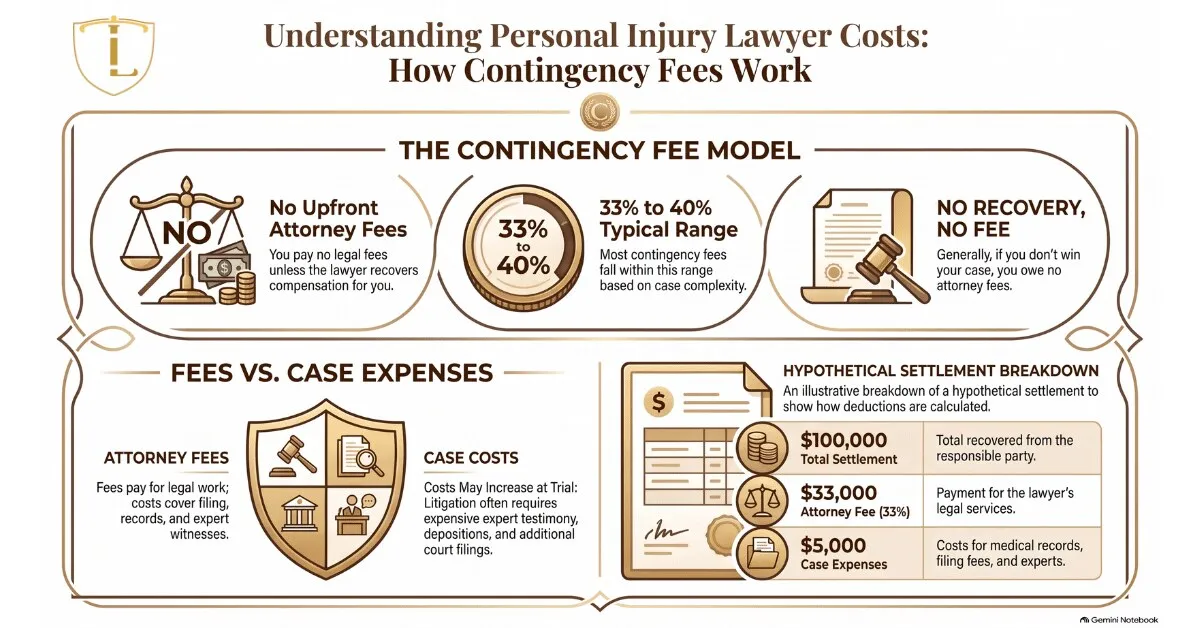
There is no single price for hiring a personal injury lawyer. Many attorneys handle these cases on a contingency fee basis, so the lawyer's payment depends on the compensation recovered. A commonly discussed range is around 33% to 40%, but the actual percentage can vary by lawyer and case.
Why the variation? A straightforward claim that settles early may require less work than a disputed personal injury lawsuit. Cases involving several defendants, complex injuries, or contested liability can require depositions, expert analysis, and lengthy court proceedings. An attorney's experience, the complexity of the claim, and the stage when the case resolves may also influence the fee structure.
Then there are the expenses of building the case itself. Court filing fees, medical record retrieval fees, deposition costs, and expert witness fees are examples. A law firm may advance some of these expenses while the case is pending. However, case expenses are separate from attorney fees, and responsibility for them should be explained before representation begins.
That makes the written fee agreement especially important. California Business and Professions Code § 6147 requires contingency agreements to address the contingency rate and how costs affect the client's recovery. It also requires certain other information about the arrangement.
Before signing, read the agreement carefully and ask questions about anything that isn't clear. Find out when the contingency fee percentage is calculated, who advances court costs, and who ultimately pays those expenses. Knowing those details upfront prevents an unpleasant surprise when your personal injury settlement arrives.
What Is a Contingency Fee?
A contingency fee means your lawyer's payment depends on the outcome of your case. Instead of receiving an hourly bill, the attorney receives an agreed percentage of the money recovered for you. The American Bar Association says these arrangements are commonly used when money is being claimed, particularly in personal injury cases.
The numbers help put that arrangement into perspective. According to the ABA, a contingency fee is often between one-third and 40% of the recovery. The exact contingency fee percentage should be established before representation begins.
Simon Etehad explains, "Many clients come to us while they're already dealing with medical bills and time away from work. A contingency arrangement allows the case to move forward without adding an hourly legal bill to that burden."
Payment generally happens when the case produces a settlement or court award. If your attorney recovers compensation, the agreed attorney fees are deducted according to your written contingency fee agreement. If there is no recovery, you generally do not owe an attorney fee for the lawyer's work.
There is an important distinction, though. Attorney fees and case expenses are not necessarily the same thing. Filing fees, deposition expenses, and costs associated with gathering evidence may still need to be paid. Who ultimately pays those expenses depends on the agreement you sign with your law firm.
For many injury victims, that structure makes hiring a lawyer possible when paying hourly fees would be difficult. The ABA has recognized contingency arrangements as one way to make legal services more accessible. Instead of deciding whether you can afford months of legal bills, you can focus on whether pursuing the claim makes sense for your situation.
How Are Personal Injury Lawyer Fees Calculated?
Personal injury lawyer fees are usually calculated as a percentage of the compensation recovered through a settlement or court award. However, the final amount you receive can also be affected by case expenses, medical liens, and the terms of your contingency fee agreement.
Here's a simple example using a hypothetical $100,000 personal injury settlement:
| Item | Example Amount | What It Means |
|---|---|---|
| Total settlement | $100,000 | The amount recovered from the insurance company or responsible party. |
| Attorney contingency fee | $33,000 | Using an agreed 33% contingency percentage for this example. |
| Case expenses | $5,000 | Hypothetical costs for medical records, filing fees, depositions, or other case-related expenses. |
| Remaining amount | $62,000 | The illustrative amount remaining after the attorney fee and case expenses. |
The math in this example is straightforward. A 33% attorney fee on $100,000 equals $33,000. After another $5,000 in assumed case expenses, $62,000 remains.
That does not necessarily mean the client receives a $62,000 check. Outstanding medical liens, medical bills, or other authorized deductions may still need to be resolved before the remaining settlement proceeds are distributed.
This example is for illustration only. Actual attorney fees, contingency percentages, expenses, and deductions depend on the individual case and the agreement between the client and the law firm. Before hiring a personal injury attorney, read the fee agreement carefully so you understand how both fees and costs will be handled.
Attorney Fees vs. Case Costs: What's the Difference?
Attorney fees and case costs are not the same thing. The contingency fee generally pays for your attorney's legal services, while case costs cover expenses incurred while investigating and pursuing your claim. Depending on the fee agreement, a law firm may advance some expenses and seek reimbursement when the case resolves.
The table below explains it better:
| Cost | What It Covers |
|---|---|
| Attorney Fees | Payment for the lawyer's legal services, including case preparation, negotiations, legal strategy, and representation. In a contingency arrangement, this is typically calculated as an agreed percentage of the recovery. |
| Court Filing Fees | Fees charged by the court for filing a personal injury lawsuit, motions, and other required documents during litigation. |
| Medical Record Fees | Costs associated with obtaining medical records, imaging, bills, and other documentation needed to establish your injuries and medical expenses. |
| Expert Witness Fees | Payments to qualified experts who may provide opinions about liability, injuries, future medical care, or other disputed issues. |
| Deposition Costs | Expenses associated with taking sworn testimony before trial, which may include court reporter fees, transcripts, and related services. |
| Investigation Expenses | Costs of locating witnesses, obtaining evidence, inspecting an accident scene, or completing other investigative work needed to establish liability. |
| Accident Reconstruction | Fees for accident reconstruction specialists who analyze evidence and help determine how a collision occurred. These expenses are more common in complex or disputed cases. |
| Administrative and Document Costs | Certain expenses related to obtaining, copying, organizing, or delivering documents required during the legal process, depending on the firm's agreement. |
Who Pays the Costs of a Personal Injury Case?

In many personal injury cases, the law firm may advance certain expenses needed to investigate and pursue the claim. That can include court filing fees, medical record costs, deposition expenses, and payments to expert witnesses. Instead of asking the client to cover each bill as it arrives, those advanced costs may be reimbursed from the recovery when the case ends.
Simon Etehad explains, "Clients should understand from day one what the lawyer charges and what it may cost to build the case. Those are two different things, and there shouldn't be surprises when a settlement is reached."
Exactly when those expenses are reimbursed depends on the contingency fee agreement. Some agreements calculate the attorney's percentage before deducting case expenses, while others address costs differently. That distinction matters because it can affect how much of the final settlement ultimately remains for the client.
Consider a case involving several depositions, extensive medical records, and an accident reconstruction specialist. Those expenses can add up as the case progresses. If the law firm advances them, the client generally does not have to continually fund those expenses while also managing medical bills and other financial pressures.
There is another question worth asking before you sign: what happens to those expenses if there is no recovery? The answer depends on the firm's agreement and applicable law. Don't assume that "no attorney fee unless we win" automatically means you can never be responsible for case expenses.
This is why the conversation about costs should happen before the attorney-client relationship begins. Ask who advances expenses, when reimbursement occurs, and how costs affect the calculation of the lawyer's fee. A clear written agreement lets you know where you stand before your attorney starts pursuing the claim.
Are There Upfront Costs to Hire a Personal Injury Lawyer?
For many personal injury cases, you won't need to pay an attorney fee before the lawyer begins working on your claim. Many firms offer a free consultation and handle cases on a contingency fee basis. Rather than paying a traditional retainer or hourly legal bills, the attorney receives an agreed portion of the recovery if the case succeeds.
That doesn't mean every expense is automatically covered. A claim can generate costs for medical records, filing fees, expert opinions, investigations, and other services. Some law firms advance these expenses and seek reimbursement later, while others may handle them differently. Your written fee agreement should tell you what to expect.
Does It Cost More If Your Case Goes to Trial?
Yes, it can cost more if your case goes to trial. A case that settles during early negotiations usually requires less work and fewer expenses than one that proceeds through litigation. Once a lawsuit is filed, attorneys may spend considerably more time gathering evidence, preparing motions, conducting discovery, taking depositions, and getting the case ready for trial.
The expenses can increase as well. Deposition costs, expert witness fees, court filing fees, trial exhibits, and court reporter fees may become necessary. Complex cases might also require physicians, economists, engineers, or accident reconstruction specialists to provide opinions or testimony.
The contingency fee percentage may also change after a lawsuit is filed or the case reaches another stage. That isn't universal, and the specific arrangement depends on the attorney and your agreement. Any change in the percentage should be addressed in the contingency fee agreement you review before hiring the firm.
This is another reason to look beyond the headline percentage when comparing lawyers. Ask what happens to the attorney fee if settlement negotiations fail and litigation becomes necessary. You should know how both legal fees and case expenses could change before deciding who will represent you.
Is Hiring a Personal Injury Lawyer Worth the Cost?

Hiring a personal injury lawyer can be worth the cost when there is meaningful compensation at stake. After an accident, you are not simply asking an insurance company to reimburse a few bills. You have to establish who was responsible, prove what the accident cost you, and determine what your injuries may cost you later.
That work begins with investigating what actually happened. A lawyer can review the police report, speak with witnesses, obtain photographs or surveillance footage, and preserve physical evidence before it disappears. This becomes especially important when liability is disputed or several parties may share responsibility. The investigation may also uncover additional defendants, insurance policies, or other sources of compensation that were not obvious at the start.
Then there is the value of the claim itself. Your current medical bills and lost wages tell only part of the story when an injury has lasting consequences. Future treatment, rehabilitation, reduced earning capacity, and pain and suffering may also need to be considered. An attorney can gather medical records, employment documentation, and expert opinions to calculate those losses before you agree to a final settlement.
Once the evidence and damages are clear, your lawyer has something concrete to take into settlement negotiations. Insurance companies may dispute treatment, question liability, or make an offer that does not account for future losses. Your attorney can respond with evidence rather than simply accepting the insurer's assessment. That distinction matters because once a claim is settled and released, you generally cannot reopen it because your injuries later become more expensive than expected.
Sometimes, however, negotiation is not enough. If an insurance company refuses to make a fair settlement, an attorney can file a personal injury lawsuit and use the discovery process to obtain additional evidence. Depositions, expert testimony, medical opinions, and accident reconstruction specialists may become necessary as the case develops. Preparing those pieces also means your claim is ready for court if settlement discussions ultimately fail.
Trial itself is relatively uncommon. Federal judiciary data show that about 1% of federal civil cases terminated during the 12 months ending March 31, 2024, reached trial. Still, preparing a case for that possibility can be important because the insurer knows litigation remains an option.
None of this means hiring an attorney automatically produces a larger recovery. No responsible lawyer can promise that. What you are paying for is the investigation, evidence, damage analysis, negotiation, and litigation experience needed to pursue the claim properly from beginning to end.
What Happens to Your Settlement After Attorney Fees?
When a personal injury settlement is reached, the full settlement amount does not usually go directly into your bank account. The funds generally pass through the law firm first so the agreed attorney fees, case expenses, and other outstanding obligations can be addressed. Only then is the remaining balance distributed to you.
The process begins when the settlement funds are received and deposited into the appropriate client trust account. Your attorney then deducts the contingency fee according to the terms of your signed agreement. For example, if your agreement specifies a percentage of the recovery, the lawyer's fees are calculated using the method described in that agreement.
Next come the expenses incurred while pursuing your claim. These might include court filing fees, medical record costs, deposition expenses, or expert witness fees advanced by the law firm. How and when those expenses are deducted depends on the terms you agreed to at the beginning of the case.
Medical balances can require additional attention. If a healthcare provider, insurer, or another party has a valid medical lien against your settlement, that lien may need to be resolved before your proceeds are released. Outstanding medical bills related to the accident may also need to be addressed, depending on the circumstances.
Once the agreed attorney fees, applicable case expenses, and outstanding obligations have been handled, the remaining settlement proceeds belong to the client. You should receive a settlement statement showing the original settlement amount, each deduction, and the final amount being distributed to you.
This is why understanding the numbers before signing a contingency fee agreement matters. Ask how attorney fees are calculated, how expenses are deducted, and what other payments could come from your recovery. That way, you have a clearer idea of what your settlement may look like after the case is resolved.
Questions to Ask a Personal Injury Lawyer About Fees
The percentage a lawyer charges matters, but it does not tell you everything about the cost of representation. Two firms may quote similar contingency fees while handling litigation expenses very differently. Before signing anything, make sure you understand what will be deducted from your recovery and when.
Start by asking, "What is your contingency fee percentage?" The attorney should tell you what percentage applies and how that percentage will be calculated. Don't hesitate to ask for an example using a hypothetical settlement amount if the explanation isn't clear.
You should also ask whether that percentage changes if the case becomes more complicated. Some fee agreements may provide different rates once a lawsuit is filed or the case reaches a particular stage. Knowing this beforehand helps you understand what litigation could mean for your eventual recovery.
Then ask about case expenses. Who pays for medical records, depositions, filing fees, investigators, and expert witnesses while the case is pending? If the law firm advances those expenses, find out when the firm expects to be reimbursed.
How those expenses are deducted matters too. Ask whether costs come out before or after the attorney fees are calculated because the method can affect the amount remaining for you. Your agreement should explain the calculation rather than leaving you to figure it out after settlement.
There is one question clients sometimes forget: "What happens to the expenses if we don't win?" A contingency arrangement may mean no attorney fee without a recovery, but that does not automatically answer who is responsible for case costs. Get a clear answer before representation begins.
Finally, ask whether everything will be provided in writing. For California contingency cases, the fee arrangement must generally be in writing and include specific information required by law. Your written agreement gives you something concrete to review before deciding whether the terms work for you.
As Simon Etehad explains, "A client should never reach the end of a case and be surprised by how the fee was calculated. We believe those conversations belong at the beginning, when there is plenty of time to ask questions." Understanding the agreement now makes it much easier to understand the numbers when your case eventually resolves.
How to Choose a Personal Injury Lawyer Beyond the Fee
Start by looking at the attorney's experience with cases like yours. Personal injury law covers everything from car accidents to medical malpractice, so years in practice alone don't tell the whole story. Ask whether the lawyer regularly handles your type of claim and has represented clients with similar injuries or liability issues. Past results cannot guarantee what will happen in your case, but they can help you understand the lawyer's relevant experience.
From there, pay attention to communication. You should be able to ask questions and receive answers you actually understand. Find out who will manage your case, how often you can expect updates, and who you should contact when something changes. A personal injury case may last months or longer, and poor communication can make an already difficult process more frustrating.
The firm's resources matter as well, particularly when a case is complicated. Some claims require investigators, medical experts, economists, or accident reconstruction specialists to establish liability and document damages. Ask how the firm approaches those expenses and whether it has the resources to investigate and litigate your case properly.
Fees should be just as easy to understand. Before signing anything, make sure the attorney explains the contingency fee percentage, how case expenses are handled, and whether the percentage changes if a lawsuit becomes necessary. You should know what may be deducted from your recovery and when those deductions occur.
Finally, find out what the lawyer is prepared to do if the insurance company refuses to offer fair compensation. Most personal injury claims never reach trial, but that doesn't mean every case should be settled simply because an offer is on the table. You want an attorney who can negotiate effectively and is prepared to litigate when the circumstances justify it.
Worried About Personal Injury Lawyer Cost?
The cost of a personal injury lawyer shouldn't stop you from finding out whether you have a valid claim. With a contingency fee agreement, you generally do not pay attorney fees upfront. Instead, the lawyer's fee comes from the compensation recovered, while case expenses are handled according to your agreement.
At Etehad Law, we believe clients should understand the financial side of their case before making any commitment. With over 30 years of personal injury experience, our legal team can review your claim, explain our fees and potential case costs, and answer your questions in plain language.
If you were injured because of someone else's negligence, contact Etehad Law for a free consultation. Let us help you understand your options and what it may cost to pursue the compensation you deserve.
Frequently Asked Questions
Here are answers to common questions about contingency fees, upfront costs, litigation expenses, and consultations.
How Much Do Personal Injury Lawyers Charge in California?
Many California personal injury lawyers charge on a contingency fee basis rather than billing by the hour. The exact percentage varies by attorney, case complexity, and the terms of the written fee agreement.
Do Personal Injury Lawyers Charge Upfront Fees?
Most personal injury lawyers working on contingency do not require upfront attorney fees. However, you should ask how the firm handles separate case expenses, such as filing fees, medical records, and expert witnesses.
What Percentage Does a Personal Injury Lawyer Take?
A contingency fee is often around 33% to 40% of the recovery, although there is no single percentage that applies to every case. Your contingency fee agreement should state the percentage and explain how it is calculated.
Do I Pay a Personal Injury Lawyer If I Lose?
With a contingency arrangement, you generally do not owe attorney fees if your lawyer does not recover compensation for you. You could still be responsible for certain case expenses, depending on your agreement with the law firm.
Are Court Costs Included in Attorney Fees?
Not necessarily, because court costs and attorney fees are generally treated as separate expenses. Your agreement should explain who advances filing fees, deposition costs, expert fees, and other litigation expenses.
Does a Lawyer Charge More If My Case Goes To Trial?
The contingency percentage may increase if a lawsuit is filed or a case proceeds toward trial because litigation requires additional work. Whether that happens in your case depends on the fee structure stated in your agreement.
Is The Initial Consultation With a Personal Injury Lawyer Free?
Many personal injury law firms offer a free consultation so potential clients can discuss their claims before deciding whether to hire an attorney. Confirm that the consultation is free when scheduling because individual law firm policies can differ.
Legal Disclaimer: This article provides general information about personal injury lawyer costs and is not legal advice. Attorney fees, case expenses, contingency arrangements, and legal rights vary by case, so speak with a qualified attorney about your specific circumstances.
You may also like
 Accident and Injury
 The Dangers of Texting and Walking
How distracted walking causes pedestrian collisions, who is at fault in a pedestrian versus car accident in California, and what to do…
Read More » Accident and Injury
 What Happens After a Gunshot Wound?
Who can be held liable after a shooting, what you must prove in a California injury claim, and the compensation a gunshot…
Read More » Accident and Injury
 What to Do in the Event of a Burn Injury
The first 24 hours after a burn, when a transfer to a burn centre is recommended, and how negligence is established in…
Read More »
