

If you're wondering who pays my medical bills after an accident, the answer depends on your insurance coverage and the circumstances. Your health insurance, MedPay coverage, or another available policy may cover treatment while your personal injury claim is pending. The at-fault driver's insurance may later compensate you for accident-related medical expenses.
At Etehad Law, we represent injury victims on a contingency fee basis, meaning you pay no attorney fees unless we recover compensation for you. Our firm has recovered more than $100 million in settlements and has earned a 5-star rating based on more than 250 Google reviews. Our case results include an $11 million-plus jury verdict and numerous policy-limit recoveries in motor vehicle and premises liability cases. If you were injured in an accident, contact us today for a free consultation to pursue the maximum compensation.
This guide explains how health insurance, auto insurance, MedPay, liability coverage, uninsured or underinsured motorist coverage, and personal injury claims can affect your medical bills. We will also cover what happens while a claim is pending, how medical liens and reimbursement may work, and what you can do when mounting medical expenses become difficult to manage.
Who Is Responsible for My Medical Bills After an Accident?
The answer depends on two different issues: who is legally responsible for your damages and who pays your medical bills while your claim is being resolved. In California, the at-fault party may ultimately be responsible for accident-related losses, but their insurance company may not pay your medical providers as you receive treatment.
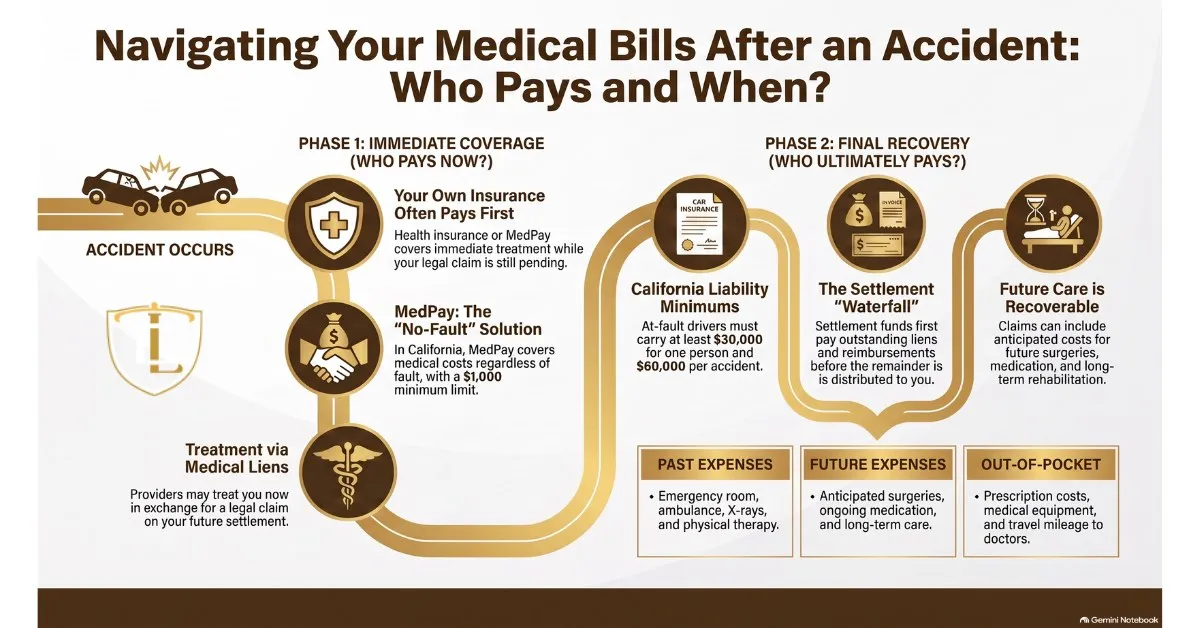
If another driver caused the accident, their liability insurance may compensate you for medical expenses through a settlement or court judgment. According to the California Department of Insurance, California drivers must carry at least $30,000 in bodily injury liability coverage for one person and $60,000 for two or more people injured in one accident.
While your claim is pending, your own insurance coverage may provide another source of payment. Uninsured or underinsured motorist coverage may help cover your losses when the at-fault driver has no insurance or does not have enough coverage for your injuries.
Your health insurance may also pay for covered accident-related medical treatment while liability is being resolved. According to the California Department of Insurance, health insurance can help pay medical expenses following an auto accident, although reimbursement rights may arise after a settlement or recovery.
Medical Payments Coverage, commonly called MedPay, may provide another way to pay medical costs. According to the California Department of Insurance, MedPay covers medical expenses regardless of who caused the accident, and California insurers must offer at least $1,000 in MedPay coverage.
Other sources of payment may also apply depending on the circumstances. Workers' compensation may cover injuries sustained at work, while other available insurance coverage could apply if the at-fault driver is uninsured or underinsured.
The key difference is that who ultimately pays for your damages is not always the same as who pays your bills first. Your health insurance, MedPay, workers' compensation, or other coverage may pay medical providers during treatment, while the at-fault party's financial responsibility is addressed later through a settlement, judgment, or other resolution of your claim.
Does the At-Fault Driver's Insurance Pay My Medical Bills?
The at-fault driver's insurance may ultimately pay your accident-related medical bills, but it usually does not pay each bill immediately. A third-party liability claim allows you to seek compensation from the person or party whose negligence caused your injuries.
Under California Civil Code Section 1714, everyone is generally responsible for injuries caused by their lack of ordinary care. That means an at-fault driver may be legally responsible for damages resulting from the accident, including medical expenses, if the evidence establishes liability.
According to the California Courts Self-Help Guide, a person injured by someone else's actions can seek money for medical bills, lost wages, ongoing treatment, and future problems resulting from the injury. The California Courts also notes that it is not always clear who is responsible for an injury, which is one reason an insurance company may investigate before agreeing to pay a claim.
This investigation can take time. The other driver's insurance company may review the police report, photographs, witness statements, vehicle damage, and other evidence before deciding whether its policyholder caused the car accident and what damages it may owe.
If the other driver disputes fault, payment may take even longer. The California Courts advises that evidence such as police reports, witness statements, photos, medical bills, and doctor's reports can help establish what happened and support an injury claim.
For that reason, the person ultimately responsible for your damages may not be the one paying your medical providers while the claim is pending. Your health insurance, MedPay, or other available coverage may pay for treatment first, while you seek reimbursement or compensation from the at-fault driver's insurer later.
Can My Health Insurance Pay My Accident-Related Medical Bills?
Yes, health insurance can pay accident-related medical bills, depending on your coverage and the coordination rules between your health plan and other available insurance. This can include emergency care, doctor visits, physical therapy, prescription medications, and other covered medical treatment, subject to your plan's deductibles, copays, coinsurance, and coverage terms.
Your out-of-pocket costs may still matter. A deductible is generally the amount you pay before your plan begins paying for certain covered services, while a copay or coinsurance may leave you responsible for part of the cost.
The fact that someone else caused the accident does not necessarily mean you must wait for that person's insurance company to resolve your personal injury claim before using available coverage. The order of payment can depend on the type of insurance involved and the circumstances of the claim, which is why you should review your own health insurance policy and provide your insurer with accurate information about the accident.
There may also be reimbursement issues if you later receive a personal injury settlement. According to the Centers for Medicare & Medicaid Services, when Medicare makes certain conditional payments for accident-related treatment and the beneficiary later receives a settlement, judgment, award, or other payment, Medicare may seek repayment for the covered amounts it paid.
Similar reimbursement rights may apply under other health plans, although the rules depend on the policy, the type of coverage, and applicable law. Before a settlement is finalized, it is important to identify any outstanding medical liens or reimbursement claims so you understand how they may affect the amount ultimately distributed to you.
What Is Medical Payments Coverage?
Medical Payments Coverage, often called MedPay, is optional coverage that may be available under your auto insurance policy. It can help pay covered medical expenses after a car accident for you and, in some situations, your passengers, regardless of who caused the crash.
According to the California Department of Insurance, MedPay can pay for immediate medical care after an accident, regardless of fault. The department also states that the minimum MedPay limit available to purchase is $1,000 per injured person, although drivers can choose higher limits.
Erik Harper explains, "MedPay can be useful because it may provide an immediate source of coverage while fault and liability are still being investigated. However, it is important to understand your policy limits and how MedPay works alongside your health insurance and other available coverage."
This differs from liability insurance, which generally pays for injuries or property damage you cause to other people when you are at fault. MedPay focuses on covered medical costs for people insured under the policy or riding in the covered vehicle, without requiring fault to be established first.
MedPay may help with expenses such as emergency treatment and other necessary accident-related medical care, subject to your policy terms and coverage limit. It is not included automatically in every California auto policy, so check your policy or contact your insurer to find out whether you purchased this coverage and how much is available.
What If I Don't Have Health Insurance?

Not having health insurance does not necessarily mean you must pay every accident-related medical bill before receiving treatment. Medical providers may discuss payment arrangements, self-pay options, or other ways to address the cost of care, depending on the provider and your circumstances.
In some personal injury cases, treatment may be provided under a medical lien arrangement. Under this type of arrangement, a healthcare provider agrees to provide treatment now and seeks payment from a future settlement or recovery, subject to the terms of the agreement. California law also recognizes certain statutory medical liens, and the California Department of Health Care Services has a formal process for recovering Medi-Cal payments from third-party injury recoveries.
Some providers may also agree to negotiated treatment arrangements when a patient has a pending personal injury claim. The exact terms matter, so you should understand whether you remain personally responsible for the bill if your case does not settle or does not produce enough money to cover the charges.
You may also be able to ask a hospital about financial assistance or discounted care. According to the Los Angeles County Department of Public Health, patients can apply for some hospitals' financial assistance programs before treatment, at the time of service, or after receiving a bill.
Most importantly, concerns about payment should not cause you to ignore necessary medical care. Delaying treatment can affect your health, and it may also make it harder to document the connection between the accident and your injuries, so explore available payment options while getting the care you need.
What Is a Medical Lien?
A medical lien is a legal or contractual claim for payment from money recovered in a personal injury case. In practical terms, a medical provider may agree to treat an injured person now and seek payment later from a settlement, judgment, or other recovery.
Erik Harper explains, "A medical lien can help an injured person access treatment when immediate payment is difficult, but it is important to understand that the medical bill does not simply disappear. Before signing anything, you should know how the provider expects to be paid and what happens if your case does not result in a recovery."
Some providers may agree to wait for payment when a patient has a pending personal injury claim against the party responsible for the accident. California law specifically gives qualifying hospitals a lien on damages recovered for reasonable and necessary treatment related to an accident or wrongful act. Under California Civil Code Section 3045.2, a qualifying hospital lien can apply to money recovered through a judgment, settlement, or compromise.
After a settlement is reached, outstanding liens may need to be identified and resolved before the remaining proceeds are distributed. For example, the California Department of Health Care Services explains that Medi-Cal may establish a lien for injury-related services it paid and seek reimbursement when a beneficiary receives a settlement, judgment, or award from a liable third party.
The terms of any medical lien matter. Before signing, understand what treatment is covered, how much you may owe, when payment becomes due, and whether you remain responsible if your personal injury case does not settle or produces less than expected. A lien arrangement can be helpful in some situations, but you should know exactly what financial obligations you are accepting.
What Happens to Medical Bills During a Personal Injury Claim?
The process usually begins with you receiving the medical care needed for your injuries. As treatment continues, your medical bills may be submitted to available health insurance, MedPay, or another source of coverage, while some providers may agree to a separate payment arrangement or medical lien.
If you hire an attorney, your legal team can keep track of accident-related medical expenses as the claim develops. This may include collecting bills, medical records, and other documentation needed to show the cost of your treatment and support the damages claimed.
Once there is enough information to evaluate the case, your personal injury claim may be negotiated with the insurance company. Your attorney can present evidence of your medical expenses, lost wages, and other damages while addressing questions about liability and the value of the claim.
If a settlement is reached, the settlement funds are not always immediately paid in full to the injured person. Outstanding medical bills, liens, and reimbursement claims may first need to be identified and resolved.
For example, according to the California Department of Health Care Services, Medi-Cal may seek reimbursement for injury-related services it paid when a beneficiary receives a settlement, judgment, or award. The department also explains that, after a settlement occurs or treatment ends, it reviews payment records to determine whether a lien applies.
After valid outstanding obligations are addressed, the remaining settlement proceeds can be distributed to the injured person. The exact process varies by case, particularly when there are attorney fees, medical liens, or multiple parties with reimbursement rights.
What Medical Expenses Can I Recover After an Accident?

If another party is legally responsible for your injuries, you may seek compensation for reasonable accident-related medical expenses. These can include costs you have already incurred and future treatment you can reasonably establish will be necessary.
The table below explains it better:
| Type of Medical Expense | Examples | What It May Cover |
|---|---|---|
| Past Medical Expenses | Emergency room treatment | Emergency evaluation and treatment immediately after the accident |
| Past Medical Expenses | Ambulance transportation | The cost of medically necessary transportation from the accident scene |
| Past Medical Expenses | Doctor visits | Examinations, follow-up appointments, and treatment from medical providers |
| Past Medical Expenses | Diagnostic imaging | X-rays, CT scans, MRIs, and other tests used to diagnose accident-related injuries |
| Past Medical Expenses | Prescription medications | Medication prescribed to treat injuries, manage pain, or support your recovery |
| Past Medical Expenses | Physical therapy | Treatment intended to restore movement, strength, and function after an injury |
| Future Medical Expenses | Surgery | Procedures that doctors reasonably expect you will need because of your injuries |
| Future Medical Expenses | Rehabilitation | Ongoing services designed to help you recover or adapt after a serious injury |
| Future Medical Expenses | Ongoing treatment | Future doctor visits, specialist care, and continued medical monitoring |
| Future Medical Expenses | Medication | Prescription drugs you may need as part of your continuing treatment |
| Future Medical Expenses | Long-term care | Extended nursing, in-home, or other supportive care when permanent injuries require assistance |
What If the Insurance Company Says My Injuries Were Not Caused by the Accident?
An insurance company may argue that your injuries existed before the accident or resulted from another event. Causation can become a major issue because proving negligence alone is not enough; you must also connect the accident to the injuries and losses for which you seek compensation.
A pre-existing condition does not automatically prevent you from bringing a personal injury claim. However, medical records and physician opinions may become especially important in showing whether the accident caused a new injury or worsened an existing condition.
Delayed symptoms can also complicate a claim. Some injuries are not immediately obvious, which is why it is important to tell your medical providers when symptoms began and describe how the accident occurred.
Gaps in medical treatment may raise additional questions. An insurer might argue that the condition was not serious or that something unrelated caused the injury during the period without treatment.
Medical records can help establish a timeline from the accident through diagnosis and treatment. Physician opinions may also help explain whether the injuries are consistent with the accident and what future medical care may be necessary.
According to the California Courts Self-Help Guide, a personal injury claim may seek compensation for medical bills, ongoing treatment, and future problems caused by an injury. That makes evidence connecting your treatment and future needs to the accident an important part of the claim
What If I Was Partially at Fault?
Being partially at fault does not automatically prevent you from recovering compensation in California. Under California's pure comparative negligence system, your recoverable damages may be reduced by your percentage of responsibility.
For example, if your total damages are $100,000 and you are found 25% at fault, your recovery could be reduced by $25,000. You could therefore recover $75,000, assuming the other elements of your claim are established.
California Civil Code Section 1714 provides that a person is generally responsible for injuries caused by his or her lack of ordinary care. California's comparative negligence principles can also account for situations where more than one person's conduct contributed to an injury.
An insurance company's decision about fault is not necessarily final. Police reports, photographs, witness statements, vehicle damage, expert analysis, and other evidence can affect how responsibility is evaluated during negotiations or litigation.
Can I Recover Medical Bills If the Accident Wasn't My Fault?
Yes, if you can establish that another party was legally responsible for your injuries, you may seek compensation for accident-related medical expenses. The claim generally requires evidence showing how the other party's conduct caused the accident and your resulting injuries.
Documenting your treatment is an important part of that process. Keep medical records, bills, prescriptions, treatment recommendations, and other documents that show the care you received and its connection to the accident.
According to the California Courts Self-Help Guide, people bringing personal injury cases may seek damages for medical bills, lost wages, ongoing treatment, emotional harm, and future problems caused by an injury. The available damages depend on the facts of the case and what losses can be supported with evidence.
Recovering medical expenses may therefore be only one part of a personal injury claim. Depending on your circumstances, you may also seek compensation for other legally recoverable losses resulting from the accident.
What Happens If My Medical Bills Are Higher Than My Settlement?
A settlement amount and the amount you ultimately receive are not always the same. If outstanding medical bills, liens, or reimbursement claims remain, those obligations may need to be addressed from the settlement proceeds.
In some cases, your attorney may negotiate outstanding medical bills or lien amounts with providers. Whether a provider agrees to reduce a bill depends on the circumstances, the terms of any agreement, and the type of lien or reimbursement right involved.
Health insurers may also have reimbursement rights after paying accident-related treatment. For example, the California Department of Health Care Services states that Medi-Cal may seek reimbursement for injury-related services it paid when a member receives money through a settlement, judgment, or award.
According to DHCS, after treatment ends or a settlement occurs, the department reviews payment records to determine whether a Medi-Cal lien applies. Its lien process can also involve statutory reductions based on the circumstances of the recovery.
This is why the gross settlement amount is not necessarily the amount you take home. Attorney fees, case expenses, medical liens, and valid reimbursement claims may affect the final amount distributed to the injured person, so these obligations should be identified before settlement funds are distributed.
How to Protect Your Right to Recover Medical Expenses
Protecting your right to recover medical expenses starts with creating a clear record of your injuries, treatment, and accident-related costs. The following steps can help you document your losses while avoiding decisions that could make your personal injury claim harder to evaluate.
Step 1: Seek Medical Attention Promptly
Get medical care as soon as possible after an accident, especially if you are experiencing pain or other symptoms. Prompt treatment can protect your health and create records showing when your injuries were first reported and treated.
Step 2: Follow Your Doctor's Treatment Plan
Attend recommended appointments and follow your doctor's instructions for medication, physical therapy, testing, or other treatment. If you cannot follow a recommendation, document the reason and discuss it with your healthcare provider.
Step 3: Keep Copies of Medical Records and Bills
Save copies of medical bills, treatment records, prescriptions, test results, and receipts for out-of-pocket expenses. These documents can help show the treatment you received and the medical costs connected to your injuries.
Step 4: Track Mileage and Other Medical-Related Expenses
Keep a record of travel to and from doctor appointments, physical therapy, pharmacies, and other medical visits. You should also save receipts for parking, transportation, medical equipment, prescription medications, and other accident-related expenses.
Step 5: Do Not Ignore Follow-Up Care
Continue attending follow-up appointments while you still need treatment. Missing care can affect your recovery and may leave gaps in your medical records that make it more difficult to show how your injuries developed over time.
Step 6: Understand Your Future Medical Needs Before Settling
Do not rush into a settlement before you understand the full extent of your injuries and reasonably anticipated future medical care. Once you sign a settlement release, you may give up the right to pursue additional compensation for the same accident, even if your medical needs later become more serious.
How a Personal Injury Lawyer Can Help With Medical Bills
Medical bills can become difficult to manage when treatment continues and several insurance companies are involved. A personal injury lawyer can help organize the financial side of your case while protecting your interests throughout the claims process.
Erik Harper explains, "Medical expenses are not just about adding up the bills you have today. We also look at the treatment you may still need, the insurance coverage available, and any liens or reimbursement claims that could affect your final recovery."
Your attorney can track and document accident-related medical expenses by collecting bills, medical records, treatment recommendations, and receipts. This creates a clearer picture of what your injuries have already cost and helps prevent important expenses from being overlooked.
A lawyer can also communicate with insurance companies on your behalf and identify available sources of coverage. Depending on the circumstances, this may include the at-fault driver's liability insurance, your health insurance, MedPay, or uninsured and underinsured motorist coverage.
If medical providers or health insurers have reimbursement claims, your attorney can review those obligations and negotiate medical liens where appropriate. This can be particularly important because the amount recovered in a settlement is not always the amount ultimately distributed to you.
Your legal team may also consider future medical costs when evaluating your claim. Ongoing physical therapy, surgery, medication, specialist care, or long-term treatment can significantly affect the value of your damages.
During settlement negotiations, your attorney can present evidence of your past and anticipated medical expenses alongside your other losses. If a fair resolution cannot be reached, your lawyer can also help determine the next steps for protecting your right to seek compensation through the legal process.
The goal is to make sure medical expenses, available coverage, future treatment needs, and outstanding financial obligations are properly considered before the claim is resolved.
Want To Work With a Personal Injury Lawyer?
After an accident, medical bills can continue arriving long before your personal injury claim is resolved. Understanding your available insurance coverage, medical liens, future treatment costs, and potential reimbursement obligations can help you make informed decisions about your claim.
At Etehad Law, we have over 30 years of experience helping injured clients pursue compensation for medical expenses and other accident-related losses. Contact us today for a free consultation to discuss your case and learn how our team can help protect your interests.
Frequently Asked Questions
Medical bills can create financial pressure after an accident, especially when insurance coverage and fault are still being determined. Here are answers to common questions about who pays for treatment and how medical expenses may be handled in a California personal injury claim.
Who Pays Medical Bills After a Car Accident in California?
The answer depends on your available insurance coverage and the circumstances of the accident. Health insurance, MedPay, or other coverage may pay bills first, while the at-fault driver's insurance may ultimately compensate you through a settlement or judgment.
Does The At-Fault Driver's Insurance Pay My Hospital Bills?
The at-fault driver's insurance may be responsible for your accident-related damages, including hospital expenses, if liability is established. However, the insurer may investigate the accident before paying, so it may not cover your bills as you receive treatment.
Can I Use My Health Insurance After a Car Accident?
Yes, your health insurance may pay for covered accident-related medical treatment, subject to your policy terms. You may still have deductibles, copays, or coinsurance, and your insurer could have reimbursement rights if you later recover money.
What If I Don't Have Health Insurance After An Accident?
You may have other options, including MedPay, a medical lien arrangement, payment plans, or available financial assistance programs. The right option depends on your injuries, insurance coverage, medical providers, and the circumstances of your case.
What Happens To My Medical Bills If I Receive a Settlement?
Outstanding medical bills, medical liens, or valid reimbursement claims may need to be addressed from the settlement proceeds. After these obligations and other applicable deductions are resolved, the remaining amount is distributed to you.
Can I Get Compensation For Future Medical Expenses?
You may seek compensation for reasonably necessary future medical care if the evidence supports those expected costs. Medical records, physician opinions, and other evidence can help establish the treatment you may need and its anticipated expense.
What Happens If The Insurance Company Refuses To Pay My Medical Bills?
A denial does not necessarily mean you have no options. You may need additional evidence to establish liability, prove that your injuries resulted from the accident, or challenge the insurer's position through negotiations or legal action.
Can a Personal Injury Lawyer Help With Medical Bills?
A personal injury lawyer can document your medical expenses, identify available insurance coverage, and communicate with insurers on your behalf. Your attorney may also address medical liens, calculate future costs, and include your medical damages when pursuing a settlement or other recovery.
You may also like
 Accident and Injury
 The Dangers of Texting and Walking
How distracted walking causes pedestrian collisions, who is at fault in a pedestrian versus car accident in California, and what to do…
Read More » Accident and Injury
 What Happens After a Gunshot Wound?
Who can be held liable after a shooting, what you must prove in a California injury claim, and the compensation a gunshot…
Read More » Accident and Injury
 What to Do in the Event of a Burn Injury
The first 24 hours after a burn, when a transfer to a burn centre is recommended, and how negligence is established in…
Read More »
