


One common question we get from clients is: ‘will posting on social media tank your case?’ Yes, it can. Social media posts, photographs, videos, comments, and location tags may be used as evidence against you during a personal injury lawsuit or other legal proceedings. Even seemingly innocent posts can be taken out of context and affect your credibility.
If you are involved in a personal injury case, Etehad Law can help protect your legal rights. With over 30 years of experience, our attorneys guide clients through every stage of the legal process, including avoiding mistakes that could weaken a claim. Our case results include an $11 million-plus jury verdict and numerous policy-limit recoveries in motor vehicle and premises liability cases. If you have a personal injury case, contact us today for a free consultation to pursue the compensation available under California law.
In this guide, we explain how social media can affect your legal case, what types of posts create problems, and why deleting content may not solve the issue. We also discuss best practices for protecting your claim while your case is pending.
How Posting on Social Media Can Damage Your Legal Case
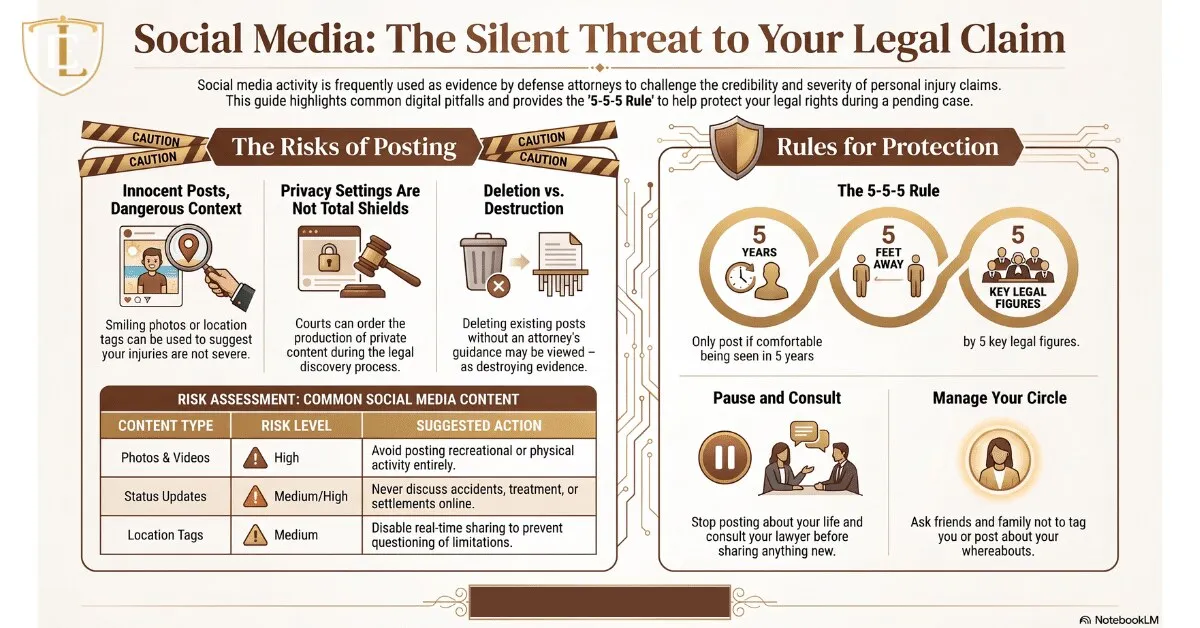
Social media can significantly affect the outcome of a legal case. In our experience, anything posted online may become evidence during the discovery process. According to the American Bar Association, courts routinely allow relevant social media content to be used as evidence when it relates to the issues in dispute.
Defense attorneys and insurance companies often review public social media accounts during personal injury litigation. They look for photographs, videos, comments, and other posts that appear inconsistent with your claimed injuries. Even content shared by friends or family members may become relevant if it relates to your case.
Seemingly innocent posts can also create serious problems. For example, a smiling photograph at a family gathering may be used to suggest you are not experiencing significant pain. A vacation photo, gym check-in, or location tag may be presented as evidence that contradicts your reported physical limitations.
Comments and opinions can also affect your credibility. Discussing the accident, your injuries, settlement negotiations, or the opposing party may provide statements that are later used against you. Even casual conversations posted online may be taken out of context during legal proceedings.
Privacy settings do not guarantee protection. Courts may order the production of relevant social media content, and investigators may obtain information through lawful discovery. Once something is posted online, controlling who ultimately sees it becomes much more difficult.
We recommend avoiding discussions about your legal case on any social media platform while your claim is pending. As a general rule, it is better to let your attorney communicate on your behalf than to risk creating evidence that could weaken your case.
How To Navigate the Risks of Social Media During Personal Injury Claims

The first step is to stop posting about your case. Avoid discussing the accident, your injuries, medical treatment, or settlement negotiations. Even a simple update may be taken out of context during legal proceedings.
Next, avoid posting photographs or videos showing physical activities, vacations, social gatherings, or recreational events. Defense attorneys may argue that these posts contradict your claimed injuries, even if they do not reflect your daily condition.
You should also avoid checking in at locations or sharing your real-time whereabouts. Location tags and travel updates may be used to question your physical limitations or the seriousness of your injuries.
Ask your family members and close friends to be cautious as well. Their photographs, comments, and tags involving you may become relevant evidence during your personal injury lawsuit.
Do not delete or edit existing social media posts without first speaking with your attorney. Removing content may create additional legal issues because the opposing party could claim evidence was intentionally destroyed.
Review your privacy settings, but do not assume they provide complete protection. Courts may still order the production of relevant social media content during the discovery process.
Finally, consult your attorney before posting anything while your case is pending. Your legal team can help you avoid mistakes that could weaken your claim or affect your credibility.
As Eden Lavian explains, “A single social media post can create a misleading story that overshadows months of legitimate medical treatment. Protecting your case often begins with saying less online.”
Best Practices for Social Media Use During a Legal Claim
One helpful guideline is the “5-5-5 Rule.” Before posting, ask yourself whether you would be comfortable with the post being viewed five years from now, by someone five feet away, or by five different people, including a judge, jury, insurance adjuster, or opposing attorney. If the answer is no, we recommend not posting it.
Limit your social media activity throughout your case. Avoid discussing the accident, your injuries, medical treatment, settlement negotiations, or any details related to your legal claim. Even unrelated photographs or comments may be misunderstood when viewed without context.
As Eden Lavian explains, “The strongest legal strategy is often the simplest one. If you are unsure whether to post something, waiting until your case ends is usually the safest decision.” Taking a cautious approach today can help prevent unnecessary challenges later in your case.
Review your privacy settings and restrict who can view your content. Although privacy settings cannot prevent legal discovery, they can reduce unnecessary public exposure. Continue remembering that private content may still become discoverable under certain circumstances.
Avoid accepting friend requests or connection requests from people you do not know. Insurance investigators or others involved in the case may attempt to gain access to information through your social media accounts.
Before sharing anything online, consult your attorney. You can also read our guide on three essential tips to prepare for your legal case for additional strategies to protect your claim throughout the legal process. Your legal team can advise you on whether a post could affect your case before it becomes evidence.
How Your Social Media Content Can Affect Different Types of Cases
In a personal injury case, social media posts are often used to challenge the severity of your injuries. A photograph at a social event, a workout video, or comments about feeling well may be presented as evidence that contradicts your medical records. Even if the content is taken out of context, it may still affect your credibility before a judge or jury.
If you are pursuing compensation, working with experienced counsel from the beginning can help protect your rights throughout the process. Hiring a lawyer for your claim early may also help you avoid costly mistakes during litigation.
In employment-related disputes, social media can also play an important role. The National Labor Relations Board explains that employees have certain rights to discuss workplace conditions online. However, not every post receives legal protection, and some online conduct may still become relevant during employment litigation.
Social media content may also create problems in defamation and libel cases. Statements posted online, comments shared with others, or accusations made on social media platforms may become the subject of litigation if they are alleged to be false and damaging. Screenshots, timestamps, and digital records are often used to evaluate what was actually published.
Regardless of the type of case, the safest approach is to think carefully before posting. Avoid discussing your legal matter online until your attorney advises it is appropriate to do so.
Types of Social Media Content and Their Impact on Legal Cases
The table below showcases various types of social media content and their impact on legal cases.
| Content Type | Risk Level | Examples | Suggested Action |
|---|---|---|---|
| Photos | High | Vacation pictures, gym selfies, family events, recreational activities | Avoid posting photos until your legal case is resolved. |
| Videos | High | Exercise videos, dancing, sports, travel clips, livestreams | Do not post videos that could be used to question your injuries. |
| Status Updates | Medium to High | Comments about the accident, recovery, medical treatment, or settlement | Avoid discussing your case or injuries on any social media platform. |
| Comments | Medium | Replies to friends, opinions about the accident, arguments, or jokes | Be careful what you write because comments may be taken out of context. |
| Location Tags | Medium to High | Restaurant check-ins, vacation locations, event attendance, GPS tags | Disable location sharing and avoid tagging places while your case is pending. |
The Role of Evidence Like Black Box Data vs. Social Media Posts

Not all evidence carries the same weight in a legal case. In our experience, objective evidence is generally more reliable than statements or photographs shared on social media. Building a strong claim often depends on presenting accurate, verifiable information rather than content that can be misunderstood.
For example, a vehicle’s Event Data Recorder, commonly called a black box, captures objective crash information before, during, and after a collision. According to the National Highway Traffic Safety Administration (NHTSA), Event Data Recorders can record information such as vehicle speed, brake application, seat belt use, and airbag deployment. This information is frequently used during accident investigations because it is generated automatically by the vehicle rather than by personal recollection.
Social media posts are very different. A single photograph, comment, or video may be incomplete or taken out of context. While those posts can influence how others view your claim, they do not always provide an accurate picture of what actually occurred or the extent of your injuries.
As Eden Lavian explains, “Objective evidence tells a far more reliable story than carefully selected moments shared online. The strongest cases rely on facts, not appearances.” That is why experienced attorneys focus on gathering evidence that can be independently verified.
Consistent medical treatment is another important form of objective evidence. Medical records document your diagnosis, symptoms, treatment, and recovery over time. Maintaining that documentation is often far more persuasive than anything posted on social media. The importance of consistent medical treatment for your case cannot be overstated because it helps establish both the existence and extent of your injuries.
Need a Lawyer For Personal Injury Claims?
Social media can have a greater impact on your personal injury claim than many people realize. A single photograph, comment, or location tag may be used to challenge your credibility or the seriousness of your injuries. In our experience, the safest approach is to avoid posting about your accident, recovery, or daily activities until your case has concluded.
At Etehad Law, we have over 30 years of experience helping injured clients protect their legal rights from the moment a claim begins. Our attorneys investigate every case thoroughly, preserve critical evidence, negotiate with insurance companies, and help clients avoid mistakes that could jeopardize their compensation. We provide practical guidance throughout the legal process so you can focus on your recovery.
If you have been injured because of someone else’s negligence, do not let a social media mistake weaken your claim. Contact Etehad Law today for a free consultation to discuss your case, understand your legal options, and learn how we can help protect your right to fair compensation.
FAQs
Below are answers to common questions about using social media while a legal claim is pending.
What is The 5 5 5 Rule On Social Media?
The 5-5-5 Rule encourages you to consider whether you would be comfortable with a post being seen years later or by important audiences. If there is any doubt, it is usually better not to post.
Should I Not Post on Social Media During My Case?
Yes, limiting your social media activity is generally the safest approach during a legal claim. Avoid discussing your accident, injuries, treatment, or any aspect of your case online.
Can I Get In Trouble At Work For What I Post On Social Media?
It depends on your employer’s policies and the nature of your post. Some online content may lead to workplace discipline if it violates company policies or affects your employment.
What is The 30 30 30 Rule For Social Media?
The 30-30-30 Rule is a general social media guideline that encourages users to pause and think before posting. Although there are different versions of the rule, its purpose is to help prevent content that could create future personal or professional problems.
How Can I Protect My Case While Using Social Media?
Avoid posting about your legal matter, disable location sharing, and ask friends not to tag you in photographs. If you are unsure whether something is safe to post, speak with your attorney before sharing it.
Legal Disclaimer: This article is for informational purposes only and does not constitute legal advice or create an attorney-client relationship with Etehad Law. Every legal matter is unique, and the impact of social media on a case depends on the specific facts, applicable law, and available evidence. If you are involved in a personal injury claim or other legal proceeding, consult a qualified attorney before making decisions about your social media activity.
You may also like
 Accident and Injury
 California Personal Injury Statute of Limitations
Learn the California statute of limitations for personal injury claims, key filing deadlines, exceptions, and why you should act quickly.
Read More » Expert Opinion
 What is a Vehicle Black Box and How Can It Help Your Case?
Uncover the role of your car black box in legal cases. Insights from Personal Injury Attorney in Beverly Hills await. Check to…
Read More » Expert Opinion
 When to Go to Trial
When does a California injury case go to trial? The litigation timeline, the two-year filing deadline, why most cases settle, and what…
Read More »
