


Settlement amounts for truck accidents vary a lot. The biggest drivers are how badly you were hurt, what your medical care costs, how much income you lost, who caused the crash, and how much insurance is available to pay the claim. Some truck accident claims involve bruises and a few weeks of physical therapy. Some result in long term disabilities, significant financial losses spanning many decades, or loss of a loved one.
We at Etehad Law understand what life looks like for those who have been seriously hurt in a truck accident and their loved ones following that. For 30 years, our team has helped injured Californians learn about their legal rights and pursue compensation after serious accidents. If you were hurt in a collision with a commercial truck, you can learn more about our truck accident legal services or contact us to talk through your situation.
This guide covers what drives truck accident settlement values, the damages California law allows you to recover, who can be held liable, how trucking insurance affects the numbers, and when it makes sense to bring in a lawyer.
How Much Is the Average Truck Accident Settlement in California?
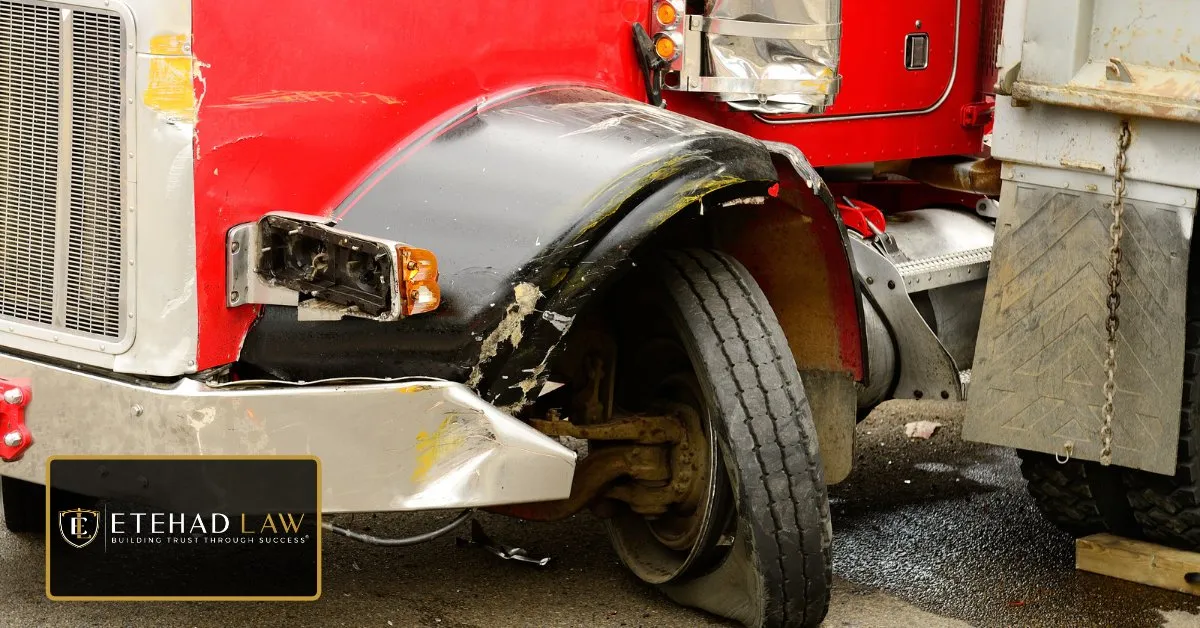
California has no official statewide average for truck accident settlements. Most settlements are private, and many are confidential, so nobody has a complete record of what these claims pay. The averages you see online usually come from a handful of reported verdicts or a single firm's own results. Think of them as marketing, not as a forecast for your specific situation.
What the public data does show is how dangerous these crashes are. According to data from NHTSA (National Highway Traffic Safety Administration), there were 5,340 deaths and 161,201 injuries in accidents that involved large trucks in the United States in 2024. Those numbers include truck occupants, people in other vehicles, and pedestrians and cyclists. They explain why truck cases often involve serious claims, but they say nothing about what any one person will recover.
Injury severity is the clearest dividing line. In general, claims fall into four rough groups:
- Minor injuries: Temporary injuries with limited treatment and no lasting effects usually lead to smaller claims that cover early medical bills, missed work, and out-of-pocket costs.
- Serious injuries: Broken bones, neck and back injuries, or injuries that need surgery and months of rehab can support larger claims, including ongoing medical costs, lost income, and pain and suffering.
- Catastrophic injuries: Spinal cord damage, a traumatic brain injury, or other permanent impairment can mean lifelong care with reduced earning potential and a long term loss of independence.
- Wrongful death: When a crash kills someone, eligible family members may bring a wrongful death claim for their financial and personal losses under California law.
That is why two crashes involving the same kind of truck can settle for very different amounts. The value of your claim comes down to your injuries, the evidence of negligence, your losses, and the insurance on the other side. Strong evidence that the driver or the trucking company was responsible for the accident bolsters your case. Disputed fault or insufficient coverage weakens it. Prior results do not guarantee a similar outcome, and any case result you read about reflects that case's facts, not yours.
What Factors Affect Truck Accident Settlement Amounts?
Several factors shape how much compensation you may recover after a truck accident in California:
- How severe your injuries are and whether they are permanent
- Medical bills, rehabilitation, and expected future care
- Lost wages and any loss of future earning capacity
- Pain, suffering, and emotional distress
- Damage to your vehicle and other property
- How strong the evidence is and how clear liability is
- How much insurance is available, and how many parties may share fault
- Your own share of fault under California's comparative negligence rule
What Types of Compensation Can You Recover After a Truck Accident?
Under California law, different kinds of damages are recognized for people who get hurt in truck accidents. Which ones apply depends on your injuries, your losses, and how the crash happened. The main types of damages fall into different categories: economic damage, noneconomic damage, damages for wrongful death, and, in narrow cases, punitive damages.
Economic damage covers losses that you can quantify. This includes care in emergencies, stays in hospitals, surgeries, medicines, physical therapy and rehab. If you can't earn money while you're recovering from something then those missed wages are considered part of your claim. If injuries prevent you from working at your old job or earn as much as before, you may be compensated for reduced earning ability. Future medical costs, in-home care, and the cost to repair or replace your vehicle can also be included.
Non-economic damages cover harm that has no receipt attached: pain, emotional distress, anxiety, and psychological trauma. Someone living with a brain injury, a spinal cord injury, or a permanent physical limitation may lose independence, strain relationships, and give up activities they used to enjoy. Compensation can account for disfigurement, scarring, and loss of enjoyment of life.
When a truck crash is fatal, eligible surviving family members may pursue a wrongful death claim. Taking into account the facts, this can cover the financial support the person would have been given, also the worth of household services performed, and the loss of love, company, comfort and moral support as well. Some funeral and burial costs may be recoverable too. California also allows a separate survival action, brought on behalf of the deceased person's estate, for some losses the person suffered before death.
Punitive damages work differently. They specifically punish very poor behavior and discourage others from doing that kind of thing again. Under California Civil Code Section 3294, a plaintiff must show by clear and convincing evidence that the defendant acted with malice, oppression or fraud. Proof that shows a trucking company was aware of a significant safety issue and continued allowing this to happen might support that kind of claim. Ordinary negligence is not enough, and neither is the severity of the crash.
Who Can Be Held Liable for a Truck Accident in California?

The truck driver is not always the only person who is responsible. Depending on how the crash happened, several parties may share liability for your injuries and property damage.
The following table outlines who may be held liable and the circumstances that could make them responsible.
| Potentially Liable Party | Circumstances That May Establish Liability |
|---|---|
| Truck drivers | Speeding, distracted driving, driving while fatigued, unsafe lane changes, or other traffic violations that contribute to a crash. |
| Trucking companies | A company may also be liable for a driver's actions when the legal requirements for employer liability are met. Negligent hiring, poor training or supervision, or failure to maintain trucks. |
| Cargo loading companies | Freight that was poorly secured, unbalanced, or overloaded and made the truck unstable, spilled cargo, or caused a collision. |
| Truck manufacturers | Defective brakes, tires, steering systems, or other parts that contributed to the crash. |
| Maintenance and repair providers | Careless inspections or repairs, or failure to detect a mechanical defect that contributed to the collision. |
| Government entities | Dangerous road conditions, missing or inadequate signage, or other roadway defects, subject to California's public entity claim rules. |
| Other negligent parties | Other drivers, contractors, or businesses whose actions contributed to the accident. |
Often more than one party can be legally responsible for the same accident. Finding all of them matters because each one may carry its own insurance, which affects how much compensation is actually available.
How Do Trucking Company Insurance Policies Affect Settlement Amounts?
Insurance often sets the practical ceiling on a truck accident settlement. Commercial trucks carry federal and state insurance requirements that ordinary cars don't, because of their size, weight, and capacity for harm. The minimum coverage depends on the type of operation, what the truck is hauling, and whether it crosses state lines.
According to the Federal Motor Carrier Safety Administration (FMCSA), interstate for-hire motor carriers hauling non-hazardous property generally must carry at least $750,000 in public liability insurance. There are higher minimum limits for some operations. Carriers hauling specified hazardous substances may need $5 million in coverage, and some other hazardous-materials operations have a $1 million minimum. The $750,000 figure represents a minimum for one type of truck; it's not a rule that applies to every single truck driving on the road.
A policy has a limit as to how much it pays out. It doesn't decide how much your claim is worth. Many trucking companies carry more money than the federal minimum standard; they often carry several million dollars. And when a crash involves a driver, a carrier, a cargo loader, or another negligent party, more than one policy may apply. You may be able to bring claims against several of them.
That's why it matters so much to track down every policy when dealing with truck cases. A lawyer can look into the carrier's insurance setup, check policy limits, and find out whether anyone else shares fault. That job identifies sources where compensation comes from.
How Is a Truck Accident Settlement Calculated?
There's no formula that spits out a specific settlement amount. Each truck accident involves different injuries, facts, and legal issues. In reality, calculations consider economic damages, non-economic damages, strength of evidence and also the amount of insurance that is available.
Economic damages are the measurable financial losses. They include medical bills, hospital charges, medication, surgery, rehab, and future treatment. Income losses and reduced earning potential are important if your injuries keep you from working now or limit how much you'll be able to earn in the future. Vehicle repair or replacement costs belong here too. Medical bills, employment records, receipts and expert reports are what prove these numbers up.
Non-economic damages cover the physical and emotional toll of the crash: pain and suffering, emotional distress, permanent impairment, disfigurement, and loss of enjoyment of life. There's no price list for this. Judgements are made based on the seriousness of injuries, how long recovery takes, what limitations persist, and also on how the accident has affected their daily lives and relationships.
Future losses generally rely on expert opinion. A medical specialist may describe the treatment you'll need over the coming years. A vocational or economic expert may estimate how a permanent injury affects your ability to work. Pay records show past earnings and missed time, and repair estimates and vehicle valuations show property damage. Police reports, witness accounts, and expert testimony all go into determining fault, which also influences the final number.
Fault is the last adjustment. After you add up all the total damages, California reduces that number based on how much fault you have. If you are found 20% at fault, your recovery drops by 20%. If you are 40% at fault, your recovery drops by 40%.
How Does California's Comparative Negligence Law Affect Truck Accident Settlements?
California follows pure comparative negligence rules. You can still get compensation even if you share some responsibility for the crash, but the amount you recover goes down based on what proportion of fault you bear. The California Supreme Court adopted this approach in Li v. Yellow Cab Co. (1975), replacing the old rule that could bar any recovery if you contributed to the accident at all. You can check out California Supreme Court decision for more details.
Here's how it plays out. A truck driver changes lanes in an unsafe way and crashes into your car and there is evidence that at the time of the crash you were speeding. An insurer or a jury might assign 80 percent blame to the truck driver and 20 percent to you. Instead of getting 100%, you would end up recovering 80% of your total damages.
The rule still holds if you are carrying most of the blame. Even at 60% fault, you can recover the remaining 40% of your damages. Being partly at fault doesn't end your claim, but your percentage can change the outcome a lot, and insurers know it. Expect them to push that number up.
Fault decisions rely on evidence: police reports, witness accounts, photographs, reconstructions of accidents and driving histories. The better documented your version of events, the harder it is for an insurer to inflate your share.
How Long Does It Take to Settle a Truck Accident Claim in California?
There's no set timeline. It depends on how complicated the crash was, how serious the injuries are, what evidence exists, and how willing each side is to negotiate. A simple claim with minor injuries and clear who is at fault may settle in a few months. Cases with very serious injuries, disputed fault, multiple defendants involved, or big financial losses tend to drag on much longer. Our guide for how long a personal injury lawsuit takes in California goes into more detail about each stage.
Your medical recovery is often the biggest factor. After a brain injury or spinal cord injury, doctors may need months to understand the long-term effects and plan further treatment. Settling before then is risky, because you may not yet know the full cost of future care, rehab, or lost earning capacity. Many claims are valued more accurately once you reach maximum medical improvement or have a clear prognosis.
Investigation takes time as well. Attorneys may need police reports, medical records, witness statements, trucking company files, electronic logging device data, and expert reports. According to the Federal Motor Carrier Safety Administration, trucking companies must generally keep electronic logging device records of duty status and supporting documents for six months. After that, key records may be gone, which is why preserving evidence early matters.
Once the evidence is in hand, you or your attorney can send a demand letter to the insurance company. The insurer reviews it, may ask for more documents, looks into fault, and makes an offer. If both sides agree on value, the claim settles and the release paperwork gets signed. If the insurer denies fault or won't make a reasonable offer, filing a lawsuit may be the next step. Litigation involves discovery proceedings, deposition of witnesses, expert testimony, court hearings and potentially a trial as well.
Waiting is frustrating. Still, an early offer accepted before you understand your injuries can leave you paying for care that shows up later.
What Evidence Can Help Maximize Your Truck Accident Settlement?
Most truck accident claims rely on evidence. It shows how the crash happened, who caused it, and how badly you were hurt. Because these cases can involve the driver, the trucking company, a cargo loader, and maintenance contractors, gathering evidence early gives you the best chance to prove fault and support a fair claim.
Police reports are a great place to start. They may contain details of the crash, the people involved, witness statements, and what officers observed at the scene. Photos and videos document damage to vehicles, roadway conditions, traffic lights, skid marks, and scattered debris. Witness statements provide an independent account if the drivers themselves tell different stories.
Medical records document how badly you're injured and back up the number for damages. These include ER reports, imaging and test results, specialist notes, prescriptions, rehab records, and bills. Pay stubs, employment records and tax documents can show what pay has been lost and a reduction in earning ability. The repair estimate and vehicle valuations document also detail property damage.
Trucks for commercial use also produce their own evidence. The electronic logging device records both the time spent driving and potential violations of hours of service. Maintenance and inspection records can reveal signs of mechanical issues. Cargo loading documents can indicate that there was cargo overloading or securing problems. Event data recorder information, often called black box data, may show speed, braking, and other details from the moments before the crash, depending on the equipment installed.
Footage from dashcams as well as nearby surveillance cameras and analysis by experts can fill in any remaining gaps. Reconstruction specialists for accidents analyze physical evidence, damage to vehicles and road conditions to understand how an accident happened. Taken together, this evidence paints a clear picture of fault and injury which improves your position when you are negotiating.
Some of those records don't last. As noted above, the FMCSA generally requires carriers to keep ELD records and supporting documents for only six months. Preservation letters sent in the first weeks after a crash are often what keeps that data from being overwritten.
How Long Do You Have to File a Truck Accident Lawsuit in California?

Generally speaking, if someone is injured in an accident involving a truck in California, they have two years from that date to file a lawsuit for personal injuries. This deadline is effectively the statute of limitations. According to the California Courts' official guidance, missing it can mean losing your right to seek compensation in court, subject to limited exceptions.
Claims for property damage have their own timing schedule. You typically have three years from the date the property was damaged to sue over damage to your vehicle or other property. If a truck crash caused both injuries and property damage, the two claims may have separate deadlines.
Claims against government agencies have shorter, stricter rules. If a public entity's negligence contributed to the crash, you generally must file an administrative claim within six months of the incident for personal injury or damage to personal property. If the agency rejects the claim you generally have six months from the date the rejection notice is mailed to file a lawsuit. Other rules and exceptions can apply. California Courts' government claim guidance goes over these requirements.
Don't put off getting legal advice until after you finish treatment. You may need time to learn the full extent of your injuries, but evidence gets harder to find with every month that passes.
When Should You Hire a Truck Accident Lawyer?
Consider hiring a truck accident lawyer soon after the crash, especially if you have serious injuries, fault is disputed, or the trucking company's insurer is pushing back on your claim. Truck accidents are different from regular car crashes. They can involve several responsible parties, layered commercial insurance, federal safety rules, and evidence that disappears quickly. A lawyer handles those details so you can concentrate on recovery.
Here is how an attorney can help you through the legal process:
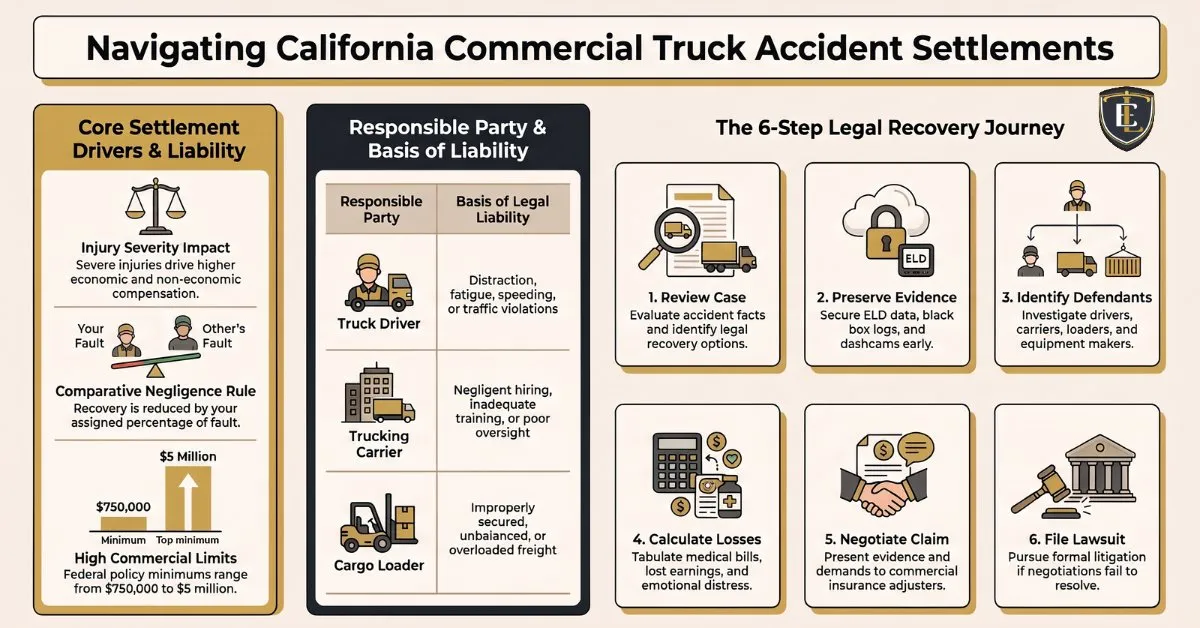
Step 1: Review the Accident and Assess Your Legal Options
Your attorney starts by looking at how the crash happened, what injuries you suffered, and the surrounding circumstances. Usually that involves checking police reports, looking at photographs, reading witness statements and early medical records to see if negligence was involved. This review also identifies possible legal claims and the parties who may be responsible.
Step 2: Preserve Important Evidence
Truck accident evidence can vanish if no one acts. An attorney can move to preserve electronic logging device records, maintenance reports, driver qualification files, event data recorder information, dashcam footage, and other documents. They may also bring in specialists who reconstruct accidents to find out exactly what happened in the collision.
Step 3: Identify All Potentially Responsible Parties
Many truck accidents involve more than one liable party. Depending on the facts, responsibility may reach the driver, the trucking company, a cargo loading company, the truck manufacturer, or a maintenance provider. Your attorney investigates each case and checks whether multiple insurance policies or other sources of compensation apply.
Step 4: Calculate Your Potential Compensation
Next comes a full accounting of all financial and personal losses. Your attorney reviews medical bills, rehab costs, lost wages, future medical needs, and reduced earning capacity to estimate economic damages. They also consider non-economic damages like pain and suffering and emotional distress along with permanent disability too. This step is especially important because if you suffer a very serious injury that means you will need lifelong care or makes working impossible.
Step 5: Handle Insurance Companies and Settlement Negotiations
With the evidence and damages documented, your attorney deals with the insurance companies and presents your claim. Handling that includes interacting with adjusters, disputing unfair fault evaluations, reviewing offers and negotiating too. Having a lawyer helps if an insurance company disputes how bad your injuries were or tries to reduce the value of your claim.
Step 6: Consider Litigation If Settlement Negotiations Fail
If the insurer won't offer reasonable compensation or denies responsibility, your attorney may recommend filing a lawsuit. That involves preparing court filings, presenting evidence, securing expert testimony, and representing you in court. Many truck accident claims settle, but litigation becomes necessary when the two sides can't agree.
Bringing in a lawyer early protects evidence, surfaces every liable party, and gives your claim a full evaluation. That matters most after a brain or spinal injury, a permanent disability, or another severe injury.
Need Legal Help After a Truck Accident in California?
Getting back on your feet after a big truck accident is very tough. It's especially hard if you have major injuries, high medical bills piling up, loss of income, and an unsure future ahead. Go see a doctor first and follow their instructions. Keep all medical records, keep the police report, keep any photographs, and keep every letter or email from your insurance company too. And keep an eye on the legal deadlines, because waiting too long can cost you the right to pursue compensation.
Before you accept any settlement offer, make sure you understand the full extent of your injuries and losses. An initial offer may not be enough to pay for future medical bills, rehabilitation, loss of earning potential, or the long-term effects of a permanent disability. An experienced truck accident lawyer can review your situation, identify everyone who may be responsible, and help you decide whether an offer is fair.
For 30 years, Etehad Law has helped people grasp their legal choices after major accidents. Whether you were injured in a commercial truck collision or lost a loved one in one, our team can explain your rights and the compensation that may be available. Contact Etehad Law today to schedule a consultation about your truck accident case.
Frequently Asked Questions About Truck Accident Settlement Amounts
Below are answers to common questions about settlement values, compensation, insurance coverage, and your legal rights in California.
What Is the Average Truck Accident Settlement in California?
California has no official statewide average for truck accident settlements. Compensation depends on injury severity, fault, financial losses, and available insurance, so each claim has to be evaluated on its own facts rather than against published estimates.
What Is the Highest Truck Accident Settlement Amount?
There's no fixed maximum. Some cases involving catastrophic injuries or wrongful death result in large recoveries. In any case what is recoverable depends on evidence that exists, the applicable laws, who is responsible, and also whether there is insurance coverage.
How Much Is a Truck Accident Claim Worth With Serious Injuries?
A claim involving serious injuries may be worth more because they include big medical bills, future treatments needed, loss of earning ability, permanent disabilities, and also compensation for pain and suffering that accrues over time. The final amount will depend on your specific situation, the strength of evidence you have and what is covered.
How Long Does a Truck Accident Settlement Take?
Settlement for a truck accident can take several months or longer depending on the severity of injuries involved, the complexity of the investigation, and if insurance companies dispute fault. Cases with catastrophic injuries, multiple defendants, or a lawsuit usually take longer.
Can I Receive Compensation If I Was Partly Responsible for a Truck Accident?
Yes. California has a system of pure comparative negligence which means that even if you share some blame for an accident, you can still recover compensation. Your compensation is reduced by your percentage of fault.
Who Pays for Damages After a Commercial Truck Accident?
Based on the facts, payments may come from the truck driver's insurance, commercial coverage of the company that owns the truck, or from other liable parties. If several parties contributed to the crash, more than one may have to pay.
Are Truck Accident Settlements Taxable in California?
Generally speaking, compensation for physical injuries or sickness is not subject to federal income tax. Some parts of a settlement, such as punitive damages and interest, may be taxable. Tax treatment depends on what the payment covers, so talk with a qualified tax professional about your settlement.
Should I Accept the Trucking Company's First Settlement Offer?
Carefully look at the first offer before accepting it. It may not account for future medical expenses, loss of earning potential, or the long-term effects of your injuries. Talk with a truck accident lawyer about the full value of your losses before you sign any settlement agreement or release.
Legal Disclaimer: This article is for general informational purposes only and does not constitute legal advice. Reading this doesn't create any attorney-client relationship with Etehad Law. Every truck accident case is different, and prior results do not guarantee a similar outcome. Talk to a qualified California lawyer about your specific situation, legal rights and any deadlines that apply.
You may also like
 Personal Injury
What to Do After a Motorcycle Accident in California
Learn what to do after a motorcycle accident in California, from seeking medical care and gathering evidence to protecting your legal rights.
Read More » Personal Injury
How Much Is My Personal Injury Case Worth?
How much is my personal injury case worth? Discover how to accurately assess the value of your personal injury case.
Read More » Personal Injury
Average Brain Injury Settlement in California
Discover key factors that influence brain injury settlements in California and learn what to expect in your case. Read more for essential…
Read More »
