

If you're wondering what to do after a motorcycle accident in California, start by calling 911 if anyone is hurt, getting out of traffic if you can do so safely, and getting medical care right away. Exchange insurance information with the other driver, take photos of the scene and collect contact information from witnesses. Report the crash to the police and your insurance company promptly, even if your injuries seem minor at first.
Motorcycle crashes rarely end at the roadside. Riders often face serious injuries, medical bills, and weeks or months away from work. Etehad Law has represented injured Californians from its Beverly Hills office since Simon P. Etehad joined State Bar in 1996 and has recovered more than $100 million through settlements and verdicts for clients who have suffered personal injuries. Our motorcycle accident lawyers handle these cases on contingency, so you pay no attorney fees unless we recover compensation for you. Contact us now!
This guide covers the steps to take after a crash, the evidence worth collecting, California's reporting rules, insurance claims, compensation, and filing deadlines.
What Should You Do Immediately After a Motorcycle Accident in California?

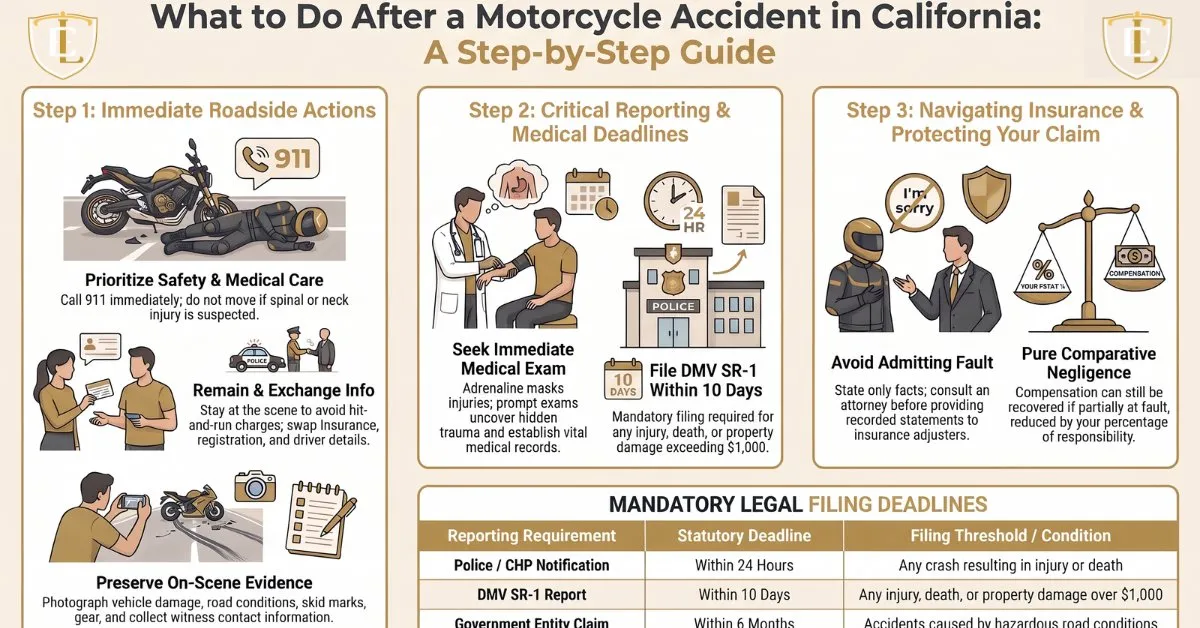
Safety comes first. Call 911 if anyone is injured, then get medical attention as soon as possible. What you do in the first hour protects your health and preserves evidence for a possible claim. TheCalifornia Highway Patrol (CHP) tells drivers in a crash to attend to medical needs first, move vehicles out of traffic when no one is hurt, notify law enforcement, and exchange information.
1. Call 911 and Check for Injuries
Call 911 immediately if someone is badly hurt, unconscious, or bleeding a lot. Being able to stand up after a crash doesn't mean you're unhurt. Adrenaline makes pain disappear and certain injuries like traumatic brain injuries and internal bleeding don't show clear signs at first. Let paramedics check you.
2. Move to Safety Without Worsening an Injury
If you can move and don't suspect a serious injury, get out of active traffic so another vehicle doesn't hit you. If you think you may have a spinal injury or broken bones, stay still and wait for emergency responders unless staying put puts you in immediate danger.MedlinePlus, the National Library of Medicine's health site, says a person with a possible spinal cord injury should not be moved unless there is urgent danger. For the same reason, leave your helmet on if you might have a head, neck, or spine injury. Paramedics train specifically to remove it safely.
3. Remain at the Accident Scene
Under California law, drivers who get into an accident need to stop and stay at the scene. Leaving early can lead to hit-and-run charges. If there's any injury or death resulting from an accident, the crash must be reported to authorities within 24 hours. That means the CHP on highways and freeways, or the local police department on city streets. Provide accurate information to officers and share details of your license, registration and insurance with other people involved.
4. Avoid Admitting Fault or Speculating About the Crash
Don't admit fault where you are and don't speculate on what caused the accident. Right after a collision, you probably don't have the full picture, especially if an unsafe lane change, a distracted driver, or a road hazard played a part. Tell officers only what you know first hand. The CHP recommends that drivers do not take responsibility or assign blame because there are people at insurance companies who are trained to figure out fault. Write your own account and consult with a lawyer before giving a detailed statement to any insurer.
Fault at the scene and fault in a claim are not the same thing. In one case involving an Etehad Law motorcycle, the police report assigned blame to our client and the other party contested that liability. Evidence told a different story and the case settled for $1 million.
Why Should You Seek Medical Attention After a Motorcycle Accident?
See a doctor after any motorcycle crash, even one that feels minor. Riders get thrown onto the pavement, hit by other vehicles directly, or slide across the road at speed. Those impacts result in brain injury, internal bleeding as well as soft tissue damage according to spinal cord injuries and broken bones. A prompt exam can catch problems you can't feel yet, and it creates a medical record of the harm the crash caused.
Many injuries don't hurt right away. The shock of a collision makes pain hard to notice, and internal injuries can stay hidden until they get worse. According to theCenters for Disease Control and Prevention (CDC), concussion symptoms can appear immediately or take hours or days to develop. Watch for headaches, dizziness, confusion, nausea, abdominal pain, numbness, weakness, or swelling that keeps growing. A worsening headache, repeated vomiting, seizures, unusual behavior, or trouble waking up after a head injury means you need emergency care now. If you hit your head or think you could be bleeding internally, don't wait for symptoms to get bad.
Prompt care allows doctors to order right tests and set a treatment plan. Take their advice, attend follow up appointments and keep copies of medical records, prescriptions, test results and bills. If you file a claim, these records tie your injuries to the crash and show what your treatment cost, including hospital bills, rehabilitation, lost wages, and future care.
Insurance companies pay close attention to when you received treatment and whether medical records match up. There can be room for an adjuster to question that your injury came from something else if there is a gap in your medical care. A delay doesn't automatically end your claim, but it makes the claim harder to prove.
The first exam isn't always going to catch everything. Some conditions develop slowly or need more testing. Let your doctor know about any new symptoms or ones that have gotten worse. The CDC recommends that anyone who suspects they have a concussion should be checked out and to contact their healthcare provider if symptoms continue or worsen. Ongoing treatment helps you recover, and it builds a record of your condition if complications come up later.
What Evidence Should You Gather at the Motorcycle Accident Scene?
Evidence has shown both what caused the accident and who was involved. If you're physically able and it's safe, document the scene before vehicles are moved or debris is cleared. This table lists things to gather and why collecting each thing is important for making a claim about an accident involving a motorcycle.
| Type of Evidence | What to Collect | Why It Matters |
|---|---|---|
| Photographs and videos | All vehicles involved, damage to your motorcycle, road conditions, traffic signals, skid marks, debris, and visible injuries. Capture the surrounding area and where each vehicle ended up, if it's safe. | Photos show how the collision happened, how much damage it caused, and whether an unsafe lane change or a road hazard was involved. |
| Driver and vehicle information | The other driver's name, contact details, driver's license number, registration, license plate, and insurance information. Get the same from any other drivers involved. | This identifies the responsible parties and the insurance companies your claim will be sent to. |
| Witness information | Names, phone numbers, and email addresses. If they're willing, ask what they saw, without pushing them. | Independent witnesses can settle disputes about speeding, distraction, signals, and who had the right of way. |
| Police report details | The names and badge numbers of the responding officers, the agency, and any report or incident number. Ask how to obtain a copy of the collision report. | The report documents the parties, witness statements, and the officer's observations. It supports your claim but doesn't decide legal fault. |
| Surveillance and dashcam footage | Nearby businesses, homes, traffic cameras, and vehicles that may have recorded the crash. Note their locations and contact the owners quickly. | Video can show the moments before and during the crash. Many systems record over footage within days, so act fast. |
| Damaged motorcycle and riding gear | Keep the motorcycle, helmet, jacket, gloves, and other damaged gear. Photograph everything before repairs or disposal, and keep repair estimates and receipts. | Physical damage indicates the impact force. A cracked helmet or torn gear can also help document injuries. |
| Medical records | Emergency room records, test results, treatment notes, prescriptions, bills, and photos of injuries as they heal. | These show what your injuries are, how serious they are, and what treatment has cost. |
| Personal notes and financial records | Your own account of the crash, written as soon as you can: time, location, weather, road conditions, and the sequence of events. Maintain receipts, pay stubs, and records of missed work. | Memory fades, and notes made early hold up better. Financial records prove lost wages, medical costs, and property damage. |
How Do You Report a Motorcycle Accident in California?
After a crash happens in California now you may be handling have three different reporting tasks: to local police, to your insurance company, and also to the California Department of Motor Vehicles (which is like DMV). Completing one does not satisfy the others. Under theDMV's SR-1 reporting rules, you generally must file an SR-1 report within 10 days if the crash caused any injury (however minor), a death, or more than $1,000 in property damage.
Contact the Appropriate Law Enforcement Agency
If anyone is hurt or in danger please call 911. In California, all crashes that result in injury or death need to be reported to police within 24 hours. It depends on whether the crash occurred near Contact the CHP or with the local police department. When officers arrive on the scene, cooperate with their investigation and ask how to obtain a copy of the accident report.
The police report notes down the details of people involved, witness accounts and also what officers observed. It doesn't substitute DMV documents or insurance reports either.California Driver Handbook elaborates on these requirements more closely.
Submit the DMV SR-1 Report Within 10 Days
A qualifying collision in California requires drivers to file a SR-1/Report of Traffic Accident Occurring with the DMV within 10 days of the accident. The rule applies when anyone is injured, even slightly, when someone dies, or when property damage exceeds $1,000. You have to file whether or not you caused the crash, with limited exceptions.
You can file through theDMV's online accident reporting service. Have your driver's license number, registration, insurance details, and the other parties' information ready.
The SR-1 is distinct from both your police report and your insurance claim. Even if police investigated and your insurer already knows, you still have to file it when the crash meets the criteria. The DMV can suspend your driving privilege if you don't.
Notify Your Insurance Company
Report this crash to your insurance company as quickly as possible and follow notice procedures in your policy. Tell them exactly when and where this happened, who was involved, what was damaged, and also any injuries that you know of. Make sure you keep duplicates of everything: letters and emails, police reports, photographs, and medical records.
If another car was involved in the accident you can file a claim with that driver's insurance as well. Before you give that insurer a recorded statement or accept a settlement, get legal advice, especially if you're seriously hurt or don't yet know the full cost of your treatment and lost income.
How Should You Deal With Insurance Companies After a Motorcycle Accident?
Insurance can cover medical bills, lost wages, and repairs, but the insurer will investigate before deciding whether to pay and how much. A few precautions early on protect your claim and keep you from accepting an offer before you know what your losses are. Our guide for dealing with an insurance adjuster goes into more details.
Start with your own policy. Make sure to check reporting requirements, coverage limits and deadlines for submitting documents. Give your insurance company accurate information about what happened in the accident and keep copies of anything that you send them. Failing to meet notice requirements can cause problems with your claim even if the other party driving is clearly responsible.
Mind if the other driver's insurance company wants you to give a recorded statement. Answer truthfully, but you don't have to guess about what caused the crash or about injuries that haven't been diagnosed yet. Ask them what they need and consult a lawyer before agreeing to recording interviews, signing something, or giving broad access to their medical records. Something you say before you fully understand the crash or your injuries can be used against you later.
Adjusters look at police reports, witness statements, photographs of damage to vehicles, and medical records. They also look at your treatment costs, missed work, and any evidence that you'll need future care. If questions or disputes come up, theCalifornia Department of Insurance has consumer information on policies, claims, and complaints.
Think carefully before you accept a settlement or sign a release. Some injuries need months of rehabilitation, specialist care, or future surgery, and an early offer may not cover those costs. After you sign a release, generally you can't ask for higher compensation for the same claim. We've seen how low first offers can be. A rider got run off the 101 near Calabasas because the driver switched lanes without checking first. He tried handling the claim himself and the insurance company offered him $2,000. After he hired Etehad Law, we secured the full policy limits within a few months, many times the original offer. If your injuries are serious, fault is disputed, or you aren't sure about an offer, have a lawyer review it first.
Who Can Be Held Responsible for a Motorcycle Accident in California?
Liability depends on how the accident happened and whether anyone was at fault based on evidence. Often it's another driver, but not always, and not only. Finding every responsible party matters, because each one may be a source of compensation for your medical costs, lost income, and other losses.
A driver may be liable if they were texting or otherwise distracted, speeding, changing lanes without looking, failing to yield, or running a light. A driver who merges without checking for a motorcycle in the next lane is a common example. Since lane splitting is legal in California, being between lanes does not mean that someone riding there is automatically at fault. The behavior of both rider and other drivers will still be looked into.
Responsibility can be shared by other parties depending on the facts. An employer may be liable if the driver was on the job when the crash happened. A manufacturer may face a product liability claim if a defective part on either vehicle contributed. A government agency may be responsible for a dangerous road condition, if the legal requirements for a claim against a public entity are met. Each of these claims has its own legal standards, so responsibility comes down to the specific facts.
California follows pure comparative negligence rule. You can recover compensation even if you were partly at fault, but your award is reduced by your share of the blame. If your damages total $100,000 and you were found to be 20% at fault, you would likely recover $80,000. You still have to prove the other party's fault and your losses.
Together the police report, witness accounts, photos, videos showing vehicle damage and medical reports show what transpired. A lawyer can investigate, weigh conflicting accounts, and explain how California law applies to your case.
What Compensation Can You Recover After a Motorcycle Accident?

If someone else is legally responsible for your crash, you may be able to recover money for medical expenses, lost wages, property damage, and other losses. The outcome depends largely on what exactly happened during the collision, how seriously you got hurt, what evidence there is and what kind of insurance is available. California law recognizes different kinds of damages.
Economic damages cover losses with a dollar amount: the ambulance, emergency care, hospital stays, surgery, medication, physical therapy, and rehabilitation. If you can't work, you can claim lost wages and, with enough evidence, reduced future earning capacity. If there is evidence that you will need more treatment in the future, future medical expenses should be taken into account. Keep your medical records, receipts and pay stubs to show that you have suffered these losses.
Non-economic damages cover harm without a price tag, such as physical pain, emotional distress, anxiety, and loss of enjoyment of life. A rider with a spinal cord injury or brain injury may live with permanent limits on their independence, relationships, and daily routine. Both medical evidence and your personal account of how this injury has changed your life back up this part of your claim.
Property damage covers the reasonable cost to repair your motorcycle, or its value if it's a total loss, along with damaged gear and other out-of-pocket costs from the crash. In rare cases involving especially reckless or intentional conduct, a court may award punitive damages to punish the defendant. California has very high standards and most motorcycle cases do not involve that level of complexity.
Your recovery depends on liability, the evidence of your losses, California law, and the insurance available. If you were partly at fault, your award goes down by your percentage but doesn't disappear. To get an idea of how claims are valued, check outhow much a personal injury case is worth.
How Long Do You Have to File a Motorcycle Accident Lawsuit in California?
In California, generally you have two years from the time of an accident involving a motorcycle to file a lawsuit for personal injuries. This deadline is the statute of limitations. Miss it, and you can lose the right to sue. Some exceptions exist, but don't assume one applies to you without confirming it.
The deadline for dealing with damage to property is different. Typically you have three years from when damage happened to take legal action for your motorcycle or other possessions. If the crash caused both injuries and property damage, the two claims run on separate clocks.
Claims against government agencies proceed much quicker. If a city, county, or state agency's negligence contributed to your crash, for example through a poorly maintained road, you generally must file an administrative claim within six months of the incident. New deadlines come after the agency responds. This process is separate from, and comes before, any lawsuit.
The California Courts explain these rules in their guides to thestatute of limitations andgovernment claims. In your specific case the deadline depends on who is involved and when you discover that there is an injury.
Don't wait until you finish treatment before seeking legal advice. You may need time to understand your prognosis, but evidence gets harder to find with every week that passes. A lawyer can pinpoint your deadlines and make sure that nothing slips through the cracks.
When Should You Contact a Motorcycle Accident Lawyer?
Contact a lawyer as soon as you reasonably can, especially if you're seriously hurt, fault is disputed, or the insurer is pushing back on your claim. Motorcycle crashes often lead to large medical bills, lost income, and long-term physical limits. Getting in touch with a lawyer early helps you avoid some common errors as you concentrate on recovery.
Getting legal help is important when dealing with serious injuries that need long term care such as brain injuries, spinal cord injuries or multiple broken bones. An attorney can investigate the crash, gather evidence, identify everyone responsible, collect records, and put a value on both the financial and personal impact of your injuries, from current bills and future treatment to lost wages and pain and suffering.
A lawyer works with your insurance company too. If the insurer disputes fault, questions your treatment, or offers less than your losses, your attorney can push back or, if needed, file a lawsuit. And before you sign any release, you'll know exactly what it covers.
Need Legal Help After a Motorcycle Accident in California?
It's hard enough to recover after a crash on a motorcycle without having to battle with an insurance company too. Put your medical care first, hold on to your evidence, and keep records of your expenses and conversations. California has very strict reporting rules and deadlines; getting ahead of things helps protect your rights.
Even if you think you were partly to blame, you may still have a claim. California comparative negligence rules say that your share of fault reduces what you can recover in compensation, but they don't necessarily prevent you from recovering anything at all. An experienced motorcycle accident lawyer can look at your situation and tell you where you stand.
Contact Etehad Law for a free consultation about your motorcycle accident that happened in California. We will explain your rights and the next steps for your case, and you will not pay attorney fees unless we succeed in recovering compensation for you.
Frequently Asked Questions
Below are answers to common questions riders ask after a crash, covering reporting, fault, and settlements.
Should I Call the Police After a Motorcycle Accident in California?
Yes. Call 911 if anyone is injured, killed, or needs emergency help, and report the crash to the CHP or local police. Generally speaking in California, accidents resulting in injuries or fatalities need to be reported to the police within 24 hours and this report serves as documentation of what occurred.
What Happens If I Feel Fine After a Motorcycle Accident?
Get checked anyway. Adrenaline blocks out pain and concussions, internal bleeding and soft tissue injuries do not usually show symptoms immediately. Taking an early exam can uncover hidden injuries and it's good to keep that record if you may need for a claim later.
Do I Have to Report a Motorcycle Accident to the California DMV?
Generally speaking, if there was any resulting injury, death, or more than $1,000 worth of damage to property as a result of a crash, then something serious happened. You must file a SR-1 report within 10 days regardless of who is responsible for the crash. The SR-1 is separate from the police report and your insurance claim, and filing those doesn't satisfy the DMV requirement.
Can I Recover Compensation If I Was Partly at Fault for a Motorcycle Accident?
Yes. California follows a pure contributory negligence system which allows recovery even if you were partly at fault. The amount you get paid is reduced according to how much responsibility you have for what happened. So the evidence about what caused an accident is very important.
What Should I Do If the Other Driver Leaves the Scene?
Call 911 if you need medical help and write down details of the other vehicle: make, model, color and license plate if possible. Keep your photos and witness contacts, and notify your insurer quickly, since uninsured motorist coverage may pay for your losses.
How Long Does a Motorcycle Accident Settlement Take in California?
It depends a lot on how serious the injuries are, how long it takes to get a prognosis, how tricky the question about who is at fault ends up being, and whether the insurance company disputes the claim. Some claims settle within a few months. Serious or contested cases can take much longer, and a lawsuit adds time.
Legal Disclaimer: This article is for general informational purposes only and does not constitute legal advice or create an attorney-client relationship with Etehad Law. Every motorcycle accident case is different so you should speak to a qualified California attorney about the specifics of your situation, your legal rights, and deadlines that apply. Past results do not guarantee, warrant, or predict the outcome of future cases; results depend on the specific facts and law of each case. This article is for advertising legal services.
You may also like
 Personal Injury
How Much Is My Personal Injury Case Worth?
How much is my personal injury case worth? Discover how to accurately assess the value of your personal injury case.
Read More » Personal Injury
Average Brain Injury Settlement in California
Discover key factors that influence brain injury settlements in California and learn what to expect in your case. Read more for essential…
Read More » Expert Opinion
Top 5 Myths About Personal Injury Cases – Debunked
If you've been injured in an accident, you may have heard myths about personal injury cases that could prevent you from seeking…
Read More »
