


The average settlement for motorcycle accidents varies from case to case in California. What a rider receives depends on how badly they were hurt, their medical bills and lost income, who caused the crash, and how much insurance is available. A sprained wrist and a few weeks off work might settle for a modest amount. A traumatic brain injury, spinal cord damage, a permanent disability or a death in the family can be worth far more.
Etehad Law has been representing injured Californians for over 30 years. We know how insurers value motorcycle claims and where they try to cut corners. If you get hurt on your bike, call us for a free consultation.
This guide covers how settlements are calculated, what raises or lowers a claim's value, and the compensation riders can pursue. It also explains California's fault rules, helmet and lane-splitting laws, insurance coverage, and filing deadlines.
What Is the Average Motorcycle Accident Settlement in California?
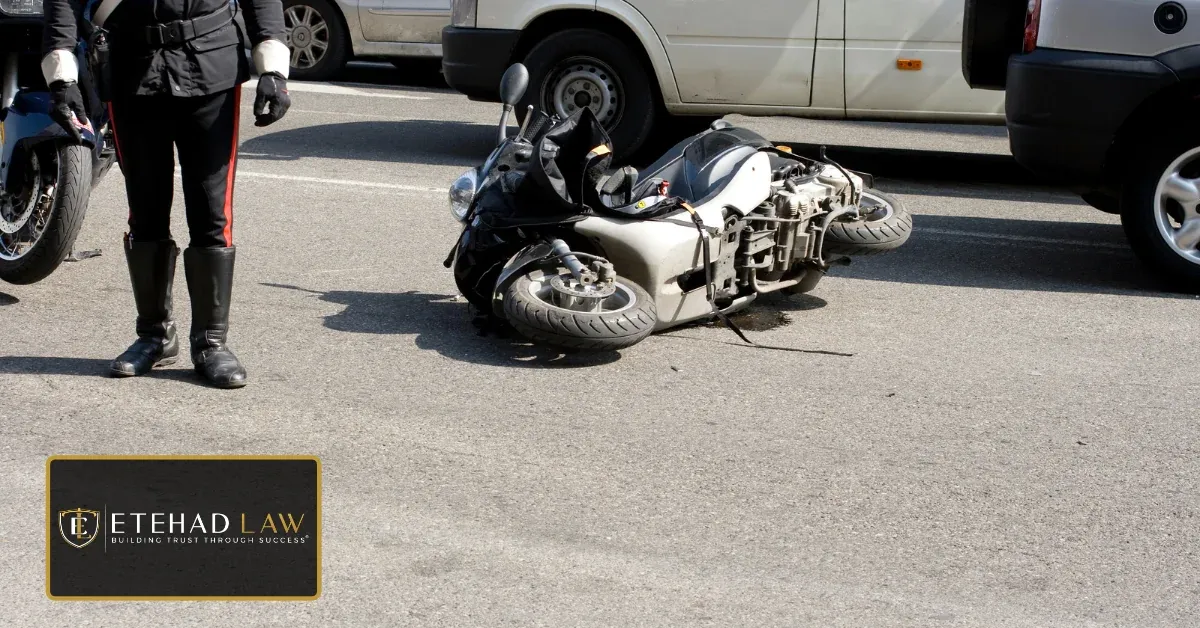
There is no official agency that keeps track of an average and any numbers you find online should be viewed carefully. Three kinds of figures often get mixed together:
- Insurance claim payouts(paid by an insurer without a lawsuit)
- Negotiated settlements (agreed before or during litigation)
- Jury verdicts (awarded after a trial)
These figures aren't interchangeable. A headline verdict in the millions says little about what most injured riders receive.
What the data shows is how risky riding can be. According to National Safety Council reports, 522 motorcyclists lost their lives on roads in California in 2024; this is one of the highest numbers nationally. Nationwide, NHTSA counted 6,228 motorcyclist deaths that year, about 16% of all traffic fatalities. Riders have little protection in a crash, so their injuries tend to be serious and their claims tend to be larger than those from typical car accidents.
What Factors Affect Motorcycle Accident Settlement Amounts?
Insurance companies and lawyers look at quite a few different things when valuing a claim. Severity of injury is most important. A rider who heals in a month has a very different claim from one who needs spinal fusion surgery or lives with a traumatic brain injury. Permanent disability, amputation and visible scarring all push the value higher because they affect the rest of the person's life.
Losses of money come next. This includes hospital bills as well as future treatments and lost wages during recovery time. If the rider can't go back to the same job, the claim also includes reduced earning capacity. The cost to repair or replacement cost is part of the claim.
There are also very real human costs: physical pain, worry, stress from trauma, sleep troubles and fear of riding a bike again. Medical records and those of therapists make it much harder for an insurance company to ignore these losses.
There are two practical limitations that determine the final number. First there's evidence. Police reports, photos, videos, and witness statements determine how strong a liability case is. The second is insurance too. A driver carrying only California's minimum policy may not have enough coverage to pay a serious claim in full, and the rider's own underinsured motorist coverage may need to fill the gap. If the rider shares some of the blame, the award is reduced by their share of fault (explained below).
What Types of Compensation Can You Recover After a Motorcycle Accident?
Damages related to a motorcycle case in California come in different types. Most claims involve more than one. A rider with a spinal cord injury, for example, might seek hospital costs, rehabilitation, lost income, future care, and compensation for pain and emotional distress all at once.
| Type of compensation | What it covers |
|---|---|
| Economic damages | Documented financial losses: emergency care, hospital bills, surgery, medication, physical therapy, lost wages, motorcycle repair or replacement, and out-of-pocket costs. |
| Non-economic damages | Losses without a price tag: pain, emotional distress, psychological trauma, scarring, disfigurement, and loss of enjoyment of life. |
| Future damages | Costs still to come: further surgery, ongoing rehab, assistive devices, long-term care, and reduced future earning capacity. |
| Wrongful death damages | Available to eligible family members after a fatal crash: funeral and burial costs, lost financial support, lost companionship, and lost household services. |
| Punitive damages | Rare. Under Civil Code Section 3294, they require clear and convincing evidence of malice, oppression, or fraud. A serious injury alone doesn't qualify. |
Who Is Responsible for a Motorcycle Accident in California?
To recover compensation, an injured rider generally has to show that someone else owed them a duty of care, failed to meet it, and caused their injuries. Most crashes involve another driver. A motorist who turns left across a rider's path, changes lanes without checking a blind spot, runs a light, tailgates, or looks at a phone can be held liable for the collision.
Other parties sometimes share the blame. A trucking company may be responsible for its driver's mistakes on the job, or for poor hiring, training or maintenance. Our guide to truck accident settlement amounts covers those claims in more detail. A manufacturer can face a product liability claim if a defective part contributed to the crash. A repair shop can be liable when faulty repairs result in a mechanical failure.
Road conditions also cause crashes. Potholes, missing signs, badly designed curves and unsafe construction zones are especially dangerous on two wheels. Under Government Code Section 835, a public entity can be liable for a dangerous condition of public property, but these claims have strict requirements and a much shorter deadline.
When several parties contribute, California assigns each one a percentage of fault, and each pays its share.
How Do Insurance Policies Affect Motorcycle Accident Settlements?
Insurance often sets the practical ceiling on a recovery, even when fault is obvious.
Since January 1, 2025, California drivers must carry at least $30,000 per person and $60,000 per accident for bodily injury, plus $15,000 for property damage. Those minimums apply to motorcyclists too, and they don't go far after a serious crash. If a rider has $100,000 in losses and the at-fault driver carries a $30,000 policy, the insurer will generally pay no more than $30,000. The rest has to come from elsewhere.
That's when the rider's own policy comes into play. Uninsured Motorist (UM) coverage kicks in if the other driver has no insurance. Underinsured motorist (UIM) coverage applies when their policy is too small. Medical payments coverage can help with medical bills regardless of fault, and collision coverage pays to repair or replace the bike after your deductible. California Department of Insurance details each type in their consumer guides.
One rule many riders don't know about is that under Civil Code Section 3333.4 (Proposition 213), a rider who was uninsured at the time of the crash generally can't recover non-economic damages such as pain and suffering, even if the other driver was entirely at fault. Keeping your coverage up to date helps protect that part of your claim.
Some crashes happen with multiple policies at the same time. Collision with a big rig might trigger coverage for both the driver and also their trucking company as well as UIM benefits for the passenger. Finding every policy, and reading its limits and exclusions, is one of the first things a lawyer does on a motorcycle case.
How Is a Motorcycle Accident Settlement Calculated?
No formula applies to every claim. Attorneys and insurers generally work through the same steps:
- Add up economic losses: Medical bills, lost wages, repair costs and other expenses, each backed by bills, receipts, or pay records.
- Value the non-economic harm: Pain, distress, scarring and lost quality of life. More severe and longer-lasting injuries carry more weight.
- Project future costs: Further surgery, long-term care, and lost earning capacity, usually supported by doctors, vocational experts, and economists.
- Weigh the evidence: Police reports, medical records, photos from the scene, witness accounts, and reconstructions of accidents all factor into what a jury might decide to award, and insurance companies price that risk into their offers accordingly.
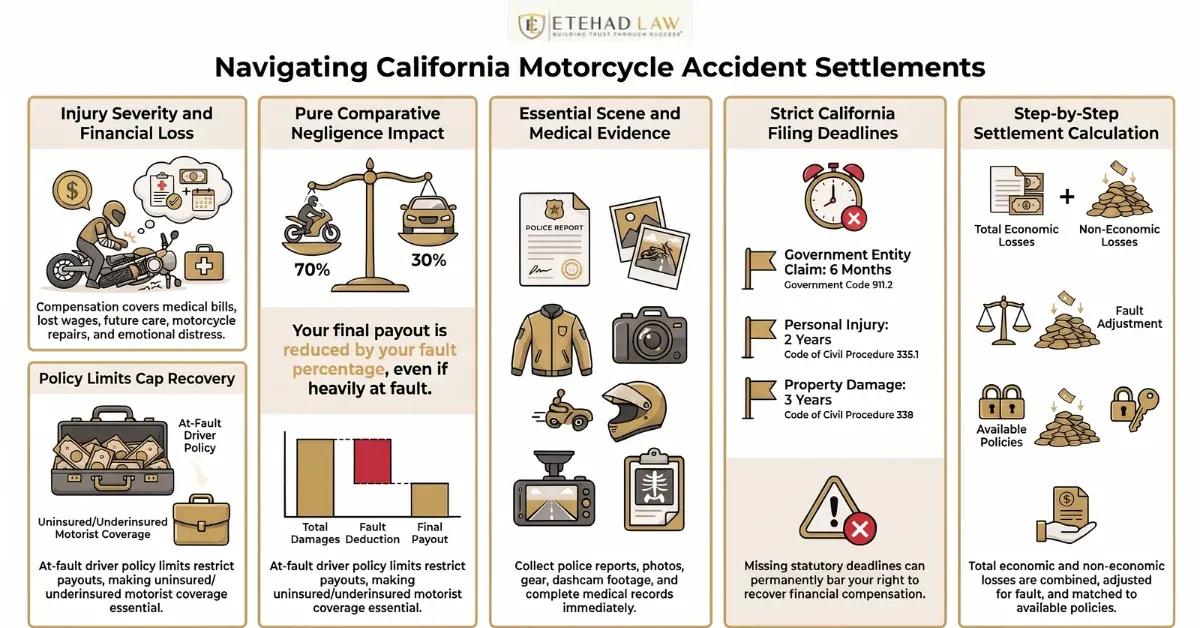
- Adjust for error and coverage: Reduce the total by any share of fault assigned to the rider, then compare the result with the insurance available.
Here is a simplified example. A rider breaks a leg, needs surgery, and misses three months of work:
| Type of damage | Illustrative amount |
|---|---|
| Medical bills and treatment | $45,000 |
| Lost wages | $15,000 |
| Future medical expenses | $20,000 |
| Motorcycle repair or replacement | $10,000 |
| Pain, suffering, and emotional distress | $110,000 |
| Estimated total damages | $200,000 |
If the rider is found responsible for 20 percent of the accident, then the $200,000 cap reduces to $160,000. If the other driver has only $30,000 worth of insurance, then rider's UIM coverage and other sources will be very important indeed. These figures are hypothetical. They don't represent an average settlement or predict any outcome.
How Does California's Comparative Negligence Law Affect Motorcycle Accident Settlements?
California follows pure comparative negligence. You can recover compensation even if you were partly at fault, and even if you were mostly at fault. Your award is reduced by your share. A rider who is found to be 20 percent at fault keeps 80 percent of their damages. Even though a rider identified as responsible for 70%, they still keep 30%.
Insurers know that too and they try to pass the blame on to riders. There are common reasons why people argue that the rider was speeding, tailgating too close, or riding dangerously in lanes. Lane splitting is legal in California and is defined in Vehicle Code Section 21658.1, so doing it isn't negligence on its own. How fast and how carefully you did it can still come up.
Helmet works the same way. Vehicle Code Section 27803 requires both riders and passengers to wear helmets that meet standards. Riding without one doesn't make you responsible for the crash. If there is a proof that a helmet would have prevented or reduced damage from a head injury, defendants can reduce the severity of resulting damages.
How Long Does It Take to Settle a Motorcycle Accident Claim in California?
A claim with minor injuries where there is clear who is at fault and low medical bills might settle in a few months. Catastrophic injuries, disputed liability, or several defendants can stretch a case past a year, especially if it goes to litigation.
Recovery sets the tempo in medical matters. Settling before you reach maximum medical improvement means guessing at future costs, and once you sign a release you can't reopen the claim. If talks stall, filing a lawsuit brings discovery, depositions, expert testimony, and often mediation before any trial date.
What Evidence Can Help Maximize Your Motorcycle Accident Settlement?
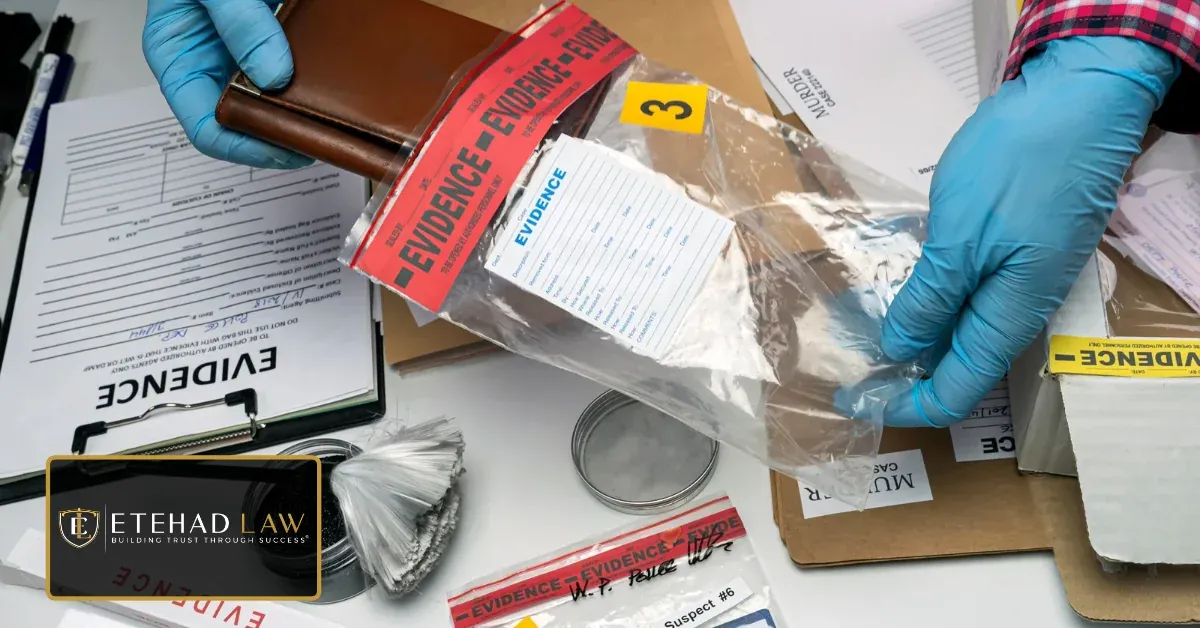
The strongest claims are built from records collected early, before they disappear. Useful evidence includes:
- Police and accident reports
- Photos and video of the scene, vehicles, road conditions, and your injuries
- Dashcam, traffic camera, and nearby surveillance footage (often deleted within days)
- Witness names and statements
- Medical records and bills
- Repair estimates for your motorcycle
- Your helmet and riding gear, kept unrepaired and unwashed
- Pay stubs and employer letters showing lost income
- Accident reconstruction reports
- Every insurance policy that might apply
How Long Do You Have to File a Motorcycle Accident Lawsuit in California?
| Type of claim | General deadline | Law |
|---|---|---|
| Personal injury | 2 years from the injury | Code of Civil Procedure 335.1 |
| Property damage (your motorcycle) | 3 years | Code of Civil Procedure 338 |
| Claim against a government entity | 6 months to file an administrative claim | Government Code 911.2 |
There are exceptions for minors and also in cases of delayed discovery. Missing a deadline can end your claim entirely, so talk to a lawyer early, especially if a road defect may have played a part.
When Should You Hire a Motorcycle Accident Lawyer?
Call a lawyer as soon as you can if you were seriously hurt, if fault is disputed, or if the insurer's first offer seems low. Initial offers typically come before you fully understand the full cost of your injuries.
A lawyer can collect footage before it's erased, interview witnesses, bring in reconstruction experts, and find every party and policy that might pay. They can also assign realistic values to future medical care and lost wages. They will stand up to insurance companies when they blame them and if negotiations fail they will sue in court too.
Need Legal Help After a Motorcycle Accident in California?
Get medical care first, even if you feel fine. Some injuries take days to show up. Keep every records, bills and reports and don't accept a settlement until you fully understand the costs of your injuries over time.
For more than 30 years Etehad Law has worked on behalf of injured Californians and their families. If you've been involved in an accident that hurts you or if you lose someone in one, we can handle your case through our Beverly Hills motorcycle accident attorneys. We'll explain your options and deal directly with insurance companies for you too. Contact Etehad Law today for a free consultation.
Frequently Asked Questions About Motorcycle Accident Settlements
Below are the most frequent questions we get concerning settlement for motorcycle accidents.
What Is the Average Motorcycle Accident Settlement in California?
There is no official statewide average. Each claim depends on the injuries, financial losses, evidence of fault, and the insurance available.
How Much Compensation Can I Get for a Motorcycle Accident?
You may recover medical bills, lost pay, future care needs, damage to your motorcycle and also compensation for pain and suffering. Total costs depend on injuries suffered, losses incurred, who is responsible, and policy limits.
What Is the Highest Motorcycle Accident Settlement?
In motorcycle injury cases in California there is no limit on damages. Major injuries and wrongful death claims can be very large sums of money, but there is no guarantee that you will get results and insurance limits usually limit what you can actually collect as well.
Can I Get Compensation If I Was Partly at Fault?
Yes. Under California's pure comparative negligence rule, your award is reduced by your percentage of fault, but you can still recover.
Does Not Wearing a Helmet Affect My Motorcycle Accident Settlement?
It can. It won't bar your claim, but if the evidence shows a helmet would have prevented or reduced a head injury, damages for that injury may be reduced.
Does Lane Splitting Affect Motorcycle Accident Claims in California?
Because lane splitting is legal in California, that doesn't mean you're automatically at fault if something goes wrong. Your speed and riding behavior while splitting can still be considered.
How Long Does a Motorcycle Accident Settlement Take?
Simple claims may settle in a few months. Serious injuries, disputed fault, or a lawsuit can push the timeline past a year.
What Happens If the At-Fault Driver Does Not Have Insurance?
Your uninsured motorist coverage may kick in depending on your policy. You can sue the driver directly but collecting from someone who has little money usually turns out to be quite hard.
Can I Sue If a Road Defect Caused My Motorcycle Accident?
Possibly. A public entity can be liable for a dangerous road condition, but you generally must file a government claim within six months of the injury.
Legal Disclaimer: This article provides information for informational purposes only and does not serve as legal advice. Reading this content does not create any attorney-client relationship with Etehad Law. It's important to consult with an attorney who is qualified for the specifics of your case.
You may also like
 Personal Injury
Dog Bite Settlement Amounts
Average dog bite settlement amounts in California, and how medical bills, lost wages, injury severity and liability affect what a claim is…
Read More » Truck Accidents
Truck Accident Settlement Amounts
Learn how truck accident settlement amounts are calculated, what affects compensation, and factors that influence your claim in California.
Read More » Personal Injury
What to Do After a Motorcycle Accident in California
Learn what to do after a motorcycle accident in California, from seeking medical care and gathering evidence to protecting your legal rights.
Read More »
