


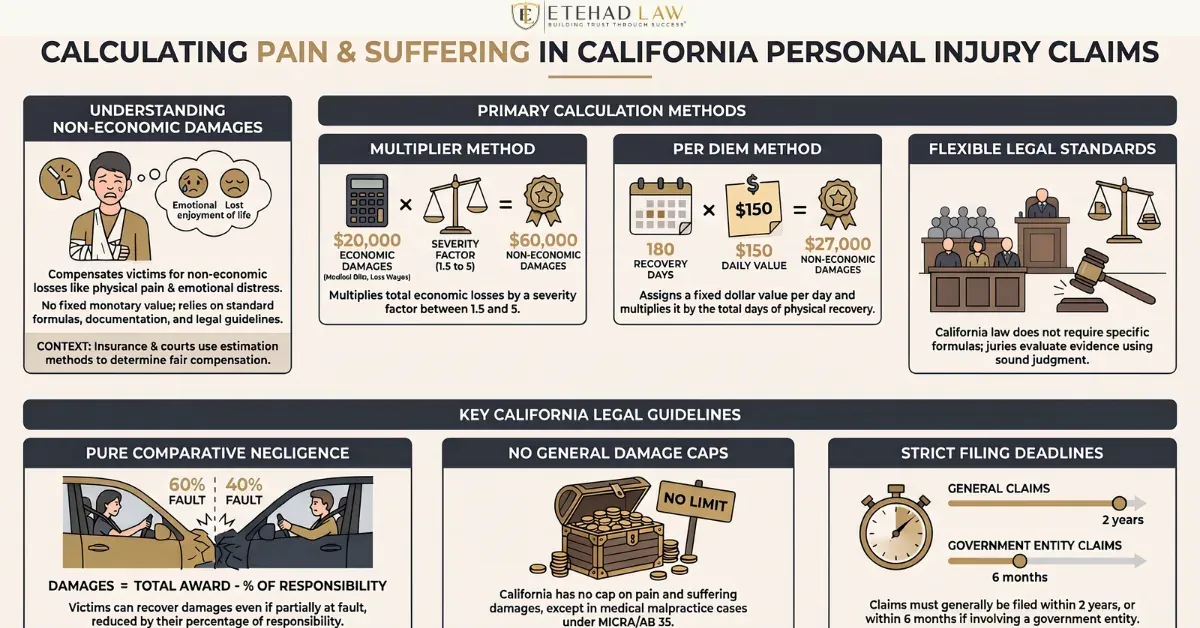
How is pain and suffering calculated in California? Pain and suffering damages compensate injured people for non-economic losses such as physical pain, emotional distress, and loss of enjoyment of life after an accident caused by someone else's negligence. Unlike economic damages, which cover measurable losses such as medical bills and lost wages, non-economic damages do not have a fixed monetary value. Instead, compensation depends on the severity of the injury, its impact on daily life, recovery time, and the available evidence.
At Etehad Law, we bring over 30 years of experience in personal injury law, helping accident victims understand their legal options and pursue fair compensation. Our team can help you assess your losses and handle your claim from start to finish. If you were hurt in an accident, schedule a free consultation to talk through your case.
This guide explains how pain and suffering damages are calculated, the multiplier and per diem methods, factors that influence compensation, and how to prove your claim under California law.
What Is Pain and Suffering in a California Personal Injury Claim?

Pain and suffering refers to the physical and emotional harm a person experiences after an injury caused by someone else's negligence. Under California law, these losses are classified as non-economic damages because they do not have a direct or easily measurable monetary value. The Judicial Council of California's Civil Jury Instruction 3905A recognizes physical pain, mental suffering, anxiety, disfigurement, physical impairment, and loss of enjoyment of life as examples of compensable non-economic damages.
Physical pain may include neck pain, chronic pain, headaches, broken bones, and ongoing discomfort that requires medical treatment or physical therapy. Emotional suffering can involve anxiety, depression, fear, trauma, embarrassment, and difficulty returning to everyday activities. A serious injury may also cause permanent scarring, disfigurement, or limitations that affect a person's relationships, independence, and quality of life.
Pain and suffering differs from economic damages, which cover measurable financial losses such as medical bills, lost wages, and out-of-pocket expenses. For example, hospital bills and missed income can be calculated using receipts and employment records, while the emotional toll of an injury requires a more subjective assessment. The CDC reported that 24.3% of US adults experienced chronic pain in 2023, while 8.5% had high-impact chronic pain that frequently limited life or work activities. These figures illustrate how persistent pain can affect daily functioning, although they are not specific to accident victims.
How Is Pain and Suffering Calculated in California?
California does not have a standard way to calculate damages for pain and suffering; rather, compensation varies according to nature of injury, the physical and emotional impacts, and the evidence supporting the injured person's losses. Attorneys and insurers often use methods like using a multiplier and per diems to estimate settlements when negotiating. Neither of these methods is required by law in California.
At trial, juries base their assessment on medical records, history of treatment, duration of physical pain, distress related to the incident, and how it impacts daily life. According to Civil Jury Instruction 3905A, jurors must use sound judgment and common sense to decide on a fair amount of compensation based on the evidence. Future pain and any resulting limitations also need to be shown as being reasonably certain to happen.
The two commonly discussed estimation methods are:
- The multiplier method involves multiplying a person's total economic losses by a certain factor to come up with an estimate for compensation for pain and suffering. Selection of that factor generally depends on the seriousness and impact of the injuries sustained, but there is no specific multiplier that California law requires.
- Using the per diem method: You estimate a daily amount for pain and suffering that you then multiply by the number of days that pain and suffering last. It is an estimate rather than something legally required or set in stone.
Both methods can help illustrate a settlement demand, but neither guarantees a particular award.
Multiplier Method for Calculating Pain and Suffering
One way to estimate damages for pain and suffering is to multiply total economic damages by a factor usually between 1.5 and 5. Economic damage includes things like medical bills, loss of income, and rehabilitation costs that can be measured. Generally speaking, this factor also represents the severity of the injury and its effect on the person’s life.
Suppose you have total medical and wage losses of $20,000 and a multiplier of 3 is used; then your estimated pain and suffering damages would amount to $60,000. So in this case, your illustrative total compensation would be $80,000 and we exclude other recoverable losses here.
There are several factors that might affect this multiplier such as how serious the injury is, the length of recovery time, ongoing medical care needed, chronic pain, permanent disability, and emotional distress. Someone who has recovered from minor injuries may get a lower multiplier compared to someone with broken bones or noticeable scarring and long lasting physical limitations.
In California though there is no law that says a particular multiplier must be used, and nothing guarantees a specific award. Both insurance companies and lawyers may use this method during settlement discussions but the real value of claims depends on evidence and circumstances related to the accident.
Per Diem Method for Calculating Pain and Suffering
The per diem method approximates compensation for pain and suffering by assigning a dollar amount per day for discomfort and emotional distress suffered by someone who has been hurt. Then this daily amount is multiplied by the number of days during which they experience symptoms of their injury.
Let's say a daily value of $150 is assigned to your pain and suffering throughout a 180 day recovery period: your estimated non-economic damages would be $27,000. This is just an example showing how much might be awarded rather than something that's certain or set by California law.
This method helps in cases where recovery time is clearly defined such as broken bones or requiring long periods of physical therapy but applying this to people with ongoing pain or permanent disabilities or lifelong limitations isn't easy, because there may be no definite end point for calculating how many days they suffer. Anyway, proof of what you claim must still back up the amount claimed.
What Factors Affect Pain and Suffering Compensation in California?

When you look at compensation for pain and suffering in California, it varies based on different factors. Every case gets looked at individually and careful consideration is given as to how the injury affects physical health as well as mental wellbeing and daily life.
| Factor | How it affects compensation |
|---|---|
| Severity and nature of the injury | More serious injuries, such as spinal cord damage, broken bones, or traumatic brain injuries, may justify higher compensation than minor injuries. |
| Duration of physical pain and recovery | Longer recovery periods, ongoing discomfort, chronic pain, and repeated medical treatment can increase the value of a claim. |
| Emotional distress and psychological effects | Anxiety, depression, trauma, and emotional suffering resulting from an accident may contribute to non-economic damages. |
| Permanent disability, scarring, or disfigurement | Lasting physical limitations, visible scars, and permanent changes to appearance can significantly affect compensation. |
| Impact on daily activities and quality of life | Difficulty working, exercising, maintaining relationships, performing household tasks, or enjoying previous activities may increase the assessed damages. |
| Strength of medical evidence and documentation | Medical records, treatment history, specialist opinions, photographs, and personal documentation help establish the extent and duration of suffering. |
| Shared responsibility under comparative negligence | If you contributed to the accident, California's pure comparative negligence rule reduces your compensation by your percentage of fault. |
How Do You Prove Pain and Suffering in California?
To prove pain and suffering in California you need proof that shows how an injury affects your body physically as well as mentally and also disrupts your daily life. Because this kind of damage is non-economic and doesn't have a fixed monetary value, strong supporting documents can help establish just how much suffering you have endured and support your case for personal injury claims.
Follow these steps to build evidence for your claim:
- Keep copies of your medical records including hospital records, medical bills, prescriptions, therapy notes, and follow up appointments so that you can document what happened and how you've been treated for injuries.
- Ask your doctors to document your symptoms, how you're recovering, physical limits you face now, and any lingering effects from this injury.
- If you're feeling anxious, depressed, traumatized or any other emotional distress, having related records of mental health assessment and treatment helps show those impacts too.
- Take photos of your injuries and progress toward recovery: snap pictures of any visible injuries, bruises, scars, deformities that you notice as well as any physical changes throughout healing.
- Keep a personal journal of personal discomfort: Write down how bad your pain feels each day, note any physical discomfort, sleep troubles, emotional struggles, and also record the things that have become difficult for you to do anymore comfortably.
- Ask family members, friends, and colleagues to share what they've noticed about any changes they've seen in how you behave, move around, interact socially, do your job and other regular day to day activities.
- Use expert testimony if needed: Medical experts, psychologists and qualified others can explain how serious your injuries are, what limits they impose in the long term and what they expect future consequences to be.
Is There a Cap on Pain and Suffering Damages in California?
California generally does not impose a universal cap on pain and suffering damages in ordinary personal injury cases. This means accident victims may recover compensation for physical pain, emotional distress, and other non-economic losses without a general statutory maximum, provided their claims are supported by sufficient evidence.
However, there are important exceptions. Medical malpractice claims are subject to California's Medical Injury Compensation Reform Act (MICRA), which limits non-economic damages. Under the revised framework introduced by Assembly Bill 35, the applicable cap depends on the type of claim and whether it involves a wrongful death. These caps increase each year on a set schedule under AB 35, followed by a 2% annual adjustment.
Claims against government entities may also involve additional restrictions under California law, including specific requirements for establishing liability and submitting an administrative claim. Therefore, the amount of pain and suffering compensation available depends on the type of personal injury case and the laws that apply.
Can You Recover Pain and Suffering Damages If You Were Partly at Fault?

Yes, California follows a pure comparative negligence rule, which allows injured people to recover compensation even when they share responsibility for an accident. However, their total damages are reduced by their percentage of fault.
For example, if your personal injury claim is worth $100,000 and you are found 20% responsible for the accident, your compensation would be reduced by $20,000. You could therefore recover $80,000, assuming the full amount of damages is established.
The California Judicial Council's Civil Jury Instruction 3960 directs juries to determine the total damages first, assign each party a percentage of responsibility, and then reduce the injured person's award accordingly. This means you do not automatically lose your right to recover pain and suffering damages because you contributed to the accident.
An experienced personal injury lawyer can help challenge allegations of shared fault and present evidence showing how the accident occurred.
How Long Do You Have to Claim Pain and Suffering Damages in California?
In California, the general statute of limitations for personal injury claims is two years from the date of injury, under Code of Civil Procedure Section 335.1. This deadline also applies to pain and suffering damages because they form part of the broader personal injury claim. The California Courts Self-Help Guide confirms the two-year deadline for most personal injury lawsuits.
A shorter deadline generally applies when a government entity is responsible for an injury. Under Government Code Section 911.2, an injured person must usually submit an administrative claim within six months of the incident before pursuing a lawsuit. This may apply to accidents involving dangerous public property or negligence by a government employee.
Exceptions may apply depending on the circumstances, including cases involving minors, delayed discovery, or other legally recognized circumstances. Medical malpractice claims also have separate limitation rules. Missing an applicable deadline can prevent you from recovering compensation, so it is important to seek legal guidance promptly rather than assume you have the full two years.
When Should You Hire a California Personal Injury Lawyer?
Consider hiring a California personal injury lawyer if you have suffered serious injuries, face expensive medical treatment, or disagree with an insurance company's assessment of your claim. Legal representation can be particularly valuable when liability is disputed, your injuries have lasting effects, or the settlement offer does not adequately account for your physical pain, emotional distress, and financial losses.
An experienced attorney can investigate how the accident occurred, collect medical records, obtain witness statements, and work with experts when necessary. They can also assess your economic and non-economic damages, including future medical expenses, lost income, and pain and suffering, to establish a reasonable compensation demand.
Your lawyer can handle communications with insurance companies, challenge attempts to minimize your injuries, and negotiate for a fair settlement. If negotiations fail or the insurer refuses to offer appropriate compensation, filing a personal injury lawsuit may become necessary to pursue your claim in court.
Need Help Recovering Pain and Suffering Damages in California?
If you get hurt in an accident, get medical attention right away and keep track of your medical care, physical symptoms and emotional issues. Document how injuries impact your daily routine, your relationships and your work as this can help support your claim for compensation due to pain and suffering.
Don't ignore that long term effects of injury can be serious too. Things like chronic pain, emotional suffering, permanent limitations and ongoing medical care can continue to affect your life long after the accident. It's important to understand all the damages fully before accepting a settlement.
Etehad Law has over 30 years of experience in personal injury cases and they are dedicated to helping people who have been involved in accidents to pursue fair compensation. Please contact us today for a free consultation so we can discuss your situation and find out how we can help you safeguard your legal rights.
Frequently Asked Questions About Pain and Suffering in California
There are many questions that can arise about what you might recover when making a claim for pain and suffering. These include things like who is eligible for compensation, when settlements take place, and how damages are measured. Here are some common answers about recovering non-economic damages according to California law.
How Much Is Pain and Suffering Worth in California?
There is no fixed amount for pain and suffering damages in California because every personal injury claim involves different circumstances. Compensation depends on injury severity, recovery time, emotional distress, lasting effects, and the strength of supporting evidence, the same factors that shape the overall value of a personal injury case.
What Is a Typical Pain and Suffering Settlement?
There is no fixed amount for settlements of pain and suffering in every personal injury case in California. Amounts can be higher when the injuries are really serious, involve long-term pain or result in permanent disability compared to cases where there are only minor injuries and short recovery times.
Can You Claim Pain and Suffering Without Physical Injuries?
Yes, you can get compensation for emotional distress even if there is no physical injury in certain circumstances recognized under California law. But eligibility depends on the type of case you have and also on proof that you really suffered emotional harm.
Does Pain and Suffering Include Emotional Distress?
Yes, damages for pain and suffering can include things like anxiety, depression, fear, trauma and psychological suffering resulting from injuries. Loss of enjoyment of life and embarrassment as well as emotional consequences due to permanent scarring or changes in appearance can also be included.
How Do Insurance Companies Calculate Pain and Suffering?
Insurance companies may use the multiplier method or per diem method to estimate pain and suffering damages during settlement negotiations. However, these are estimation tools rather than legally required formulas, and insurers also consider medical evidence, injury severity, recovery time, and liability. Knowing how to deal with an insurance adjuster can help you avoid undervaluing your claim.
Can I Get Pain and Suffering Compensation After a Minor Accident?
Yes, if you can prove that someone was negligent and this negligence resulted in harm that is worth compensation from them, then you may recover damages for pain and suffering resulting from a minor accident. How much you get depends on how serious your injuries really are and what evidence there is to support your case.
Is Pain and Suffering Taxable in California?
Generally, compensation received for physical injuries or physical sickness, including related pain and suffering damages, is excluded from federal taxable income under Section 104(a)(2) of the Internal Revenue Code. However, different tax rules may apply to emotional distress damages unrelated to physical injuries, punitive damages, and interest.
How Long Does It Take to Receive Pain and Suffering Compensation?
The timeline depends on injury severity, medical recovery, evidence collection, liability disputes, and insurance negotiations. Straightforward claims may settle within months, while a personal injury lawsuit in California involving serious injuries can take considerably longer.
Legal Disclaimer: This article is provided for informational purposes only and does not constitute legal advice. Reading or relying on this content does not establish an attorney-client relationship with Etehad Law, and you should consult a qualified attorney about the specific circumstances of your case.
You may also like
 Personal Injury Law
What to Do After a Truck Accident in California
Learn what to do after a truck accident in California, from seeking medical care and gathering evidence and protecting your legal rights.
Read More » Personal Injury Law
Dealing with Insurance Adjuster After An Accident
Learn how to deal with insurance adjusters after an accident, what to say, what to avoid, and how to protect your California…
Read More » Personal Injury Law
Are E-Bikes Legal in California?
Are e-bikes legal in California? Discover the laws governing e-bikes in California, including safety regulations, classifications, and key compliance tips.
Read More »
