

Are e-bikes legal in California? Yes they are, but not every electric bicycle is treated the same way. California law divides e-bikes into three classes based on how the electric motor works and how fast it can assist you. Those differences can affect where you can ride, who can ride, and what safety rules apply.
At Etehad Law, we represent injury victims on a contingency fee basis, meaning you pay no attorney fees unless we recover compensation for you. Our firm has recovered more than $100 million in settlements and has earned a 5-star rating based on more than 267 Google reviews. Our case results include an $11 million-plus jury verdict and numerous policy-limit recoveries in motor vehicle and premises liability cases. If you were injured in an accident, contact us today for a free consultation to pursue the maximum compensation.
In this guide, we'll break down California's three e-bike classes, where each type can be ridden, age and helmet requirements, speed and motor limits, and the rules that apply when an e-bike is modified. We'll also cover what parents and riders should know about local restrictions and staying safe around other road users.
View this post on Instagram
What Is Considered an E-Bike Under California Law?
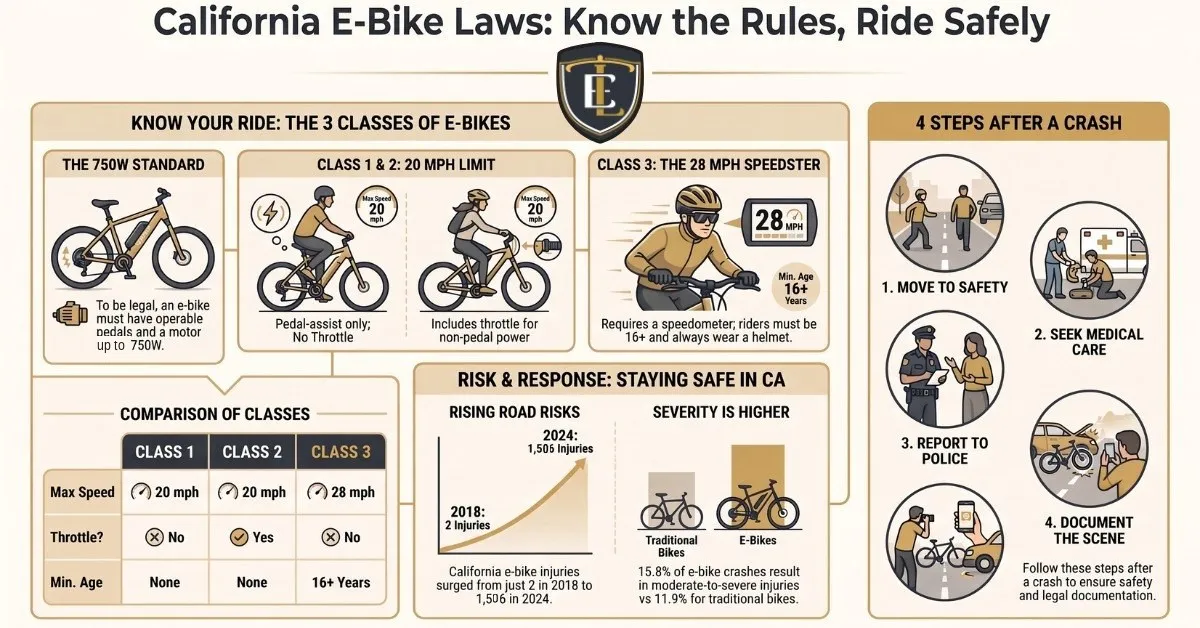
Under California law, an electric bicycle is still considered a bicycle when it meets specific requirements. The California Highway Patrol explains that an e-bike must have fully operable pedals and an electric motor that does not exceed 750 watts. California then places qualifying e-bikes into three classes based on how the motor provides assistance and the bike's maximum assisted speed.
That classification matters because an e-bike that falls outside these requirements may not receive the same treatment as a legal electric bicycle. For example, CHP notes that an electric bicycle operating outside the statutory definition can potentially be treated as a motorcycle, bringing different requirements for licensing, registration, equipment, and operation.
For most riders, the basic requirements are straightforward:
- The bicycle must have fully operable pedals.
- Its electric motor must not exceed 750 watts.
- Class 1 e-bikes provide pedal assistance up to 20 miles per hour.
- Class 2 e-bikes can use motor power without pedaling but cannot provide assistance beyond 20 miles per hour.
- Class 3 e-bikes provide pedal assistance up to 28 miles per hour and must have a speedometer.
And here's a number worth remembering if you're buying or riding an e-bike: 750 watts is the motor-power ceiling under California's e-bike definition. Going beyond the state's definition can change how the vehicle is legally classified, which can affect what rules apply to the rider.
E-bikes are also subject to California's bicycle traffic laws. Riders generally have the same rights and responsibilities as bicyclists, including following applicable traffic signals and other rules of the road.
There is another detail parents should know. California requires anyone under 16 to stay off Class 3 e-bikes, and riders under 18 must wear a properly fitted and fastened bicycle helmet on any e-bike. On a Class 3 e-bike the helmet rule goes further: every rider and passenger must wear one, whatever their age.
So, an e-bike isn't automatically a motorcycle just because it has an electric motor. The pedals, motor power, assistance system, and assisted speed all matter when determining whether the bike falls within California's legal e-bike definition.
Is Riding an E-Bike illegal in California?
No, riding an e-bike is legal in California as long as the bicycle and rider follow the state's e-bike laws. California's Vehicle Code recognizes qualifying electric bicycles as bicycles, rather than automatically treating them as motor vehicles, but that does not mean every e-bike can be ridden anywhere or at any speed.
The rules become especially important when you look at the bike's classification. Where you ride matters, too. California law allows local authorities to create additional rules governing e-bike use, so an e-bike that is legal on one road or bike path may be restricted on a particular trail or in another city. Riders also have to follow the applicable traffic laws, including rules involving traffic lights, stop signs, and riding in the same direction as other road users.
For parents, that last point is worth paying attention to. An e-bike may look like a regular bicycle, but higher speeds can give young riders less time to react when a car, pedestrian, or another bicycle suddenly enters their path. Knowing which class of e-bike your child is riding and where that e-bike is legally allowed can go a long way toward preventing an avoidable accident.
Where Can You Legally Ride an E-Bike in California?
In California, e-bikes can generally be ridden on roads and in bike lanes, but the rules can change depending on where you are and what type of e-bike you have. Riders must follow the same basic traffic laws as other bicyclists, including obeying traffic lights and stop signs and riding in the same direction as traffic. California law also allows local authorities to place additional restrictions on e-bikes, so a route that permits one class of e-bike may restrict another.
Bike paths and multi-use trails require a little more attention. Class 1 e-bikes are commonly permitted on bicycle paths, while Class 2 and Class 3 e-bikes can face additional restrictions depending on the trail or agency managing it. California law allows local authorities to prohibit or restrict e-bike use on certain recreational trails, including hiking, equestrian, and other multi-use paths.
Sidewalks are another area where local rules matter. California does not have one blanket rule that makes sidewalk riding legal or illegal everywhere, so riders should check the rules in the city where they are riding. For example, San Diego advises e-bike riders not to ride on sidewalks and directs them toward roads and bike lanes instead.
This is particularly important in places such as San Francisco, Los Angeles, and San Diego, where local agencies can establish rules for particular streets, parks, bike paths, and trails. Don't assume that because your e-bike is legal under California state law, you can automatically take it onto every trail or pedestrian area.
Wherever you're riding, a few basic habits can make a difference. In busy urban areas, watch for turning vehicles, pedestrians, parked cars, and opening doors, and slow down around intersections. On rural roads and multi-use trails, look out for uneven surfaces, loose gravel, blind corners, animals, and other trail users. Since an e-bike can reach higher speeds than a traditional bicycle, giving yourself extra stopping distance is especially important.
The Three Classes of E-Bikes in California
California uses a three-class system to distinguish electric bicycles based primarily on how the electric motor provides assistance and the bike's maximum assisted speed. Knowing your e-bike's class matters because the rules for age, helmets, and where you can ride are not identical for every e-bike.
Class 1 and Class 2 E-Bikes
Class 1 e-bikes provide electric assistance only while you are pedaling. The motor stops providing assistance once the bike reaches 20 miles per hour.
Class 2 e-bikes can provide assistance through a throttle, even when you aren't actively pedaling. Their motor assistance also cuts off at 20 miles per hour.
There is no statewide minimum age for riding a Class 1 or Class 2 e-bike. However, riders under 18 must wear a properly fitted and fastened bicycle helmet. Where you can ride these bikes can also depend on local regulations, particularly on bike paths and multi-use trails.
Class 3 E-Bikes
Class 3 e-bikes are different because they can provide pedal assistance up to 28 miles per hour. Riders must be at least 16 years old, and everyone riding a Class 3 e-bike must wear a bicycle helmet. Class 3 e-bikes must also have a speedometer.
A common misconception is that Class 3 e-bikes can never use bike lanes, but that's not quite accurate. California law allows Class 3 e-bikes on certain bicycle paths and bikeways unless a local authority prohibits them, and cities can establish additional restrictions. So if you're riding along Wilshire Boulevard, through downtown Santa Monica, or near Sunset Boulevard, check the local rules and posted signs rather than assuming the classification alone determines where you can ride.
Because Class 3 e-bikes can reach higher assisted speeds, riders may have less time to react when a vehicle turns across their path, a pedestrian steps into the roadway, or traffic suddenly stops. That makes understanding both the speed capability of the bike and the rules for that particular road or path especially important.
E-Bikes Comparison Table
The table below helps you quickly differentiate between classes and understand legal constraints:
| Class | Motor Type | Max Speed | Throttle Allowed? | Legal Use Areas |
|---|---|---|---|---|
| Class 1 | Pedal-assist | 20 mph | No | Roads, bike lanes, and bicycle paths where permitted |
| Class 2 | Throttle-assisted | 20 mph | Yes | Roads, bike lanes, and paths where permitted; local restrictions may apply |
| Class 3 | Pedal-assist | 28 mph | No | Roads and bike lanes where permitted; local restrictions may apply |
The Hidden Dangers of E-Bikes in Los Angeles
E-bikes can make getting around Los Angeles easier, but their speed and weight can also make crashes more serious. A 2026 study using California Highway Patrol collision data found 4,035 e-bike injury collisions between 2018 and 2024, with reported e-bike injuries rising from just 2 in 2018 to 1,506 in 2024. The same study found that 15.8% of e-bike riders suffered moderate-to-severe injuries, compared with 11.9% of traditional bicyclists.
For parents, the numbers involving younger riders are particularly important. About 15.6% of injured e-bike riders in the California study were 14 or younger, compared with 10.2% of injured traditional bicyclists. The California Attorney General's Office has also cited research showing that e-bike injuries among riders under 18 in San Diego increased by 300% between 2019 and 2023.
There are several reasons an e-bike crash can become serious:
- Higher speeds: A Class 3 e-bike can provide pedal assistance up to 28 mph. At those speeds, riders have less time to react to a vehicle turning, a pedestrian stepping into the roadway, or an unexpected obstacle.
- Teenagers and inexperienced riders: Class 1 and Class 2 e-bikes do not have a statewide minimum riding age, meaning younger riders can legally operate them. But legal access does not necessarily mean a rider has enough traffic experience to handle a busy Los Angeles street.
- Local rules differ: Los Angeles, Beverly Hills, Santa Monica, and other communities can have different rules governing sidewalks, trails, and other riding areas. A rider who does not understand those restrictions may unexpectedly end up in a dangerous location.
- Greater injury severity: The California collision study found moderate-to-severe injuries were more common among e-bike riders than traditional bicyclists. It also found unsafe speed was recorded in 11.2% of e-bike injury collisions, compared with 7.1% involving traditional bicycles.
- Mechanical problems: Brake problems, tire failures, defective batteries, and other equipment defects can cause a rider to lose control. A properly maintained and legally compliant e-bike is much easier to operate safely.
That does not mean every e-bike is inherently unsafe or that traditional bicycles are always safer. It does mean riders and parents should take the bike's speed capability, size, equipment, and intended riding environment seriously. The California Attorney General's Office specifically warns that modifying an e-bike to travel faster can create additional safety and legal concerns.
Common Causes of E-Bike Accidents in Los Angeles

E-bike crashes can happen for many of the same reasons as other bicycle collisions, but certain hazards deserve particular attention in Los Angeles. Drivers may fail to see an e-bike rider, especially when turning or entering a bicycle lane. Riders can also lose control because of excessive speed, unfamiliar traffic conditions, sudden obstacles, or riding somewhere where e-bikes are restricted.
Visibility is another concern. Riding after dark without the required lights or reflectors can make it much harder for drivers and pedestrians to see an e-bike. Poorly maintained brakes, tires, or other components can create another layer of risk.
The California data provides some useful perspective. Among e-bike injury collisions from 2018 through 2024, improper turning was recorded in 9.5% of cases, while traffic-light and signal violations appeared in 6.6%. These figures don't mean those factors caused every crash, but they show how quickly a normal traffic interaction can become dangerous when an e-bike and other road users are sharing limited space.
If you or your child has been injured in an e-bike accident, don't assume the rider is automatically responsible because they were on an electric bicycle. Who had the right of way, whether traffic laws were followed, whether the e-bike was properly classified, and whether a defective product or dangerous roadway contributed to the crash can all matter when determining liability.
What to Do After an E-Bike Accident
An e-bike accident can leave you dealing with medical bills, missed work, rehabilitation, and injuries that don't fully appear until hours or days later. What you do immediately afterward can also affect your ability to document what happened and protect a potential injury claim. Here's a practical step-by-step process to follow.
1. Get to a Safe Location and Check for Injuries
If you can move safely, get yourself and anyone else involved out of immediate traffic. Check for obvious injuries, but don't assume you're fine just because you can stand or walk. Adrenaline can temporarily mask pain, and some injuries become more noticeable later.
Call 911 if anyone has suffered a serious injury or needs emergency medical care.
2. Seek Medical Attention
Get medical attention as soon as possible after the crash, even if your injuries initially seem minor. A medical professional can identify injuries that may not be obvious immediately and create a record connecting your symptoms to the accident.
Follow your doctor's treatment recommendations and keep records of appointments, prescriptions, therapy, and other accident-related medical expenses.
3. Report the Accident
If a motor vehicle was involved, report the collision to the appropriate law enforcement agency. Depending on where the crash happened and how serious it was, police may investigate the scene and prepare an accident report.
If the accident happened on private property, a bike path, or another location with its own reporting procedures, make sure the appropriate property owner or authority is notified as well.
4. Document the Scene
If you're physically able to do so, take photographs and videos before the scene changes. Capture the e-bike, your injuries, damaged clothing or equipment, vehicles involved, traffic signs, road conditions, skid marks, and anything else that may help explain how the crash occurred.
Get the names and contact information of witnesses. If another driver was involved, photograph their vehicle, license plate, and insurance information. Don't rely solely on the other person's version of events.
5. Preserve the E-Bike and Other Evidence
Don't immediately repair, modify, sell, or throw away the e-bike after a serious crash. If a mechanical problem, defective component, or modification may have contributed to the accident, the bike itself could become important evidence.
Keep your helmet, clothing, damaged phone, and other personal property involved in the crash. Take photographs before making repairs or discarding anything.
6. Be Careful With Insurance Companies
You should report the accident to your own insurer when required, but be cautious about giving a recorded statement or discussing the extent of your injuries before you understand your rights. Insurance companies may ask questions that seem routine but can later become relevant to a claim.
You don't need to guess at your injuries, accept an early settlement, or decide who was legally responsible while you're still recovering.
7. Speak With a Personal Injury Attorney
If you were seriously injured, contact an experienced personal injury attorney before agreeing to a settlement or making detailed statements to another party's insurance company. An attorney can investigate the crash, identify potentially responsible parties, preserve evidence, and determine what damages may be available under California law.
This can be especially important in an e-bike case because liability isn't always as simple as asking whether the rider or driver caused the collision. The circumstances may involve a driver, another cyclist, a defective e-bike component, a property owner, or even a dangerous roadway condition.
Are You An E-Bike Accident Victim?
At Etehad Law, we have extensive experience representing clients in bicycle, e-bike, and motor vehicle accident cases across Los Angeles County, Beverly Hills, and surrounding communities. Our team understands the unique risks e-bike riders face and knows how to pursue full compensation for medical bills, pain and suffering, and lost wages.
If you or your loved one has been injured in an e-bike accident in Beverly Hills, Santa Monica, Los Angeles, or anywhere in California, do not face the process alone. Contact a Los Angeles bicycle accident lawyer at Etehad Law today for a free consultation. We will take care of you like family, and you do not pay unless we win your case.
FAQs
California's e-bike rules can seem confusing because state law sets the basic requirements while cities and other local authorities can add restrictions. Here are quick answers to some of the questions riders and parents ask most often.
Are 750 Watt E-Bikes Legal in California?
Yes, a 750-watt electric bicycle can qualify as a legal e-bike in California if it otherwise meets the state's requirements, including having fully operable pedals and complying with the applicable class and speed rules. The key point is that California law limits the motor of a qualifying e-bike to 750 watts or less.
Can I Ride My E-Bike On The Road in California?
Yes, e-bikes that meet California's legal requirements can generally be ridden on public roads, and riders must follow applicable traffic laws. Local authorities can impose additional restrictions, so check the rules for the specific road or area where you plan to ride.
What Are The New E-Bike Laws in California 2026?
California's e-bike rules continue to regulate e-bikes through a three-class system based on motor assistance and speed, with additional requirements for Class 3 riders. Because local governments can also establish restrictions, riders should check current local regulations rather than relying only on statewide rules.
Which E-Bikes Are Street Legal in California?
An e-bike generally must have fully operable pedals, an electric motor of 750 watts or less, and meet the requirements for Class 1, Class 2, or Class 3 classification. E-bikes that have been modified to exceed the legal speed or power limits may no longer qualify as legal electric bicycles under California law.
What Should I Do if I Get Into An E-Bike Accident in California?
After an e-bike accident, seek medical attention, report the collision when appropriate, document the scene, collect witness information, and preserve the e-bike and other evidence. If you were injured, speaking with a personal injury attorney before accepting a settlement or giving a detailed statement to an insurance company can help you understand your legal options.
Legal Disclaimer: The information provided in this article is for general informational purposes only and does not constitute legal advice. Every e-bike accident case is different, and the laws and deadlines that apply can depend on the specific facts of your situation. Reading this article does not create an attorney-client relationship. If you have been injured in an e-bike accident, consult a qualified California personal injury attorney for advice about your individual case.
You may also like
 Accident and Injury
 California Personal Injury Statute of Limitations
Learn the California statute of limitations for personal injury claims, key filing deadlines, exceptions, and why you should act quickly.
Read More » Expert Opinion
 What is a Vehicle Black Box and How Can It Help Your Case?
Uncover the role of your car black box in legal cases. Insights from Personal Injury Attorney in Beverly Hills await. Check to…
Read More » Expert Opinion
 Will Posting on Social Media Tank Your Case?
How social media posts can affect a legal case, the dos and don'ts while a claim is open, and what insurers look…
Read More »
