


California's comparative negligence refers to the legal rule that allows an injured person to recover damages even if they were partly at fault. Under California's pure comparative negligence system, your compensation is reduced by your percentage of fault rather than eliminated entirely.
At Etehad Law, we have over 30 years of experience representing injury victims on a contingency fee basis, meaning you pay no attorney fees unless we recover compensation for you. Our firm has recovered more than $100 million in settlements and has earned a 5-star rating based on more than 250 Google reviews. Our case results include an $11 million-plus jury verdict and numerous policy-limit recoveries in motor vehicle and premises liability cases. If you were injured in an accident, contact us today for a free consultation to pursue the maximum compensation.
This guide explains how comparative negligence works in California, how fault percentages are determined, and how the rule affects settlements and court awards. We also compare California's system with modified comparative negligence and contributory negligence, discuss the evidence used to assign fault, and explain how an experienced personal injury lawyer can strengthen your claim.
What Is Comparative Negligence?
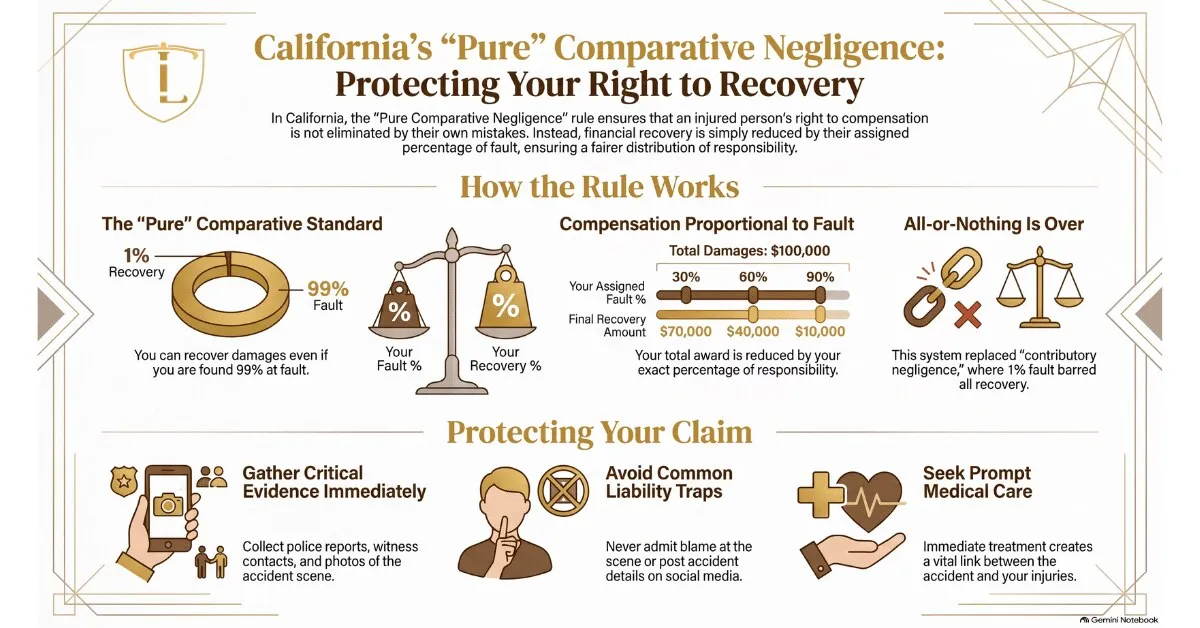
Comparative negligence is a legal doctrine that allows an injured person to recover damages even if their own negligence contributed to the accident. In comparative negligence California, the court reduces compensation according to the injured person's fault percentage instead of denying recovery altogether. This approach was adopted by the California Supreme Court in the landmark Li v. Yellow Cab Co. decision in 1975, replacing the state's older contributory negligence doctrine.
The court, jury, or an insurance company evaluates factors such as the police report, witness statements, medical records, photographs, and other physical evidence before determining each party's share of responsibility. California Civil Jury Instructions, including CACI 405 and CACI 406, provide guidance for juries when deciding comparative fault issues.
The purpose of this legal doctrine is to distribute responsibility fairly among all parties involved. Rather than placing all blame on one person, California's comparative negligence law allows judges, juries, and insurance companies to apportion fault based on the available evidence. Under California's pure comparative negligence, an injured person may still recover compensation even when they are mostly responsible for the accident. For example, someone found 30% at fault may recover 70% of their proven damages, while even a plaintiff who is 99% at fault may still recover 1% of their damages.
For example, if your total damages equal $100,000 and you are found 30% responsible, you may recover $70,000. Likewise, a plaintiff who is 60% at fault may still recover $40,000 because damages are reduced in proportion to the plaintiff's own negligence.
California follows a pure comparative negligence system, making it one of the most plaintiff-friendly approaches in the country. Unlike modified comparative negligence, which bars recovery after reaching a specified fault threshold, California does not prevent recovery because of a high percentage of fault. Instead, compensation is reduced in direct proportion to the injured person's share of responsibility.
This rule also differs significantly from the contributory negligence rule still used in a small number of jurisdictions. Under contributory negligence, even a plaintiff who is only 1% responsible may be completely barred from recovering damages. California rejected that all-or-nothing approach because it often produced unfair outcomes. Instead, the state's comparative negligence system promotes fair responsibility by ensuring every person involved remains accountable only for their share of the harm caused.
How Is Fault Determined in California?
Under California's comparative negligence law, insurance companies, attorneys, and courts examine all available evidence before they assign fault or determine each party's fault percentage. According to the California Courts Self-Help Guide, negligence cases require proof that a person's conduct caused another's injuries, making evidence critical to establishing liability.
The police report is often one of the first documents reviewed after a car accident. Although it does not automatically determine liability, it may include the officer's observations, citations issued, statements from the parties involved, and details about how the collision occurred. Insurance adjusters frequently rely on these reports when forming their initial fault assessment.
Witness statements can provide valuable information when the drivers disagree about what happened. Independent witnesses often describe traffic conditions, vehicle movements, and driver behavior before the crash. Their accounts may support or challenge the version presented by either party.
The accident scene also provides important physical evidence. Skid marks, vehicle damage, road conditions, debris, and traffic signs can help establish how the collision occurred and whether someone violated traffic laws. Photographs and videos taken immediately after the accident preserve details that may disappear once the vehicles are removed.
Traffic cameras, dashboard cameras, and nearby surveillance systems can provide objective evidence of the collision. Video footage may show vehicle speed, traffic signals, lane positions, or unsafe driving behaviors that help apportion fault more accurately. When available, this evidence often carries significant weight during settlement negotiations or at trial.
Some cases require testimony from expert witnesses. Medical experts explain how the injuries occurred, while engineering or automotive specialists evaluate vehicle damage and road conditions. Their professional opinions can clarify complex issues that are difficult for juries or insurance adjusters to interpret.
Your medical records also play an important role in determining liability and damages. Prompt medical treatment documents the injuries sustained, establishes when symptoms began, and helps connect those injuries directly to the accident. Consistent treatment also makes it more difficult for the other driver's insurance company to argue that your injuries resulted from another event.
In more complex California car accident cases, attorneys may work with accident reconstruction experts. These specialists use vehicle damage, measurements, photographs, electronic vehicle data, and scientific analysis to recreate the collision. A comprehensive investigation often provides the strongest foundation for challenging disputed fault allegations and pursuing a fair settlement.
Common Personal Injury Cases Where Comparative Negligence Applies

Comparative negligence in California applies to many types of personal injury cases, not just motor vehicle collisions. Whenever more than one person may have contributed to an accident, California's pure comparative negligence allows fault to be shared among the parties involved.
Simon Etehad explains, "Many people assume they cannot bring a claim because they made a mistake. California law often allows injured victims to recover compensation even when they share some responsibility for the accident."
One of the most common situations involves a car accident. A driver may have been speeding while another failed to yield the right of way. Instead of placing all blame on one person, California courts apportion fault based on each driver's actions, allowing both parties to bear responsibility according to their level of negligence.
The same principle applies to motorcycle accidents, truck accidents, pedestrian accidents, and bicycle accidents. For example, a pedestrian may cross outside a marked crosswalk while a driver exceeds the speed limit. Likewise, in Los Angeles bike crash cases, a cyclist may fail to signal before turning while a motorist drives distracted. In each situation, the jury determines how much each person's negligence contributed to the collision.
Premises liability claims also frequently involve comparative fault. A property owner has a legal duty to maintain reasonably safe conditions, but an injured visitor may also share responsibility. For example, a person who ignores visible warning signs or enters a restricted area could be found partially responsible, reducing the amount they may recover damages.
Slip and fall accidents are another common example. A business may fail to clean a hazardous spill promptly, while the injured customer may have been distracted by a mobile phone. California law allows fault to be divided between the property owner and the injured person rather than assigning all responsibility to one side.
Dog bite cases may also involve comparative negligence in certain circumstances. Although California generally applies strict liability to dog bite claims, a victim's conduct may still affect recovery in limited situations. For example, intentionally provoking a dog or trespassing on private property may become relevant when evaluating liability and damages.
Regardless of the type of accident, a thorough investigation is essential. Police reports, witness statements, photographs, surveillance footage, medical records, and other physical evidence help establish how each person's actions contributed to the incident. An experienced personal injury lawyer can use that evidence to challenge unfair fault allegations and pursue a fair settlement under California's comparative negligence law.
Examples of Comparative Negligence
Many of our clients initially believe they cannot pursue a claim because they made a mistake before the accident. In our experience, California's pure comparative negligence often allows injured people to recover damages even when they are partially responsible. The following examples show how comparative negligence in California may apply in different types of personal injury cases.
One client was injured in a rear-end collision after stopping suddenly because of traffic ahead. The investigation showed the other driver was following too closely, but our client's brake lights were not functioning properly. After reviewing the police report, vehicle damage, and physical evidence, fault was divided between both drivers. The client's compensation was reduced by their fault percentage, but their claim remained valid.
Another client was struck while crossing a street outside a marked crosswalk. The driver, however, was travelling above the speed limit and failed to react in time to avoid the collision. Because both parties negligence contributed to the accident, the jury determined each person's share of responsibility before calculating the damages the client could recover.
We also represented a client injured in a slip and fall at a grocery store. Store employees failed to clean a spill within a reasonable time, but surveillance footage showed the client looking at a mobile phone while walking. Under California's comparative negligence law, the property owner remained liable for failing to maintain safe premises, while the client's partial fault reduced the final compensation award.
In another matter, our client suffered serious injuries in a motorcycle accident after travelling slightly above the speed limit. A driver turned left across the motorcycle's path without yielding the right of way. Although our client's speed contributed to the crash, the driver's failure to yield was the primary cause. The fault was apportioned between both parties, allowing our client to recover compensation despite sharing responsibility.
Comparative negligence is especially important in multi defendant cases involving several vehicles. One case involved a chain-reaction collision where one driver was distracted, another followed too closely, and our client changed lanes without signaling. The court reviewed witness statements, the police report, photographs, and expert analysis before assigning fault among all multiple parties. Each defendant became responsible only for their share of the damages, reflecting California's commitment to fair fault allocation.
How Comparative Negligence Affects Compensation
Being partially responsible for an accident does not prevent you from recovering compensation in California. Instead, California's pure comparative negligence reduces each category of damages by your percentage of fault, allowing you to recover the remaining amount supported by the evidence.
Simon Etehad explains, "Many clients worry that admitting a small mistake ends their case. In reality, California law often allows recovery, but every percentage of fault can affect the value of the claim."
| Type of Damages | How Comparative Negligence Affects Compensation |
|---|---|
| Medical Expenses | You may recover the cost of past medical bills related to your injuries. However, the final amount is reduced by your fault percentage. For example, if your medical expenses total £50,000 and you are 20% at fault, you may recover £40,000. |
| Lost Wages | If your injuries prevent you from working, you may recover income lost during your recovery. Any award for lost wages is reduced according to your share of responsibility for the accident. |
| Future Medical Expenses | Many serious injuries require ongoing treatment, rehabilitation, or surgery. Future medical expenses remain recoverable, but the award is reduced by the percentage of fault assigned to you. |
| Loss of Earning Capacity | Some injuries permanently limit your ability to earn a living. Compensation for diminished future earning capacity is also subject to the same comparative fault reduction applied to the rest of your claim. |
| Pain and Suffering | California allows injured victims to seek non economic damages for physical pain, emotional distress, and reduced quality of life. These damages are reduced by your share of fault, just like economic damages. |
| Property Damage | Damage to your vehicle or other personal property may also be recovered. If you are found partially responsible for the collision, the amount you receive for property damage will be reduced accordingly. |
Can Insurance Companies Use Comparative Negligence Against You?
Yes, insurance companies frequently use comparative negligence as part of their claims strategy. While California's comparative negligence law is designed to allocate fault fairly, insurers may attempt to increase your fault percentage to reduce the amount they pay. Their goal is often to minimize the value of your claim rather than maximize your recovery.
One common tactic is disputing liability from the beginning of the claim. Insurance adjusters often begin forming fault theories within the first 24 to 48 hours after an accident. They review the police report, interview witnesses, inspect vehicle damage, and examine photographs while looking for evidence they believe supports a higher share of plaintiff fault.
Another strategy involves shifting blame to the injured person. An adjuster may argue that you were speeding, distracted, failed to obey traffic laws, or delayed seeking medical treatment. Even when another driver clearly caused the accident, the other driver's insurance company may argue that your own negligence contributed to your injuries to reduce what they owe.
Insurance companies may also minimize settlement offers by questioning the seriousness of your injuries or disputing the medical treatment you received. They sometimes argue that your injuries existed before the accident or claim that certain medical bills, lost wages, or future medical expenses are unrelated to the collision. These arguments can significantly reduce the compensation offered during settlement negotiations.
Evidence is often the strongest defense against these tactics. A comprehensive investigation that includes medical records, witness statements, photographs, surveillance footage, expert opinions, and other physical evidence can help establish what happened and challenge inaccurate fault allegations. The stronger your evidence, the more difficult it becomes for an insurer to unfairly inflate your percentage of fault.
How to Protect Your Right to Compensation

At Etehad Law, we encourage our clients to follow the steps below because they help preserve valuable evidence, protect your health, and strengthen your California personal injury claim.
Step 1: Seek Immediate Medical Treatment
Your health should always come first. Seek medical attention as soon as possible, even if your injuries appear minor. Prompt treatment creates medical records that connect your injuries to the accident and reduces the likelihood that an insurance company will question your claim.
Step 2: Preserve All Available Evidence
Evidence can disappear quickly after an accident. Keep damaged property, save receipts, retain medical documents, and preserve any other records that may support your claim. A thorough comprehensive investigation often begins with the evidence collected immediately after the incident.
Step 3: Take Photographs of the Accident Scene
Photographs can provide valuable evidence long after the scene has changed. Capture vehicle damage, road conditions, traffic signs, skid marks, visible injuries, and anything else that may help establish how the accident occurred. If possible, take photographs from multiple angles before vehicles are moved.
Step 4: Obtain Witness Information
Independent witnesses can provide important details if liability is disputed later. Collect names, telephone numbers, and contact information whenever possible. Their statements may help challenge attempts to unfairly increase your fault percentage.
Step 5: Follow Your Doctor's Recommendations
Continue attending medical appointments and complete your recommended treatment plan. Gaps in treatment may allow the other driver's insurance company to argue that your injuries were not serious or were caused by something unrelated to the accident.
Step 6: Avoid Discussing Fault
Do not speculate about who caused the accident or apologize at the scene. Even casual comments may later be interpreted as admissions of responsibility. Allow the investigation and available evidence to determine comparative fault.
Step 7: Be Cautious When Speaking With Insurance Adjusters
Insurance adjusters often contact injured people shortly after an accident. Answer basic questions carefully, but avoid recorded statements or accepting an early settlement before understanding the full extent of your injuries. Early offers rarely reflect the complete value of your claim.
Step 8: Contact a Personal Injury Attorney Early
An experienced personal injury lawyer can begin protecting your interests immediately. Early legal representation allows your attorney to preserve evidence, communicate with insurance companies, challenge unfair fault allegations, and pursue the maximum compensation available under California's comparative negligence law.
Common Mistakes That Can Increase Your Assigned Fault
Even strong California personal injury cases can become more difficult when avoidable mistakes occur after an accident. The actions below may give an insurance company additional arguments to assign fault, increase your fault percentage, or reduce the value of your claim.
| Common Mistake | How It Can Affect Your Claim |
|---|---|
| Admitting Blame at the Scene | Apologizing or accepting responsibility before the facts are known may be interpreted as an admission of fault. Insurance companies may use those statements to argue comparative negligence and reduce the compensation you recover. |
| Delaying Medical Treatment | Waiting days or weeks to seek medical care can make it harder to connect your injuries to the accident. Insurers may argue that your injuries were minor, unrelated, or caused by another event. |
| Posting About the Accident on Social Media | Photos, comments, or updates posted online may be taken out of context. Insurance adjusters often review social media accounts for information they believe supports a higher plaintiff fault or challenges the seriousness of your injuries. |
| Ignoring Medical Advice | Missing appointments or failing to follow your treatment plan may suggest that your injuries are not as serious as claimed. The insurance company may argue that your own actions worsened your condition or increased your damages. |
| Giving Recorded Statements Without Legal Counsel | Recorded statements can be used to identify inconsistencies or statements that shift responsibility toward you. Speaking with an experienced personal injury lawyer before providing detailed statements helps protect your rights and reduces the risk of unintentionally harming your claim. |
How a California Personal Injury Attorney Can Help
An experienced personal injury lawyer understands how fault is evaluated and works to ensure your percentage of fault accurately reflects the evidence rather than the insurance company's assumptions. Simon Etehad explains, "Comparative negligence cases are often won through preparation. The stronger the evidence, the harder it becomes for an insurance company to unfairly increase a client's share of fault."
One of the first steps your attorney takes is conducting a comprehensive investigation into the accident. This includes reviewing the police report, interviewing witnesses, obtaining surveillance footage, preserving physical evidence, and collecting your medical records. Building a strong factual foundation is essential to proving liability and protecting your right to recover damages.
Your attorney also works to challenge unfair fault allocations. Insurance companies sometimes overstate an injured person's responsibility to reduce settlement payments. By carefully analyzing the evidence, consulting experts, and identifying weaknesses in the insurer's position, your attorney can dispute attempts to unfairly assign fault or inflate your fault percentage.
Many cases also require expert evidence. Accident reconstruction specialists, medical professionals, engineers, and other expert witnesses can explain how the accident occurred, the extent of your injuries, and why the evidence supports your version of events. Their opinions often strengthen negotiations and provide persuasive testimony if litigation becomes necessary.
Negotiating with insurers is another critical part of the process. Your attorney communicates directly with the other driver's insurance company, responds to settlement offers, presents supporting evidence, and advocates for compensation that reflects your medical bills, lost wages, future medical expenses, and other damages. This allows you to focus on your recovery while your legal team protects your interests.
Although most claims settle before trial, some disputes require court intervention. If negotiations do not produce a fair settlement, your attorney can present your case before a judge or jury, challenge the defendant's arguments, and advocate for an accurate fault allocation under California law.
Got a Personal Injury Claim?
Understanding California's comparative negligence law can make a significant difference in the outcome of your case. Even if you were partially at fault, you may still have the right to recover compensation for your medical bills, lost wages, pain and suffering, and other damages. The key is acting quickly, preserving evidence, and working with an attorney who knows how to challenge unfair fault allegations and build a strong claim.
At Etehad Law, we have spent more than 30 years helping injured Californians protect their rights and pursue the compensation they deserve. If the insurance company is trying to shift blame or reduce your settlement, we're ready to fight for you. Contact Etehad Law today for a free consultation, and let our experienced personal injury attorneys evaluate your case, explain your legal options, and help you pursue the maximum compensation available under California law.
Frequently Asked Questions
Below are answers to some of the most common questions we receive from injured clients.
What Is Comparative Negligence in California?
Comparative negligence is a legal rule that allows an injured person to recover compensation even if they were partially responsible for an accident. Under California's pure comparative negligence system, your compensation is reduced by your percentage of fault rather than eliminated.
Can I Recover Compensation If I Was 50% At Fault?
Yes. California's pure comparative negligence law allows you to recover damages even if you were 50% responsible, although your compensation will be reduced by 50%.
Can I Recover Compensation If I Was More Than 50% At Fault?
Yes. Unlike states that follow modified comparative negligence, California allows injured parties to recover compensation even if they are more than 50% at fault. Your financial recovery will simply be reduced by your assigned percentage of fault.
Who Decides Each Party's Percentage of Fault?
Insurance adjusters typically assign fault during the claims process based on the available evidence. If the case goes to trial, a judge or jury makes the final determination after reviewing the facts and applying California law.
How Do Insurance Companies Calculate Comparative Negligence?
Insurance companies evaluate police reports, witness statements, medical records, photographs, surveillance footage, and other evidence to determine each party's share of responsibility. Their findings are not always accurate, which is why strong evidence and experienced legal representation are important.
Does Comparative Negligence Apply To Slip and Fall Accidents?
Yes. Comparative negligence can apply to slip and fall accidents when an injured person's actions may have contributed to the incident, such as ignoring visible hazards or failing to exercise reasonable care. Even if you share some responsibility, you may still recover compensation under California law.
Legal Disclaimer: The information in this article is provided for educational purposes only and should not be considered legal advice or create an attorney-client relationship. Every case is unique, so you should consult an experienced California personal injury attorney to discuss your specific circumstances and legal options.
You may also like
 Accident and Injury
 The Dangers of Texting and Walking
How distracted walking causes pedestrian collisions, who is at fault in a pedestrian versus car accident in California, and what to do…
Read More » Accident and Injury
 What Happens After a Gunshot Wound?
Who can be held liable after a shooting, what you must prove in a California injury claim, and the compensation a gunshot…
Read More » Accident and Injury
 What to Do in the Event of a Burn Injury
The first 24 hours after a burn, when a transfer to a burn centre is recommended, and how negligence is established in…
Read More »
