

Los Angeles Dog Bite Lawyer
Attorney advertising.
Etehad Law takes dog bite cases from anywhere in Los Angeles County. The firm has a single office, at 150 S. Rodeo Drive, Suite 350, in Beverly Hills, and none anywhere else. Simon P. Etehad, the firm's managing partner, was admitted to the State Bar of California in 1996.
In Los Angeles, the first question after a bite is often who to call, and the answer turns on which city line the bite fell inside. This page sorts that out first. It then explains the City of LA's dangerous-dog hearing, when a landlord, dog walker or public agency may share responsibility, and the extra rules for workers and children.
Who takes the report depends on where the bite happened
Los Angeles County has two kinds of agencies that deal with a dog bite, and they do different jobs. Public health tracks rabies. Animal control investigates whether a dog is dangerous. Every bite should be reported to public health. A complaint to animal control is a separate step, for when you believe the dog is dangerous. Which office covers you depends on the address.
| Where the bite happened | Bite report (rabies and quarantine) | Dangerous-dog complaint |
|---|---|---|
| City of Los Angeles (including Hollywood, Van Nuys, South LA and San Pedro) | LA County Veterinary Public Health: 213-288-7060, or its online public portal | LA Animal Services: 888-452-7381, or the nearest of its six shelters |
| Unincorporated county areas, such as East Los Angeles | LA County Veterinary Public Health | LA County Department of Animal Care and Control (DACC) |
| Long Beach | Long Beach Animal Control: 562-570-7387 | That city's animal control agency |
| Pasadena | Pasadena Humane: 626-792-7151 | That city's animal control agency |
| Vernon | City of Vernon Health Department: 323-583-8811 | That city's animal control agency |
| Any other city in the county | LA County Veterinary Public Health | That city's animal control, which may be DACC under contract |
The bite-report column comes from LA County Public Health's reporting page, which sends Pasadena, Long Beach and Vernon bites to those cities. DACC covers all unincorporated areas and 43 of the county's 88 cities, and it keeps a locator for checking a specific address (DACC service areas). DACC's online service request form has a "Dog Bite (Non-emergency)" option.
Don't call county animal control about a bite inside the City of LA. The City runs its own department, so a dangerous-dog complaint there goes to LA Animal Services. Public Health's online portal is for members of the public. Its reporting page says that in California, anyone with knowledge of an animal bite to a person must report it, not only the doctor who treated it.
Write down the agency, the date you called and any reference number. You will need them later.
The rabies report is not a dangerous-dog complaint
People often assume one call covers everything. It doesn't. LA County Public Health says it plainly: "A report of a bite from an animal does not mean that the animal is deemed dangerous. Residents that believe an animal to be dangerous must file a separate report with their local animal control agency."
The public health report starts a quarantine. California's rabies rules call for a dog that bites a person to be confined and watched, usually for 10 days after the bite, at the local health officer's discretion (Cal. Code Regs., title 17, section 2606). In LA County, Public Health says the dog may complete that period at home. The quarantine FAQ for owners asks the owner to send in the dog's rabies vaccination certificate, spay or neuter certificate and license. It also lets an owner who disputes the bite put that in writing for the case file. Public Health adds that it "does not decide on fault."
For your claim, the quarantine file can tie a specific dog to its owner and address, and it holds the vaccination and license papers the owner sent in. It won't say who was at fault or what your injury is worth. The quarantine is for the dog. It has no bearing on your own care: your doctor decides whether you need rabies shots, antibiotics or a tetanus booster.
How a dangerous-dog case works in the City of LA
If you believe the dog will hurt someone else, the complaint goes to LA Animal Services. The department says an animal control officer will investigate. A dog found dangerous "may be impounded for further observation." Complaints that the department's process doesn't resolve can go to an administrative hearing. The City's Municipal Code has authorized these hearings since 1987 (LA Animal Services).
LA Animal Services links Section 53.18.5 of the Municipal Code as its hearing procedure (hearing procedure, PDF). The section is written for barking-dog and license cases, and it also governs an owner's appeal when a dog is declared dangerous. A few parts matter if you were the one bitten:
- You can take part. The dog's owner, "the complainant or complainants," and the department may each present evidence and call and cross-examine witnesses.
- It is on the record. A recording or transcript is taken, and testimony is under oath. Keep your account the same as the one in your medical chart and any claim.
- The department carries the burden. It must prove its allegations by a preponderance of the evidence.
- The outcome is about the dog. It won't award you money. The hearing examiner can recommend conditions such as a required enclosure, a muzzle, approved training, removal of the dog from the premises or sterilization. If the owner doesn't comply, a later hearing can revoke the dog's license and order the dog surrendered or removed from the City.
- The examiner's report is a public record. It is due to the department's General Manager within 15 days of the hearing. The owner can appeal the General Manager's decision to the Board of Animal Services Commissioners within 15 days of being served with it.
None of this pays your medical bills, and the hearing doesn't decide your injury claim. It can, though, produce sworn testimony and findings about the dog that are hard to get any other way.
State law runs alongside the City's process. Under California's dangerous-dog law, an animal control or police agency can ask a court to declare a dog "potentially dangerous" or "vicious." A city or county may set up its own administrative hearing for these cases instead (Food and Agricultural Code sections 31602, 31603 and 31621). Civil Code section 3342.5 adds a second route. Once a dog has bitten people on at least two separate occasions, "any person" can sue the owner. The court can order changes to how the dog is kept, its removal from the area or, if necessary, its destruction. That suit is filed in the county where a bite happened and is a limited civil case. It doesn't change the owner's liability for your injuries (Civil Code 3342.5).
What you have to prove against the owner
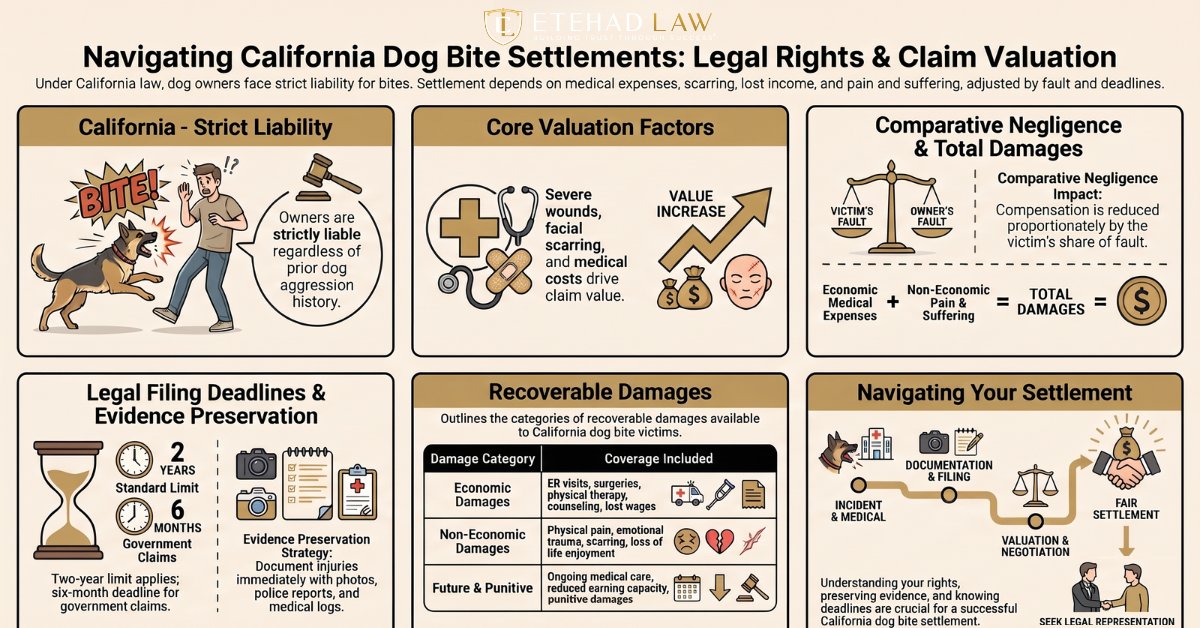
California's dog bite statute makes the owner liable "regardless of the former viciousness of the dog or the owner's knowledge of such viciousness" (Civil Code 3342). The state's civil jury instructions boil it down to four things. The defendant owned the dog. The dog bit you in a public place or while you were lawfully on private property. You were harmed. And the bite was a substantial factor in that harm (CACI No. 463). The skin doesn't have to be broken.
The statute has limits: a trespasser generally can't use it, and comparative fault and assumption of risk can still be raised. Courts have held that veterinary staff and kennel workers caring for a dog accept the risk of a bite as part of the job. Our page on comparative negligence in California explains how shared fault reduces a recovery.
If the dog knocked you down, jumped on you or chased you into the street without biting, the bite statute doesn't apply. The claim then runs on negligence. It can also run on strict liability. That applies if the person who "owned, kept, or controlled" the dog knew or should have known it had a dangerous tendency (CACI No. 462). Cyclists and runners hit by loose dogs are a common example. Our Los Angeles bicycle accident page covers the riding side of those cases. If a loose dog sent you into the street and a car hit you, the driver may share the blame; our Los Angeles pedestrian accident page covers that side.
When the owner isn't the only one responsible
Landlords
When a tenant's dog bites someone in a hallway, courtyard or parking area, people ask whether the landlord is responsible. A landlord isn't liable just for owning the building. The leading California case, Uccello v. Laudenslayer (1975) 44 Cal.App.3d 504, holds that a landlord has no duty to inspect for a tenant's dangerous dog. A duty arises "only when the landlord has actual knowledge of the animal, coupled with the right to have it removed from the premises." California added a jury instruction for these cases in July 2025 (CACI No. 1013). Under it you must show the landlord "knew or must have known" the dog had a dangerous nature and could have taken reasonable steps, such as enforcing the lease, but didn't.
That kind of knowledge is usually proven with paper. Look for earlier complaints to the manager, emails or texts, a lease or pet addendum, and prior animal control complaints about the same dog. If the building itself played a part, such as a broken gate or a door that won't latch, our Los Angeles premises liability page covers property-owner claims.
Dog walkers, sitters and other keepers
The bite statute names the owner. A walker, sitter or friend who had the dog that day can still be liable under the negligence and known-danger rules above. Write down who was holding the leash, and get their name and contact details.
Police dogs
The bite statute doesn't reach a government agency whose police or military dog bites while helping an officer catch or hold a suspect, investigate a crime, serve a warrant, or defend an officer or another person. It also doesn't reach a bite by such a dog defending itself from being provoked. That exception has two limits. It doesn't apply when the person bitten wasn't involved in, or suspected of, the act that led to using the dog. And it applies only if the agency has adopted a written policy on how its dogs may be used. A claim against a city or county generally has to be filed with that public entity within six months (Government Code 911.2), long before the usual two-year deadline. Our article on California's statute of limitations covers both deadlines.
Bitten while working: delivery drivers, mail carriers and home-service workers
The statute speaks directly to people who come onto property for work. A person is lawfully on the owner's property while performing "any duty imposed upon him by the laws of this state or by the laws or postal regulations of the United States." The same goes for someone there by the owner's invitation, express or implied. A delivery driver or gig worker walking to a front door will usually rely on the implied invitation. An insurer can still argue the point, for example over a side gate or a "no entry" sign.
If you were working, you may have two claims. For most California employees, workers' compensation from your employer doesn't stop a separate claim against the dog's owner. Labor Code section 3852 preserves an injured employee's "right of action for all damages" against anyone other than the employer (Labor Code 3852). The same section lets an employer or its insurer that paid benefits recover them from the third party, so both claims have to be coordinated.
Two groups follow different rules. Mail carriers are federal employees. Their benefits come from the federal workers' compensation program, and federal law decides how a claim against the dog's owner is brought and what must be repaid from it (5 U.S.C. 8131 and 8132). App-based delivery drivers who are independent contractors under Proposition 22 usually have no workers' compensation. Instead, the app company must carry occupational accident insurance for injuries while the driver is online (Business and Professions Code 7455). Whoever covers you, tell them right away, and keep your delivery logs or route data for the stop.
When the person bitten is a child
According to the Insurance Information Institute, about 4.5 million people are bitten by dogs in the U.S. each year, most of them children. A child's claim follows extra rules:
- The deadline usually waits. In a claim against a private owner, the two-year period generally doesn't run while the injured person is under 18 (Code of Civil Procedure 352). Evidence doesn't wait, though: photos of fresh wounds, witness names and the dog's identity fade fast.
- Except against public agencies. Section 352 doesn't pause the six-month claim deadline for a city, county or other public entity. If that deadline passes, a late claim can sometimes still be filed within one year, and the rules favor children (Government Code 911.4 and 911.6).
- A parent can't sign alone. In a lawsuit, a child is usually represented by a guardian ad litem. A settlement of a child's disputed claim is valid only after a superior court approves it (Probate Code 3500).
- Keep a record over time. Take dated photos and keep the doctor's follow-up notes. The claim will need to show how the injury changed, not just how it looked on the first day.
Who usually pays
Dog bite claims are commonly paid under the liability part of a homeowners or renters insurance policy, not out of the owner's own pocket. The Insurance Information Institute reports that California again had more dog-related liability claims than any other state in 2025, with 2,830. Its count "includes other dog-related injuries," such as fractures and blunt-force trauma, not just bites. Knockdown injuries can be claimed under the same policies.
Coverage isn't automatic. Policies have limits, and the Institute notes that some insurers limit or refuse coverage for some breeds. The first job is to find out which policy covers the dog's owner or keeper. Our article on dog bite settlement amounts explains what tends to raise or lower a claim's value. We don't quote an average for Los Angeles cases.
Working with Etehad Law on a Los Angeles dog bite claim
We run every Los Angeles case out of our Beverly Hills office. If you were bitten inside Beverly Hills, our Beverly Hills dog bite page covers that city's reporting route and leash rule. Century City cases are covered on our Century City dog bite page. This page is for bites everywhere else in the county. If a dog bite was only part of what happened to you, our Los Angeles personal injury page covers the firm's other injury work.
Early work in a dog bite claim usually includes:
- identifying the owner, any keeper and, for rentals, the landlord and property manager;
- getting the Public Health and animal control records, and any hearing report, for the same dog;
- finding the homeowners or renters policy that covers the dog;
- gathering your medical records, wound photos and proof of missed work.
Attorneys at Etehad Law
- Simon P. Etehad (managing partner): admitted December 10, 1996, Bar #186449. His State Bar record lists Farsi (Persian) and Hebrew.
- Kirk S. Comer (senior attorney): admitted in 2005, Bar #240847.
- Erik Harper (trial attorney): admitted in 2006, Bar #247618.
Case reviews are free. It helps to have the bite address ready, with the agencies you reported to and any reference numbers. Bring the owner's name if you know it, and a list of every clinic or hospital you went to.
Call (310) 550-1220 or send us a message.
Los Angeles dog bite questions
Is county animal control the right place to report a bite in Los Angeles?
Only for unincorporated areas and the cities that contract with it. Inside the City of Los Angeles, a dangerous-dog complaint goes to LA Animal Services. Almost everywhere in the county, the bite itself is reported to LA County Veterinary Public Health. The exceptions are Pasadena, Long Beach and Vernon, which take their own bite reports.
Can I get the animal control file or the hearing report?
The City's hearing rules make the examiner's report a public record. Ask the department in writing, and give the address and date of the bite. If you hire a lawyer, the records can also be requested formally once a case is filed.
The owner says the dog is vaccinated. Do I still need to see a doctor about rabies?
Yes. Public Health says a healthcare provider should assess the rabies risk, and its bite sheet also covers wound care, antibiotics and tetanus boosters (What to do after an animal bite, PDF). A vaccination certificate is something the quarantine process checks. It doesn't replace your own medical evaluation.
Do I need a lawyer for a dog bite in Los Angeles?
Not always. A small bite that heals fully, with a cooperative insurer, can sometimes be settled directly. It is worth talking to a lawyer when the bite is to the face or hands. The same is true when there is scarring, nerve damage or infection, or when the person bitten is a child. It also makes sense if the owner disputes what happened, if a landlord, keeper or public agency may be involved, or if you were bitten at work.
Etehad Law, APC. Attorney responsible for this page: Simon P. Etehad, State Bar of California #186449 (State Bar record). The firm's only office is at 150 S. Rodeo Drive, Suite 350, Beverly Hills, CA 90212. This is attorney advertising and general information, not legal advice, and contacting us does not create an attorney-client relationship. Phone numbers and agency coverage are as published by LA County Public Health, LA Animal Services and DACC in November 2026.
Free Consultation
Request a free case review
Tell us what happened in 60 seconds. Please complete the form below, and one of our qualified representatives will contact you shortly.
By submitting this form, you consent to receive our newsletter and agree to our Privacy Policy and Terms of Service. We respect your privacy and will not share, rent, or sell your email address to third parties.
Thank you. We have your details.
One of our qualified representatives will contact you shortly. If your matter is urgent, please call our office directly.