

Knowing what to do after an accident with an uninsured driver can help protect your health, preserve important evidence, and identify available options for recovering your losses. After getting to safety, seek medical attention when needed, call the police, gather the other driver's information, document the accident, and notify your own insurance company promptly.
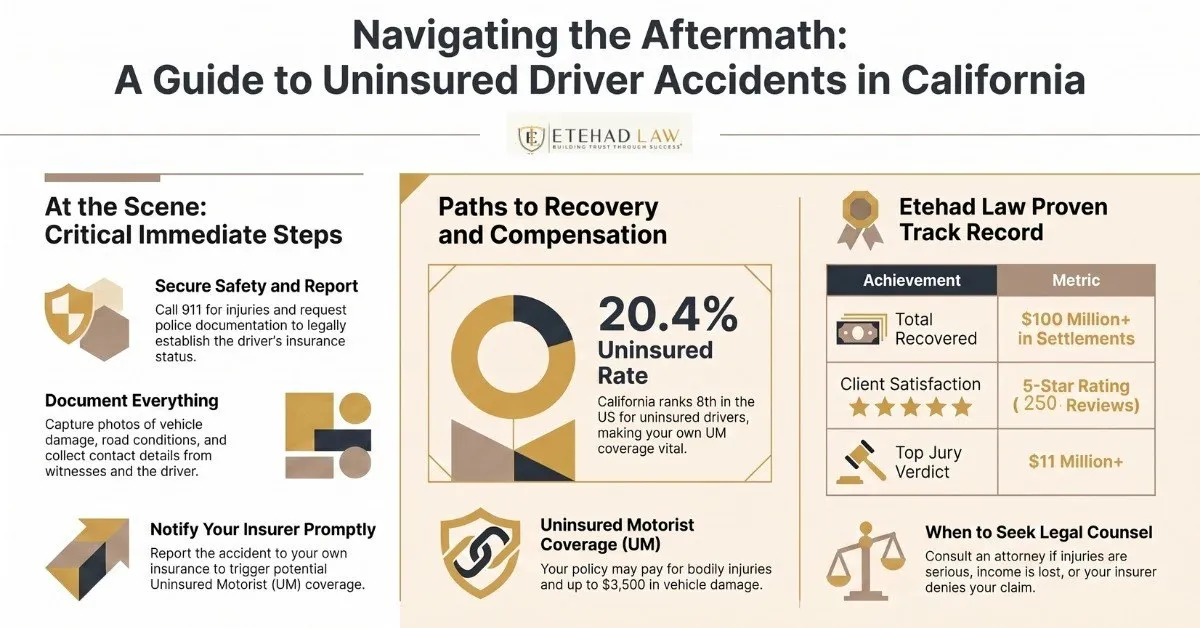
At Etehad Law, we represent injury victims on a contingency fee basis, meaning you pay no attorney fees unless we recover compensation for you. Our firm has recovered more than $100 million in settlements and has earned a 5-star rating based on more than 250 Google reviews. Our case results include an $11 million-plus jury verdict and numerous policy-limit recoveries in motor vehicle and premises liability cases. If you were injured in an accident, contact us today for a free consultation to pursue the maximum compensation.
This guide explains how uninsured motorist coverage may help, what evidence to collect, and what happens when the at-fault driver has no insurance. We will also cover medical bills, property damage, hit-and-run accidents, filing an insurance claim, and when speaking with an experienced car accident attorney may help.
Who Is An Uninsured Driver?
An uninsured driver is someone operating a vehicle without the liability insurance required to cover injuries or property damage they cause. If that driver causes an accident, there may be no liability insurer available to pay the injured person's medical expenses, lost income, or vehicle damage.
This is not a rare problem. According to the Insurance Research Council, an estimated 20.4% of California drivers were uninsured in 2023, placing California eighth among the states with the highest uninsured motorist rates.
Simon Etehad explains, "An uninsured driver can leave an accident victim facing a difficult situation, but the lack of the other driver's insurance does not necessarily mean there are no options. The first step is identifying every available source of coverage and preserving the evidence needed to support the claim."
Your own uninsured motorist coverage may provide important protection in this situation. According to the California Department of Insurance, uninsured motorist bodily injury coverage can pay for injuries to you and people in your vehicle when an uninsured driver is at fault, while uninsured motorist property damage coverage may pay up to $3,500 for vehicle damage when the uninsured driver is identified. California insurers must offer uninsured motorist coverage when you purchase liability coverage, although you may decline it in writing.
An uninsured driver is different from an underinsured driver. An underinsured driver has liability insurance, but their policy limits may not be enough to cover all the damages caused by the accident. In either situation, reviewing your own insurance policy can help determine what coverage may be available after the crash.
Immediate Steps to Take After an Accident with an Uninsured Driver
The moments after a crash can be confusing, but taking the right steps can protect your health and preserve evidence for a future claim. Simon Etehad explains, "When the at-fault driver has no insurance, the information collected immediately after the crash becomes even more important. Document what you can, report the accident promptly, and understand your own coverage before making decisions about how to move forward."
Start by checking whether anyone is injured and calling 911 when emergency assistance is needed. If it is safe and your vehicle can be moved, get out of the flow of traffic, but remain at the scene until you have exchanged the necessary information and law enforcement has completed its work.
Next, call the police and ask that the accident be documented. Under California Vehicle Code Section 16028, a driver must provide evidence of financial responsibility when requested by a peace officer, which can help establish whether the other driver carried the required insurance at the time of the crash.
While you wait, gather as much evidence as you safely can. Take photographs and videos of the vehicles, visible damage, road conditions, traffic signs, skid marks, and visible injuries. Write down the time, location, weather conditions, and anything else that may help explain how the collision occurred.
You should also collect the other driver's name, contact details, driver's license information, license plate number, and vehicle details. If witnesses saw the accident, ask for their names and contact information because their accounts may later help establish what happened.
Keep conversations with the other driver brief and factual. Do not argue about fault, apologize, or speculate about the cause of the accident before the available evidence has been reviewed.
Seek medical attention if you are injured or begin experiencing symptoms, even if the other driver does not have insurance. Prompt treatment can protect your health and create medical records showing when your injuries were reported and treated.
Finally, notify your own insurance company promptly and explain that the other driver may be uninsured. According to the California Department of Insurance, insurers must offer uninsured motorist coverage with an auto liability policy unless the coverage is rejected in writing, so reviewing your policy may help you identify coverage available for your injuries or other losses.
How to Recover Compensation After an Uninsured Driver Accident?
When the driver who caused your accident has no insurance, recovering compensation often starts with reviewing your own auto insurance policy. In California, uninsured motorist coverage is designed to protect insured people who are legally entitled to recover damages for bodily injury caused by an uninsured driver. Under California Insurance Code Section 11580.2, insurers generally must provide uninsured motorist coverage with an auto liability policy unless the named insured agrees in writing to delete or reduce that coverage.
Simon Etehad explains, "An uninsured driver does not automatically mean there is no path to compensation. The key is to look carefully at the available coverage, the facts of the accident, and whether another party may share responsibility for what happened."
If you have uninsured motorist coverage, you may file a claim with your own insurance company for qualifying bodily injury losses caused by the uninsured driver. This can include damages such as medical expenses, lost income, and other legally recoverable losses, subject to your policy limits and the facts of your claim. California law also treats an underinsured motor vehicle differently, allowing UIM coverage to apply when the at-fault driver's available liability coverage is lower than your applicable UIM limits, subject to the requirements of the statute.
Other coverage under your policy may also help with specific expenses. For example, MedPay may help with covered medical costs, while collision coverage may help pay for repairs to your vehicle, depending on the terms of your policy and deductible. California law specifically recognizes automobile medical payment insurance as a separate source of coverage in connection with uninsured motorist claims.
If your available insurance does not cover your losses, you may have the option of bringing a legal claim against the uninsured driver. However, obtaining a judgment and actually collecting money are separate issues, particularly if the driver has limited assets or income.
An investigation may also reveal that the uninsured driver was not the only party responsible. Depending on how the accident happened, there could be another driver, vehicle owner, employer, or other party whose conduct contributed to the crash. Identifying all potentially responsible parties can be important when pursuing compensation.
A hit-and-run accident can present additional issues, but California law includes unknown drivers within the definition of an uninsured motor vehicle in certain circumstances. The statute includes specific requirements, including physical contact and prompt reporting to law enforcement for certain claims involving an unidentified driver.
Finally, do not assume your own insurer will automatically agree with your assessment of the claim. If your insurance company disputes coverage, fault, or the value of your losses, you can review the reasons for its position, provide additional evidence, and consider speaking with an experienced car accident attorney before accepting a settlement or abandoning the claim.
When to Hire a Lawyer for Your Uninsured Driver Claim
Not every accident with an uninsured driver requires legal representation. However, speaking with an experienced car accident lawyer may be helpful when the injuries are serious, medical bills are increasing, or you have lost income because you cannot work.
Simon Etehad explains, "Uninsured driver claims can be more complicated than they initially appear. The question is not only whether the other driver had insurance, but also what coverage is available, who was responsible, and whether the proposed payment accounts for the full impact of the accident."
You may also want to contact an attorney if your insurance company denies your uninsured motorist claim, delays its decision, or makes an offer that does not appear to account for your documented losses. A lawyer can review the policy, investigate the reason for the insurer's position, and help you understand the options available under your coverage.
Legal representation can become particularly important when fault is disputed. Your attorney can gather evidence, review the police report, speak with witnesses, obtain available video footage, and, when appropriate, work with accident reconstruction experts to establish how the collision occurred.
It may also be worth seeking legal advice when your injuries require ongoing medical treatment or you expect future medical expenses. Understanding the full extent of your injuries before resolving a claim can be important because accepting a settlement may require you to release further claims arising from the accident.
Finally, if your case requires arbitration, litigation, or a claim against another potentially responsible party, an attorney can guide you through the legal process. A lawyer can prepare the necessary evidence, handle court proceedings, and advocate for your interests while you focus on your recovery.
Need Help Dealing With An Uninsured Driver?
An accident with an uninsured driver can leave you facing medical bills, vehicle repairs, lost income, and uncertainty about where compensation will come from. Understanding your insurance coverage, preserving evidence, and identifying all available options can make the claims process easier to navigate.
At Etehad Law, we help accident victims evaluate uninsured motorist claims and understand their options after a crash. Contact us today for a free consultation to discuss your case and learn how our experienced team can help protect your interests and pursue the compensation available under the law.
FAQs
An accident with an uninsured driver can raise questions about insurance coverage, deadlines, and who ultimately pays for your losses. These answers provide general information about California uninsured driver claims, but the details of your case and insurance policy can affect your options.
What Happens If My Car Is Hit By An Uninsured Driver?
You may be able to file a claim under your own uninsured motorist coverage, collision coverage, or other available insurance, depending on your policy. You should also document the accident, obtain a police report, and notify your insurance company promptly.
How Does Insurance Work If It's Not Your Fault?
If the other driver is at fault and insured, their liability insurance may be responsible for covered damages up to the policy limits. If the at-fault driver is uninsured, your uninsured motorist coverage or other available coverage may help pay qualifying losses.
Is It Ever Too Late To Make An Insurance Claim?
Yes, insurance policies and California law can impose deadlines for reporting accidents and making claims. Because the applicable deadline depends on the type of claim and policy language, it is best to review your policy or seek legal advice as soon as possible.
What Happens If The Person At Fault In An Accident Has No Insurance In California?
You may have options through uninsured motorist coverage if you purchased it and meet the requirements of your policy. You may also have the right to pursue a claim directly against the at-fault driver, although recovering money can be difficult if that person has limited assets.
Legal Disclaimer: This information is for general educational purposes only and does not constitute legal advice. Reading this article does not create an attorney-client relationship, and you should speak with a qualified attorney about the specific facts of your situation.
You may also like
 Accident and Injury
 California Personal Injury Statute of Limitations
Learn the California statute of limitations for personal injury claims, key filing deadlines, exceptions, and why you should act quickly.
Read More » Expert Opinion
 What is a Vehicle Black Box and How Can It Help Your Case?
Uncover the role of your car black box in legal cases. Insights from Personal Injury Attorney in Beverly Hills await. Check to…
Read More » Expert Opinion
 Will Posting on Social Media Tank Your Case?
How social media posts can affect a legal case, the dos and don'ts while a claim is open, and what insurers look…
Read More »
