


You generally sue after a car accident when the insurance company will not offer a fair settlement, when liability is disputed, or when serious injuries push your damages beyond the available policy limits. Most car accident cases settle, so a lawsuit is usually the step you take when negotiation stalls or the filing deadline is near. In California, that deadline is strict: you typically have two years from the date of the crash to file.
For more than 30 years, Etehad Law has represented injury victims across California on a contingency fee basis, so you pay no attorney fees unless we recover compensation for you. The firm has recovered more than $100 million and holds a 5.0 Google rating across 267 reviews, with results that include an $11 million-plus jury verdict and numerous policy-limit recoveries in car accident cases. If you were injured in a crash, contact us for a free consultation.
This article explains when filing a car accident lawsuit makes sense, California’s deadlines and their exceptions, how to weigh suing against settling, and the evidence that strengthens a claim.
Key Takeaways
Suing after a car accident makes sense when an insurer refuses a fair settlement, liability is contested, or your losses exceed the at-fault driver’s coverage. California gives you two years from the crash to file a personal injury lawsuit under Code of Civil Procedure section 335.1, three years for property damage, and only six months to file an administrative claim if a government vehicle was involved. Because California follows pure comparative negligence, partial fault reduces your recovery but does not bar it. Settlements are faster and more certain; a lawsuit can reach compensation an insurer will not offer voluntarily. Weigh your injury severity, the fairness of the offer, and the clarity of fault before you decide, and talk with an attorney well before the deadline runs.
When To Sue After A Car Accident: Key Considerations

The Insurance Information Institute reports that the average auto bodily injury liability claim amounts to $28,278. Knowing when to sue after a car accident starts with a few clear triggers. Serious injuries are the big ones. So is an at-fault driver who disputes who caused the car crash, an insurance offer that falls short, or damages that exceed the insurance policy limits. Legal action also makes sense when the at-fault party is an uninsured motorist with no coverage at all. A fender bender with minimal property damage and no injuries usually does not justify a lawsuit. A wreck that requires months of medical treatment is a different situation.
Most fender benders are resolved through the claims process with the other driver’s insurance company. A car accident lawsuit becomes the right tool when the numbers are large, the facts are contested, or the insurer fails to act in good faith.
Your damages can be categorized into two types. Economic damages are the costs you can add up: medical bills, lost wages, future care, property damage, and lowered earning capacity. Non-economic damages cover the human side, such as pain and suffering and emotional distress. California does not cap these in an ordinary car accident; the medical-malpractice cap does not apply here. In rare cases involving gross negligence, a court may award punitive damages. Severe injuries can run into millions in medical expenses, which is often why a claim outgrows what an insurance policy will pay.
Injury Severity and Its Role in Lawsuit Decisions
Injury severity drives almost every decision about whether to file. Deciding to sue means weighing how badly you were hurt against what the insurer will pay. Minor soft-tissue strains that heal in weeks tend to settle. Severe injuries that demand surgery, physical therapy, or future care push a case toward litigation because the lifetime cost is hard to cover within a standard policy.
Timing matters here. Before you finalize anything, you generally want to reach Maximum Medical Improvement, the point where your condition has stabilized and doctors can project future medical needs. Settle before then, and you may sign away money you will need later. Some states set an injury threshold before you can sue. California does not have such a requirement, so the question becomes practical rather than statutory: are your financial losses large enough to justify the legal process? Seek medical attention right away after any crash, both for your health and for the record it creates.
Insurance Offers: When They Are Not Enough
Insurance companies aim to minimize payouts, and a low first offer is normal, not personal. An insurance adjuster investigates the claim, assigns fault, and often opens a settlement well below what your sustained injuries are actually worth. The claim moves forward through a demand letter that lays out the accident facts, your medical expenses, and your lost income. Insurers usually take 30 to 45 days to respond. The California Department of Insurance publishes consumer guides that explain how auto claims are handled and what to do when an offer seems unreasonable.
A lowball figure or a flat denial does not end things; you can keep negotiating. If settlement negotiations fail, you file a lawsuit to force a fair number. A lawsuit may be required when the at-fault party’s insurance refuses a fair settlement or when the damages plainly exceed the policy limits. Filing does not end talks either. Most car accident cases still resolve through insurance negotiations even after you file a suit. If the other driver has no policy at all, your insurance company may cover the loss through uninsured motorist coverage.
Policy limits matter more than most drivers expect. As of January 1, 2025, California’s minimum liability coverage rose to $30,000 per injured person, $60,000 per accident, and $15,000 for property damage, up from the long-standing 15/30/5 minimums. Even the higher figures fall short of a serious injury, so when the at-fault driver carries only the minimum, your own underinsured motorist coverage or a lawsuit may be the only way to close the gap between the offer and your real losses.
California law also holds insurers to a duty of good faith. Your own carrier owes you an implied covenant to handle claims fairly, and an insurer that denies a valid claim without a reasonable basis, drags out an investigation, or ignores a fair demand within policy limits can face a separate bad-faith claim beyond the original accident. That leverage often moves a stalled negotiation, and it is one more reason to have counsel review a denial rather than accept it at face value.
Liability Disputes and Legal Action
Liability disputes are a common reason to sue. When the other driver denies fault, or the parties involved tell conflicting stories, a lawsuit lets a court sort out who the negligent party really is. Filing a legal claim opens formal discovery, where both sides exchange evidence under oath, and that often settles a dispute that the insurer would not. If you were rear-ended and the other driver still contests fault, an experienced rear-end accident lawyer can press the liability question that the insurance claim alone could not resolve. You typically sue the at-fault driver, not their insurance company directly.
Reporting the Crash to the DMV and Your Insurer
California has its own reporting rules that run separately from any lawsuit. Under Vehicle Code section 16000, you must file an SR-1 report with the DMV within 10 days when a crash causes injury, death, or property damage over the statutory threshold, and this duty applies no matter who was at fault. The California Driver Handbook spells out these financial-responsibility rules. Report the crash to your own insurer promptly too, because most policies require timely notice, and a late report can give the carrier a reason to question the claim. Meeting these deadlines does not commit you to sue; it simply keeps your options open while you decide.
Understanding the Statute of Limitations for Car Accident Lawsuits

A statute of limitations is the legal deadline to file a lawsuit. Miss it, and the court will almost certainly throw out your case, no matter how strong it is. Statutes of limitations vary by state, so the deadline that mattered for a friend in another state may not be yours.
In California, you generally have two years from the date of the crash to file a personal injury lawsuit, California Code of Civil Procedure section 335.1. The deadline for property damage, including your vehicle, is longer at three years (Code of Civil Procedure section 338). A single car accident can run both clocks at once. The California courts’ self-help resources at courts.ca.gov explain these deadlines in plain language.
Filing late is the most avoidable mistake in any personal injury claim. Once the two years pass, your bargaining power disappears, because the insurer knows you can no longer sue. That is why it helps to talk with a personal injury attorney early about when to go to trial versus pushing for a settlement. You can review the firm’s full range of personal injury practice areas to see how different claims are handled.
A few situations change the standard deadline. The most common ones:
- Government vehicles or entities: If a city, county, or state vehicle caused the crash, you are legally required to file an administrative claim within six months (California Government Code section 911.2), well before any lawsuit.
- Minors: The clock is paused while an injured child is under 18, so a minor generally has until about age 20 to file (Code of Civil Procedure section 352).
- Delayed discovery: When an injury or its cause was not reasonably discoverable right away, the clock can start when you discovered it or should have.
- A common misconception: Insurance negotiations do not pause the deadline. Only filing the complaint stops the clock, so do not let an open claim lull you past two years.
Is It Worth Suing After a Car Accident? Evaluating Your Case
Whether a lawsuit is worth it comes down to three things: how badly you were hurt, how fair the insurance offer is, and how clear the liability is. A strong case with serious injuries and an unreasonable insurer is a good candidate for legal action. A thin case with minor property damage and a fair settlement offer usually is not.
Putting a number on a claim helps you judge whether litigation pays. Lawyers start with economic damages, the hard costs you can document: past and future medical bills, lost wages, reduced earning capacity, and vehicle repair. On top of that sit non-economic damages for pain, suffering, and the way an injury reshapes daily life. Unpaid medical bills and health-insurance liens also come out of any recovery, so a settlement figure and the money you actually take home are not the same thing. When the documented losses clearly outrun the insurer’s offer and the available coverage, a lawsuit starts to make financial sense. When the gap is small, the time, cost, and stress of litigation may outweigh what you would gain, and a negotiated settlement is the more practical path.
Settling and suing each carry trade-offs. A settlement is faster, cheaper, and certain. A lawsuit takes longer and costs more, but it can produce a financial recovery the insurer would never offer voluntarily. Suing after a car accident can take several months to over a year, and a trial itself may run several days or weeks. Discovery alone, where both sides exchange documents and take depositions, often runs six months to more than a year. If you want a fuller picture of the schedule, our guide on how long a personal injury lawsuit takes in California walks through each phase.
Every driver on a California road owes others a basic duty of ordinary care under Civil Code section 1714, and breaking that duty is what makes a driver liable. California then applies pure comparative negligence, a rule the state Supreme Court adopted in Li v. Yellow Cab Co. (1975). Even if you carry part of the blame, you can still seek compensation; your award is reduced by your share of fault. A driver found 30 percent at fault on a $100,000 claim recovers $70,000. For non-economic damages such as pain and suffering, Civil Code section 1431.2 makes each defendant responsible only for its own percentage of fault. Shared fault lowers a recovery, but it does not erase one, which makes legal representation valuable when the insurer tries to pin the blame on you.
Consider your legal options before deciding whether to file. The table below sets out the advantages of settling against those of suing across the factors that matter most.
Advantages of Settling vs. Advantages of Suing
| Factor | Advantages of Settling | Advantages of Suing |
| Cost | Lower legal costs and expenses | Can recover damages a settlement would not reach |
| Time | Resolves in weeks or months | Worth the wait for full, fair compensation |
| Certainty of Outcome | Known result you control | A court can decide a disputed liability fight |
| Potential Compensation | Capped by the insurer’s offer | Not limited by the first settlement offer |
| Emotional Toll | Closure sooner, less stress | A sense of accountability when fault is denied |
A personal injury lawyer helps you read these trade-offs against your own facts. An experienced car accident lawyer prices the claim, anticipates the defense, and protects your legal rights while mapping out a clear course to recover compensation. For drivers in Southern California, a Beverly Hills car accident attorney can tell you early whether your case belongs in negotiation or in court.
What the Car Accident Lawsuit Process Looks Like in California
Knowing the road ahead makes the decision easier. A California car accident lawsuit starts when your attorney files a complaint in the superior court for the county where the crash happened or the defendant lives. The defendant is served and files an answer, usually within 30 days. Then comes discovery, the longest phase, where both sides trade documents, answer written questions, and take depositions under oath. Most courts order the parties into mediation or a mandatory settlement conference before trial, and the large majority of cases resolve there. If no agreement is reached, the case goes to trial, where a judge or jury decides fault and damages. From filing to resolution, expect anywhere from several months to more than two years, depending on the court’s calendar and how hard the defense fights. Understanding these stages helps you see why filing early, well before the two-year deadline, keeps your options open.
How Evidence Like Your Car’s Black Box Can Strengthen Your Lawsuit
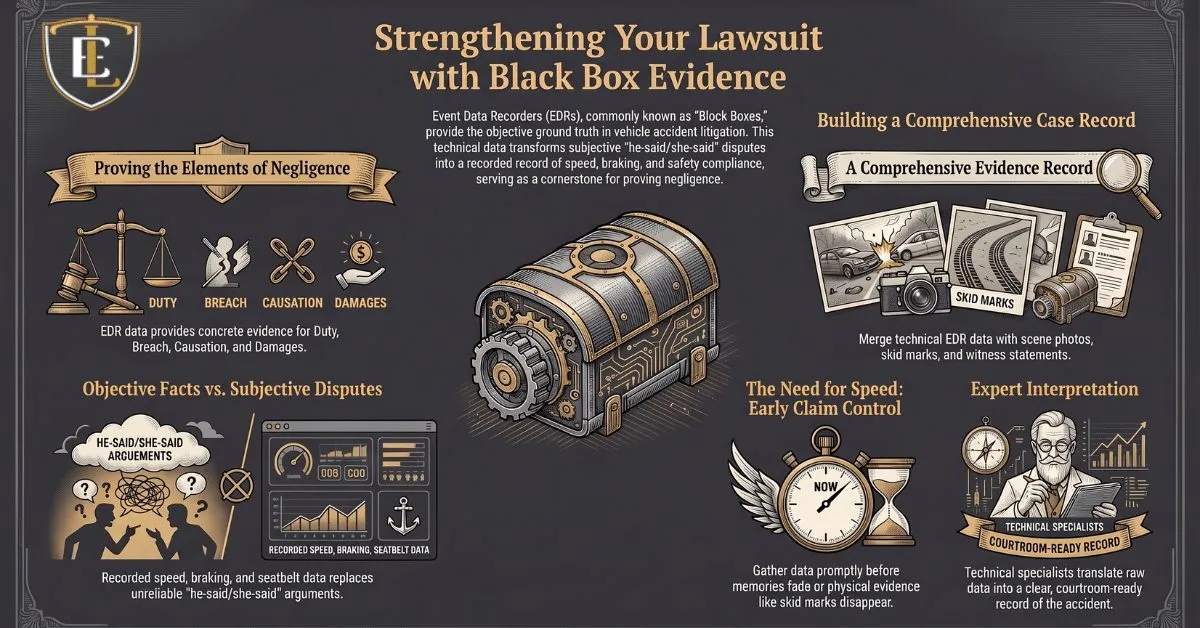
Most newer vehicles carry an event data recorder, or black box. It captures the seconds around a crash: vehicle speed, braking, throttle position, and whether seatbelts were buckled. That data can prove the at-fault driver was speeding or rebut a claim that you stopped short. In a contested case, the black box in your car can turn a he-said dispute into a question of recorded fact.
Event data recorders can be overwritten or lost once a vehicle is repaired or scrapped, so preserving that evidence matters. A lawyer can send a spoliation letter that puts the other side on notice to keep the vehicle intact, then use a certified download tool to pull the data before it disappears. Because the module often sits in the at-fault driver’s car, getting it usually requires a formal request or a court order, which is one more reason a lawsuit can unlock proof that a friendly insurance claim never would.
To win a personal injury lawsuit, you must prove negligence, which has four elements: duty, breach, causation, and damages. The other driver owed you a duty of care, breached it, caused the car crash, and the crash caused your losses. Black box data and other evidence support each element.
Black box data is strongest alongside the rest of the record.
- Photos from the accident scene and of the vehicles
- Skid marks and road conditions
- Witness statements from the parties involved and bystanders
- Your medical records and treatment history
- The police report from the responding officer
Collect evidence promptly. Skid marks can disappear, vehicles may be fixed, and memories can fade, so it’s important to gather information soon after the car accident.
Video evidence and eyewitness testimony complement black box data, and expert testimony explains what the numbers mean. The same approach applies across crash types. A Los Angeles bicycle accident lawyer, for instance, gathers different evidence for a rider struck at an intersection than for a two-car highway collision, but the goal is the same: a clear record of what happened.
Common Mistakes to Avoid When Deciding Whether to Sue
Even a strong claim can lose value through avoidable errors. The most damaging one is waiting too long. California’s two-year deadline under CCP section 335.1 is firm, and a claim involving a government vehicle needs an administrative claim within six months. If you miss the deadline, the court will likely dismiss your case permanently. Many individuals mistakenly believe that engaging in settlement discussions stops the statute of limitations. This is not the case. Only filing the lawsuit stops the statute of limitations, so ongoing negotiations with the insurance company give you no protection on their own.
Settling too early is the next trap. An insurance adjuster’s first settlement offer often arrives before you reach Maximum Medical Improvement, which leaves future care and lost earning capacity uncounted, and once you sign a release, you cannot reopen the claim. Taking that first number, or giving a recorded statement without advice, hands the insurer room to minimize what you recover. Evidence fades too, so photos of the accident scene, the police report, and witness statements are worth gathering early rather than late.
One more myth costs people real money: the belief that shared fault ends a claim. Under California’s pure comparative negligence rule, you can still recover even if you were partly at fault, with your award reduced by your percentage rather than erased. A gap in medical treatment can undercut that recovery, so prompt, consistent care protects both your health and your claim. Skipping the required SR-1 report or delaying notice to your own insurer is another quiet mistake, since either can hand the carrier a technical reason to fight you later.
Ready to Find Out if You Should Sue After Your Car Accident?
Deciding when to sue comes down to your injuries, the insurer’s offer, who was at fault, and the deadline on your claim. Wait too long, and California’s two-year limit can bar your case entirely; settle too soon, and you may give up compensation for future care. A short conversation with an attorney can tell you where your claim stands before either clock runs out.
Our experienced car accident attorneys represent injured Californians on a contingency fee basis, so there is no fee unless we recover for you, and the firm has recovered more than $100 million for its clients. With a 5.0 Google rating across 267 reviews and results that include an $11 million-plus jury verdict, the team handles motor vehicle and premises liability claims from the first demand letter through trial. Contact us today for a free consultation to pursue the full compensation you are owed.
Frequently Asked Questions
At Etehad Law, APC, our team has handled California car accident claims since 1996, and these are the questions car accident victims ask us most. None of this replaces advice about your specific case.
Can I Sue for a Car Accident if I Am Not Physically Hurt?
Yes. Property damage carries a three-year deadline in California, so you can sue over your vehicle even without an injury. Emotional distress may also be recoverable in some cases. That said, a claim with no real damages is weak and rarely worth a lawsuit.
What Is the Statute of Limitations for Suing After a Car Accident?
In California, you generally have two years to file for personal injury and three years for property damage. If a government vehicle was involved, you must file an administrative claim within six months. Deadlines vary by state, so confirm yours with an attorney.
What Factors Should I Consider Before Deciding to Sue?
Weigh how serious your injuries are, whether the insurance offer is fair, and whether liability is disputed. Compare your total damages against the available policy limits. Factor in the legal costs and time a lawsuit takes before you file.
When Does Suing After a Car Accident Make Legal Sense?
A lawsuit makes sense when negligence is clear, your injuries are serious or permanent, liability is contested, or an insurer refuses to pay fair value. It is also the move when your damages exceed the at-fault driver’s coverage. If the claim resolves fairly in negotiation, suing may be unnecessary.
How Does California’s Comparative Fault Rule Affect My Case?
California uses pure comparative negligence, set by Li v. Yellow Cab Co. You can recover even if you were mostly at fault, but your award drops by your percentage of blame. For pain-and-suffering damages, Civil Code section 1431.2 ties each defendant’s share to its own fault, so the rule cuts both ways depending on the facts.
What if the Other Driver Was Uninsured or Underinsured in California?
Your own uninsured or underinsured motorist coverage can step in when the at-fault driver has no policy or too little coverage. These claims run against your insurer and can involve arbitration rather than a court trial. Suing the at-fault driver directly is still possible, but collecting from someone with no assets is often difficult.
Do I Have to Report My California Car Accident to the DMV?
Yes, in many cases. Vehicle Code section 16000 requires an SR-1 report to the DMV within 10 days when a crash causes injury, death, or property damage above the state threshold, regardless of fault. This is separate from any police report or lawsuit, and missing it can affect your driving privileges.
Is It Bad to Sue After a Car Accident?
No. Filing a lawsuit is a legal right, not a sign of greed. It is simply one way to recover what you are owed when an insurer will not pay. Weigh the time, cost, and emotional toll against the compensation at stake.
What Do I Have to Prove to Win a Car Accident Lawsuit?
You must prove negligence through four elements: duty, breach, causation, and damages. In plain terms, the other driver owed you care, failed to use it, caused the crash, and the crash caused your losses. Evidence ties each element together.
How Much Can I Expect From a Car Accident Settlement?
It depends on your injury severity, your total damages, who was at fault, and the policy limits. There is no standard figure, and anyone who quotes one before reviewing your medical bills and lost income is guessing.
Is My California Car Accident Settlement Taxable?
Usually not the injury portion. Under IRS Publication 4345, compensation for physical injuries or sickness is generally not taxable, though interest and some punitive damages can be. Rules get technical, so confirm your situation with a tax professional before you spend the money.
What Should I Do With a Large Car Accident Settlement?
Plan for the long term. Consider future medical needs, then talk with financial and tax professionals about managing the money. Compensatory damages for personal injury are generally not taxable income, but rules differ, so confirm your situation with a qualified advisor.
Legal Disclaimer
This article is general information, not legal advice; deadlines and outcomes vary by case; consult an attorney about your specific situation. Reading it does not create an attorney-client relationship. This advertisement is the responsibility of Etehad Law, APC.
You may also like
 Accident and Injury
 California Personal Injury Statute of Limitations
Learn the California statute of limitations for personal injury claims, key filing deadlines, exceptions, and why you should act quickly.
Read More » Expert Opinion
 What is a Vehicle Black Box and How Can It Help Your Case?
Uncover the role of your car black box in legal cases. Insights from Personal Injury Attorney in Beverly Hills await. Check to…
Read More » Expert Opinion
 Will Posting on Social Media Tank Your Case?
How social media posts can affect a legal case, the dos and don'ts while a claim is open, and what insurers look…
Read More »
