


If you’re wondering how to file a slip and fall claim in California, start by reporting the fall, getting medical attention, and documenting what happened. You’ll also need to gather evidence that shows where and how the accident occurred and whether the property owner’s negligence contributed to your injuries. From there, you can file an insurance claim and pursue compensation for medical bills, lost wages, and other losses.
At Etehad Law, we represent injury victims on a contingency fee basis, meaning you pay no attorney fees unless we recover compensation for you. Our firm has recovered more than $100 million in settlements and has earned a 5-star rating based on more than 240 Google reviews. Our case results include an $11 million-plus jury verdict and numerous policy-limit recoveries in motor vehicle and premises liability cases. If you were injured in an accident, contact us today for a free consultation to pursue the maximum compensation.
In this guide, we’ll walk through how to file a slip and fall claim in California, what evidence you need, how to prove negligence, what compensation you may recover, and when legal deadlines may apply.
Understanding Liability In Slip And Fall Claims

One of the most critical aspects of any slip and fall claim is determining liability. In most cases, this falls under the legal concept of premises liability, which holds property owners accountable for maintaining safe conditions. Premises liability means that property owners have a legal duty to ensure that their premises are reasonably safe for visitors. If they fail to fulfill this duty, they can be held responsible for any accidents that occur as a result of unsafe conditions on their property.
When you enter a public or private property, you have the right to expect that the premises are safe. Legally, property owners are responsible for ensuring that hazardous conditions, such as wet floors, broken steps, or poor lighting, are promptly addressed. However, being injured on someone else's property doesn't automatically mean the owner is liable. To establish liability, you must prove that the property owner knew (or should have known) about the hazardous condition and failed to address it in a timely manner. For example, if a grocery store employee spills a liquid and doesn't clean it up or put up a warning sign, the store may be held liable if someone slips and gets injured. The key factor here is negligence — proving that the property owner did not take reasonable steps to maintain a safe environment.
Conditions For Property Owner Liability
In California, property owners and others who control a property generally have a duty to keep the premises in a reasonably safe condition. The Judicial Council of California explains that this duty can include inspecting the property, discovering dangerous conditions, and repairing them or providing an adequate warning when reasonable care would have revealed the hazard.
Common hazards include wet or slippery floors, uneven flooring, cluttered walkways, and inadequate lighting. But simply falling on someone else’s property does not automatically make the property owner liable. A successful slip and fall claim generally requires evidence showing that a dangerous condition existed, the property owner knew or should have known about it, and the failure to take reasonable steps to address the condition contributed to the injury.
This is why evidence matters in a slip and fall case. Photos of the accident scene, incident reports, witness statements, and medical records can help establish what happened and connect the hazardous condition to your injuries.
Steps To Filing A Slip And Fall Claim
Filing a slip and fall claim can feel overwhelming, but taking the right steps after an accident can significantly improve your chances of success. Here's what you need to do to ensure your claim is as strong as possible:
Step 1: Seek Medical Attention
Your health should come first after a slip and fall. Seek medical attention promptly, even if your injuries seem minor or you initially feel fine. Some fall injuries, including head injuries and soft-tissue damage, may not be immediately apparent.
Tell the medical professional exactly how the fall happened and where you were injured. Follow any recommended treatment and keep copies of your medical records, bills, prescriptions, and other treatment-related documents.
Medical records establish what injuries you suffered and help connect those injuries to the fall. They can also document the treatment you needed and the medical expenses you incurred.
Step 2: Document The Scene
If you are physically able to do so, document the accident scene as soon as possible after the fall. This can be some of the most valuable evidence in a slip and fall case.
Start by taking photographs of the hazard that caused your fall. If you slipped on a wet floor, photograph the spill before it is cleaned. If you tripped over broken flooring, photograph the damaged area from several angles. Don't just take a close-up. Capture photographs of the surrounding area so someone reviewing the evidence can understand where the fall occurred.
You should also document:
- The exact location where you fell
- The hazardous condition that caused the fall
- The area around the hazard
- Lighting and visibility conditions
- Any warning signs or barriers
- Your clothing and shoes
- Any visible injuries
- Weather conditions if the fall happened outdoors
- Nearby security cameras or other potential sources of footage
Pay attention to details that may seem insignificant. A photograph showing that a wet floor had no warning sign may be more useful than a photograph of the floor alone. Likewise, photographs showing poor lighting can help explain why a hazard was difficult to see.
Why Timing Matters
Documenting the scene quickly matters because hazardous conditions can disappear. For example, a store employee may clean up a spill, a broken object may be removed, or a walkway may be repaired before you have another opportunity to photograph it.
Security camera footage can also be overwritten or deleted. If you notice cameras near the accident scene, make a note of their location and tell your attorney. Your attorney may be able to request that the property owner preserve relevant footage.
If anyone witnessed the fall or the hazardous condition, ask for their name and contact information. Witness statements can help confirm what happened, particularly if the property owner or insurance company later disputes your version of events.
You should also report the fall to the property owner, manager, or another person responsible for the property. Ask for a written incident report and keep a copy if one is provided. An incident report can create an important record of when and where the fall occurred and who was notified.
Step 3: Contact A Personal Injury Attorney
Consider speaking with a personal injury attorney who handles slip and fall cases. A slip and fall attorneycan review the circumstances of your fall, explain your legal options, and help determine whether the property owner may be responsible for your injuries.
Your attorney can also help gather evidence, communicate with the insurance company, and calculate the compensation you may be entitled to pursue. This can include medical expenses, lost wages, physical pain, emotional distress, and other losses.
An attorney can also help protect you from making statements or accepting a settlement before you understand the full value of your claim.
Step 4: File The Claim And Begin Negotiations
Once your attorney has the necessary evidence and medical documentation, they can help you pursue an insurance claim against the responsible party. This generally involves presenting evidence of the accident, explaining why the property owner was negligent, and documenting your damages.
Your attorney may prepare a demand package containing relevant medical records, medical bills, lost wage documentation, photographs, witness information, and other evidence supporting your claim.
The insurance company may accept the claim, dispute liability, or make a settlement offer. Don't assume the first offer is a fair settlement. Your attorney can negotiate on your behalf and assess whether an offer reasonably reflects your medical expenses, lost wages, pain and suffering, and other damages.
If the parties cannot reach a fair settlement, you may need to pursue a slip and fall lawsuit. Your attorney can explain the legal process and help determine whether filing a formal complaint is appropriate for your case.
Key Considerations For A Successful Slip and Fall Claim
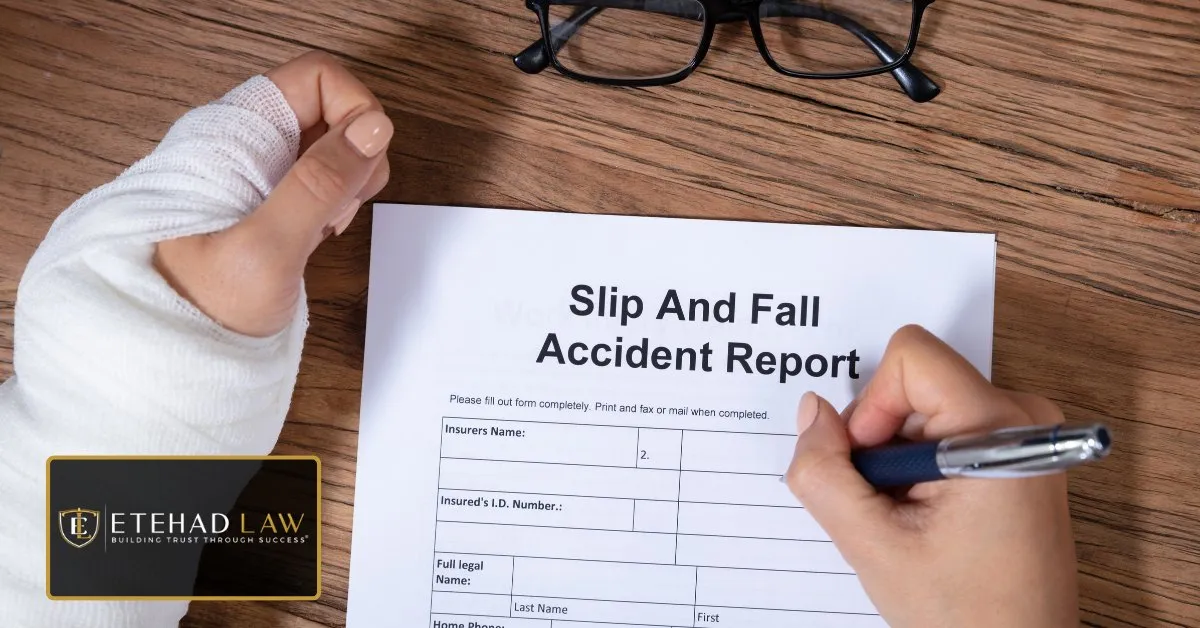
A successful slip and fall claim usually comes down to whether you can prove the property owner was negligent. In California, you generally need to show that a dangerous condition existed, the property owner knew or should have known about it, and failed to take reasonable steps to fix it or warn you about it. You also need to show that the condition contributed to your injuries.
Proving the Property Owner Knew About the Hazard
One of the most important questions in a slip and fall case is how long the hazardous condition existed and whether the property owner had a reasonable opportunity to address it.
For example, suppose a grocery store employee sees a spill but leaves it on the floor without cleaning it or placing a warning sign. If you later slip on that same spill and suffer injuries, the evidence may support an argument that the store knew about the hazard and failed to act reasonably.
But actual knowledge isn't always necessary. A property owner may also be responsible when they should have discovered the dangerous condition through reasonable inspections and maintenance.
This is why evidence showing when and how the hazard developed can be important. Surveillance footage, cleaning records, inspection logs, employee statements, and witness testimony may help establish whether the property owner had enough time to discover and correct the problem.
Gathering Evidence That Supports Your Case
Solid evidence can make it easier to establish what happened and why the property owner should be held responsible. Depending on the circumstances, this may include:
- Photos and videos of the hazardous condition
- Photographs of the surrounding accident scene
- Witness statements and contact information
- Security camera footage
- Incident or accident reports
- Property inspection and maintenance records
- Records showing previous complaints about the same hazard
- Your clothing and shoes worn during the fall
- Medical records and medical bills
- Documentation of lost wages and other financial losses
Security footage can be particularly useful because it may show the condition of the property before, during, and after the fall. However, businesses may not keep surveillance footage indefinitely. If cameras captured the fall, tell your attorney as soon as possible so appropriate steps can be taken to preserve potentially relevant evidence.
Connecting the Fall to Your Injuries
You also need evidence connecting the hazardous condition to the injuries you are claiming. Seeking medical attention promptly can help establish this connection.
Your medical records can show when you sought treatment, what injuries were diagnosed, and what treatment your medical professional recommended. Keep records of medical expenses, physical therapy, medication, and other accident-related costs.
This documentation becomes especially important when injuries require ongoing medical treatment or result in lost wages. It can help demonstrate the financial impact of the fall as well as the physical pain and limitations you experienced.
When Expert Testimony May Help
Some fall cases involve technical questions that may require expert testimony. For example, an expert may be able to address whether a particular property condition violated applicable safety standards or whether the property owner used reasonable maintenance practices.
Expert testimony isn't necessary in every slip and fall case. Whether it is useful depends on the circumstances and the specific legal and factual issues involved.
The goal is to build a clear connection between the hazardous condition, the property owner's failure to act reasonably, and your fall injuries. The stronger the evidence supporting each part of your case, the better positioned you may be to pursue fair compensation.
What If You Were Partially at Fault?
Being partly responsible for a slip and fall does not automatically prevent you from recovering compensation in California. The state follows a comparative negligence system, which means your compensation can be reduced based on the percentage of fault assigned to you. California’s official jury instructions state that if a plaintiff’s negligence contributed to their harm, their damages are reduced by the percentage of responsibility assigned to them.
For example, an insurance company or property owner might argue that you contributed to the accident because you:
- Were wearing footwear that was unsuitable for the conditions
- Ignored a clearly visible warning sign
- Failed to use an available safe route
- Were distracted and did not notice an obvious hazard
Suppose you suffered $100,000 in damages but were found 35% responsible for the fall. Your recoverable damages could be reduced by 35%, leaving you with $65,000.
That does not mean the property owner is automatically off the hook. The important question is whether your conduct was a substantial factor in causing your injuries and, if so, how much responsibility should reasonably be assigned to each party. California's CACI instructions recognize that responsibility can be divided among multiple parties rather than treating liability as an all-or-nothing question.
This is one reason it's important to speak with a slip and fall attorney before assuming you cannot bring a claim. An insurance company may try to place more blame on you than the evidence supports. A personal injury lawyer can review the accident scene, witness statements, photographs, medical records, and other evidence to determine how comparative negligence may affect your fall case.
What If the Slip and Fall Happened on Government Property?
A slip and fall on a public sidewalk, government building, or other government property can involve different rules from a typical premises liability claim. If a city, county, state agency, or other California government entity is responsible for the property, you generally must file an administrative claim before filing a lawsuit. California Courts explains that injury claims against a government agency generally must be submitted within six months of the injury.
This administrative claim is different from simply reporting your fall to a government employee. It is a formal claim that provides information about the accident, the government entity involved, your injuries, and the compensation you are seeking. After receiving the claim, the agency generally has 45 days to respond. If the agency rejects your claim, you generally have six months from the date the rejection was mailed to file a lawsuit. If the agency does not respond within 45 days, different deadlines may apply.
The government entity responsible for the property also matters. For example, a dangerous city sidewalk may involve a city government, while a fall at a county facility could involve the county. A state-owned property may involve a state agency. Identifying the correct agency is important because sending a claim to the wrong entity can create problems with your case.
Since these deadlines are shorter and the filing requirements are different, don't wait to address a fall on government property. A slip and fall attorney can help identify the responsible government entity, gather evidence from the accident scene, and determine which deadlines apply to your claim.
How Long Do You Have to File a Slip and Fall Claim in California?

In California, you generally have two years from the date of a slip and fall injury to file a personal injury lawsuit. California Courts identifies personal injury cases, including slips and falls, as subject to a two-year statute of limitations. If you wait until after the deadline, the other side may ask the court to dismiss your case.
However, the two-year rule does not apply to every situation. Certain circumstances can change when the deadline begins or how much time you have to file. For example, California Courts notes that the deadline may be affected by tolling in certain situations. The rules can also differ when the injury was not immediately discovered or when the claim involves a government agency.
Government claims have particularly important deadlines. If your slip and fall occurred on government property, you generally must submit an administrative claim within six months of the injury before you can file a lawsuit. If the government rejects your claim, you generally have six months from the date the rejection was mailed to file a lawsuit. If the government does not respond within 45 days, different rules may apply.
It's also important to understand that reporting your accident is not the same as filing a lawsuit. Telling a store manager, property owner, or insurance company about your fall creates a record of the incident, but it does not necessarily stop the statute of limitations from running. The date you reported the accident and the deadline for filing a lawsuit are separate legal considerations.
Because missing a filing deadline can prevent you from recovering compensation, don't wait until the last minute to address a slip and fall claim. If you're unsure which deadline applies to your fall case, a slip and fall attorney can review the circumstances and help you determine the appropriate deadline.
When Should You Hire a Slip and Fall Lawyer?
You don't necessarily need a lawyer for every minor slip and fall. However, speaking with a slip and fall lawyer in Los Angeles can be especially helpful when liability, your injuries, or the amount of compensation is disputed.
Consider hiring a lawyer if the property owner denies responsibility for the accident. They may argue that the hazardous condition did not exist, that they were unaware of it, or that someone else was responsible for maintaining the area. An attorney can investigate the circumstances and gather evidence to determine whether the property owner's negligence contributed to your fall.
You should also consider legal help if the insurance company blames you for the accident. California's comparative negligence rules can reduce your compensation based on your share of fault. An attorney can review the evidence and challenge an unfair attempt to shift responsibility onto you.
Legal representation can be particularly valuable when you have suffered serious or permanent injuries. Broken bones, head injuries, spinal injuries, and disabilities can result in significant medical expenses, lost wages, and long-term changes to your daily life. These cases may require a closer evaluation of both your current and future losses.
You may also benefit from a lawyer when significant evidence is disputed or could disappear. Surveillance footage, for example, may not be kept indefinitely. Witness accounts, photographs, incident reports, and other evidence can also become harder to obtain as time passes. An attorney can take steps to identify and preserve important evidence.
A lawyer can also help when multiple parties may be responsible for the fall. Depending on the circumstances, liability could involve a property owner, business, property manager, maintenance company, or another party. Determining who may be legally responsible can become complicated when several parties are involved.
If your accident happened on government property, getting legal advice promptly is especially important. Claims against government entities can involve additional requirements and shorter deadlines than ordinary personal injury claims.
Finally, consider speaking with an attorney if an insurance company offers a settlement that does not adequately cover your losses. Before accepting an offer, you should understand whether it accounts for your medical bills, lost wages, physical pain, emotional distress, and other damages related to the fall.
A slip and fall attorney can investigate the accident, gather evidence, communicate with the insurance company, and guide you through the legal process. Etehad Law offers a free consultation and can help you understand your options for pursuing fair compensation after a fall.
Common Mistakes That Can Hurt a Slip and Fall Claim
Small decisions after a slip and fall can affect the evidence available for your case. Avoid these common mistakes:
| Mistake | Why It Can Hurt Your Claim |
|---|---|
| Failing to report the accident | If you don't report the fall, there may be no incident report documenting when and where it happened. Report the fall to the property owner, manager, or responsible employee as soon as possible. |
| Waiting too long to seek medical care | Delaying treatment can make it harder to connect your injuries to the fall. Seek medical attention promptly and follow your medical professional's recommendations. |
| Not photographing the hazard | A spill, obstruction, or other hazardous condition can be cleaned, repaired, or removed quickly. Photos taken at or near the time of the accident can help show what caused your fall. |
| Throwing away the shoes or clothing involved | Your shoes and clothing may provide useful evidence about the conditions at the time of the accident. Keep them in their original condition rather than washing, repairing, or throwing them away. |
| Assuming the business's incident report proves liability | An incident report can document that the fall occurred, but it does not automatically establish that the property owner was negligent. You may need additional evidence showing what caused the fall and whether the property owner knew or should have known about the hazard. |
| Giving a recorded statement without understanding what is being asked | An insurance company may ask questions about the accident, your injuries, or your medical history. Statements taken out of context can potentially be used to dispute your claim. Understand what you are being asked before providing a recorded statement. |
| Accepting a settlement before knowing the extent of your injuries | Some injuries require ongoing medical treatment or physical therapy. Accepting a settlement too early can leave you without enough compensation for future medical expenses and other losses. |
| Waiting until the statute of limitations is approaching | Personal injury claims have legal deadlines, and government claims can have even shorter deadlines. Waiting too long can leave you with insufficient time to investigate the accident or take the necessary legal steps. |
Need Help With Your Slip and Fall Claim?
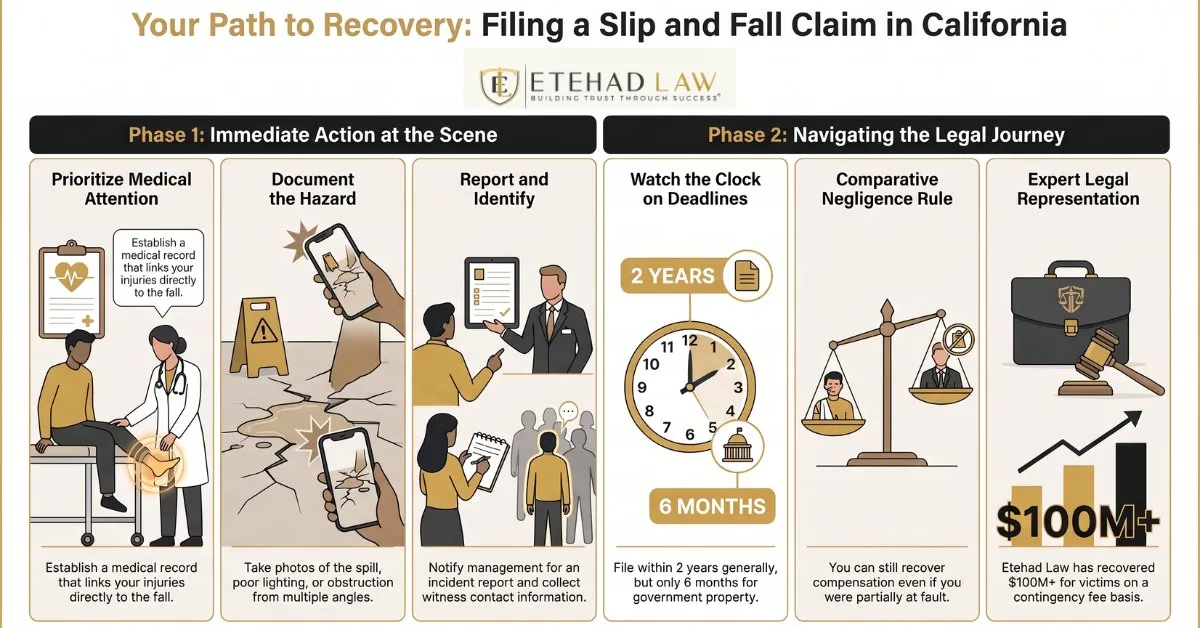
A slip and fall can leave you dealing with injuries, medical bills, lost wages, and uncertainty about what to do next. If you believe a property owner's negligence caused your fall, you don't have to handle the claim alone. Etehad Law can help you understand your legal options, gather important evidence, and pursue the compensation you may be entitled to recover.
Our team can help build your case using evidence such as medical records, witness statements, photographs, incident reports, and available security footage. We can also handle communication and negotiations with the insurance company while you focus on your recovery.
If you've been injured in a slip and fall accident in California, it's important to act promptly. Seek medical attention, report the incident, preserve evidence, and speak with a personal injury attorney before making decisions that could affect your claim.
Contact Etehad Law today for a free consultation. We can review the circumstances of your fall, explain your options, and help you determine the next step toward seeking fair compensation.
FAQs
A slip and fall claim can raise questions about evidence, fault, deadlines, and what to do after an accident. Here are answers to some of the most common questions California fall victims may have.
How Do I File a Slip and Fall Claim in California?
Start by seeking medical attention, reporting the accident to the property owner or manager, and documenting the accident scene. Take photographs of the hazardous condition, collect witness contact information, and keep your medical records and bills. You can then file an insurance claim with the responsible party's insurer. If the insurer refuses to offer a fair settlement, you may need to pursue a slip and fall lawsuit.
Do I Need Proof That the Property Owner Knew About the Hazard?
Not necessarily. In California, a property owner may be responsible when they knew about a dangerous condition or should have discovered it through reasonable care. Evidence showing how long the hazard existed, such as surveillance footage, inspection records, employee statements, or witness accounts, can help establish whether the owner had an opportunity to address it.
What If the Dangerous Condition Was Only There for a Short Time?
A short-lived hazard does not automatically prevent you from bringing a claim. The important question is whether the property owner had actual or constructive notice of the condition and failed to take reasonable steps to address it. For example, a spill that appeared shortly before a fall may be more difficult to establish as negligence if there is no evidence the property owner had a reasonable opportunity to discover and clean it.
Can I Sue If I Was Partially at Fault for the Fall?
Yes, you can. California follows comparative negligence rules, so being partially responsible for a fall does not necessarily prevent you from recovering compensation. However, your damages may be reduced according to your percentage of fault. For example, if you were found 20% responsible for an accident resulting in $100,000 in damages, your recovery could be reduced to $80,000.
What Evidence Do I Need for a Slip and Fall Claim?
Useful evidence can include photographs and videos of the accident scene, witness statements and contact information, incident reports, security footage, medical records, medical bills, and documentation of lost wages. You should also preserve the shoes and clothing you were wearing during the fall. Evidence showing the condition of the property around the time of the accident can be particularly important because hazards may be cleaned, repaired, or removed quickly.
What If the Business Refuses to Give Me the Accident Report?
Ask the business to provide you with a copy and keep a record of your request. A business refusing to provide an incident report does not necessarily mean you cannot pursue a claim. You can still document the accident independently through photographs, witness information, medical records, and other evidence. An attorney may also be able to help obtain relevant records during the legal process.
How Long Do I Have to File a Slip and Fall Lawsuit in California?
California generally gives you two years from the date of the injury to file a personal injury lawsuit. However, exceptions can affect the deadline. Claims involving government property have additional requirements and generally require an administrative claim within six months of the injury. Because missing a legal deadline can prevent you from recovering compensation, it is important to determine the deadline that applies to your specific case.
What If I Fell on Government Property?
A fall on government property can involve special claim requirements and shorter deadlines. In California, you generally must submit an administrative claim to the appropriate government entity within six months of the injury. If the claim is rejected, additional deadlines may apply before you can file a lawsuit. Speak with a slip and fall attorney promptly to determine which government entity is responsible and which deadlines apply.
Legal Disclaimer: The information provided in this article is for general informational purposes only and does not constitute legal advice. Every slip and fall case is different, and the laws and deadlines that apply can depend on the specific facts of your situation. Reading this article does not create an attorney-client relationship. If you have been injured in a slip and fall accident, consult a qualified California personal injury attorney for advice about your individual case.
You may also like
 Accident and Injury
 California Personal Injury Statute of Limitations
Learn the California statute of limitations for personal injury claims, key filing deadlines, exceptions, and why you should act quickly.
Read More » Expert Opinion
 What is a Vehicle Black Box and How Can It Help Your Case?
Uncover the role of your car black box in legal cases. Insights from Personal Injury Attorney in Beverly Hills await. Check to…
Read More » Expert Opinion
 Will Posting on Social Media Tank Your Case?
How social media posts can affect a legal case, the dos and don'ts while a claim is open, and what insurers look…
Read More »
