

Key Takeaways
- An army veteran hurt in a California motorcycle crash can pursue two separate recoveries at once: a civilian injury claim against the at-fault driver and a VA service-connection claim.
- The two paths run independently, so settling a civilian claim rarely cancels VA disability benefits.
- California allows two years to file a civilian claim (CCP §335.1); active duty can pause that clock under the SCRA (50 U.S.C. §3936).
- VA disability compensation is tax-free and separate from any civilian settlement.
An Army veteran injured in a California motorcycle accident can typically pursue two recovery paths at the same time: a civilian personal injury lawsuit against the at-fault driver and a VA service-connection claim through Veterans Affairs. These two avenues run independently, and pursuing one does not usually cancel the other. That parallel structure is the single most important fact behind any settlement for an army veteran injured in a motorcycle accident.
Etehad Law has 30+ years of California personal injury experience and represents injured veterans and civilian victims statewide. Our practice areas cover motorcycle crashes, catastrophic injuries, and complex insurance disputes. Contact us for a free case evaluation if a motorcycle accident has affected your health, your family’s finances, or your military career.
This article covers the dual recovery framework, California’s filing rules, the documentation chain veterans need to protect, common mistakes, and the FAQs we hear most often.
Why Army Veteran Motorcycle Accidents Carry Unique Stakes
According to the National Highway Traffic Saftey Administration (NHTSA), motorcyclists were nearly 27 times more likely than passenger-car occupants to die in a crash, and about 5 times more likely to be injured per vehicle mile traveled. The most common causes range from speed and rider error to other drivers failing to yield at intersections. The most common injuries sustained in a motorcycle crash include shattered femurs, compartment syndrome, road rash, broken bones, traumatic brain injuries, spinal cord damage, neck whiplash, and upper extremity fractures.
CDC data shows approximately 30% of non-fatal motorcycle accident injuries are to the lower extremities. For a service member, even a moderate injury can mean medical disqualification from military service. The psychological aftermath of motorcycle accidents can include PTSD, depression, and anxiety. These mental health challenges compound the physical toll on veterans and their families. This is why an army veteran motorcycle settlement must address both medical bills and the long-term impact of a shortened career.
The Two Recovery Paths Available After a Motorcycle Accident
Veterans frequently possess two distinct avenues for financial recovery after a motorcycle crash. The first is a civilian personal injury lawsuit or settlement against the at-fault driver’s insurance company under California law. The second is a federal VA service-connection benefits claim through the U.S. Department of Veterans Affairs.
These paths protect different parts of a veteran’s life. The civilian motorcycle accident claim recovers damages tied to the collision itself: medical expenses, lost wages, pain and suffering, and property damage. The VA path produces tax-free monthly disability compensation and free medical care for the service-connected condition.
Critically, pursuing a civilian PI settlement does not usually disqualify a veteran from receiving VA disability compensation. The two avenues run on parallel tracks with separate eligibility rules and deadlines, so a veteran who settles a civilian motorcycle accident claim can still file or update a VA disability rating.
| Recovery Path | Source | Eligibility | Compensation Type | Tax Treatment | Deadline |
| Civilian PI Settlement | At-fault driver’s insurer or lawsuit | Any California accident victim | Medical expenses, lost wages, pain and suffering, property damage | Generally taxable on the lost-wages portion | 2 years from the date of the accident (CCP §335.1) |
| VA Service-Connection | U.S. Department of Veterans Affairs | Active-duty injury, or exacerbation of a pre-existing service-connected condition | Tax-free monthly disability compensation, free VA medical care, TSGLI for severe traumatic injury | Tax-free | No strict filing deadline; sooner produces a faster rating |
Step-by-Step Process Etehad Law Recommends After a Veteran Motorcycle Accident
What a veteran does in the first 30 days after a motorcycle crash shapes both recovery tracks. Etehad Law recommends this framework to protect evidence, secure medical proof, and preserve both civilian and VA claims, whether the rider was on active duty or already separated from service.
Step 1: Secure Safety and Call 911
Assess your injuries and those of anyone else involved. Turn on hazard lights, move out of active traffic, and call 911 so police respond on the scene. Officers create the first official record of the crash. This record is essential for both the personal injury lawsuit and any subsequent VA documentation.
Step 2: Document the Scene and Gather Evidence
Take photos of the vehicles, your gear, skid marks, and the scene from multiple angles. Collect contact information for every witness. Preserve damaged gear like helmets, jackets, and boots. These items help an attorney show the full extent of impact forces.
Step 3: Obtain a Certified Copy of the Police Accident Report
Request a certified copy of the police accident report as soon as it becomes available, usually within a week or two. The certified version is what insurers, the VA, and the court treat as authoritative. Without it, the insurance company has room to dispute fault and the basic facts.
Step 4: Seek Immediate Medical Attention and Begin the Documentation Chain
Adrenaline and shock can mask injuries for 24 to 72 hours, so riders who feel fine may later discover serious internal injuries. Get evaluated immediately and ask treating physicians to explicitly note any exacerbation of a pre-existing service-connected condition in your medical records. The incident should be recorded in both military and civilian records. That documentation chain links the motorcycle accident to long-term health outcomes the VA will assess. Gaps in treatment are a top reason insurers cut settlement value.
Step 5: Notify the VA and Begin the Service-Connection Process
File a new claim with Veterans Affairs or move to update an existing disability rating. Veterans on active duty when injured should document the crash through their command and medical channels. Records that clearly link the accident to service, or to a pre-existing service-connected condition, are essential to a favorable rating.
Step 6: Contact a California Motorcycle Accident Lawyer Before Speaking to Insurers
Talk to a California lawyer before giving any recorded statement to the at-fault driver’s insurer. Dealing with adjusters alone almost always lowers what you recover. An experienced attorney coordinates both tracks, protects against insurer undervaluation, and preserves the 2-year California statute of limitations.
Filing a California Motorcycle Accident Personal Injury Claim
California Code of Civil Procedure §335.1 sets the personal injury statute of limitations at two years from the accident. If you miss that window, the court will almost always refuse to hear your case.
California follows pure comparative negligence under Li v. Yellow Cab Co. (1975) 13 Cal.3d 804. Even a 70% at-fault rider can recover the remaining 30%, which is why fault determinations and the circumstances at the scene matter so much.
Recoverable damages cover medical expenses, lost wages, pain and suffering, and property damage. Most California motorcycle accident cases resolve through settlement rather than trial, but a strong settlement position depends on readiness to litigate. Insurance companies routinely undervalue motorcycle claims and use recorded-statement traps to limit what they pay out.
Active-duty deployment can also affect timing. The Servicemembers Civil Relief Act (50 U.S.C. §3936) tolls statutes of limitations during active duty, preserving a claim a veteran was unable to file while deployed. For a focused review of fault, damages, and filing strategy, work with California personal injury attorneys who handle motorcycle cases regularly.
VA Service-Connection Benefits for Veteran Motorcycle Accident Victims
Active-duty motorcycle accidents can be documented as service-connected under 38 U.S.C. §1110 when long-term health issues result. A motorcycle crash that exacerbates a pre-existing service-connected condition also qualifies, even if the new accident itself happened off duty.
VA disability compensation ranges from $152.64 per month for a 10% rating up to several thousand per month for a 100% rating, and the funds are tax-free. The Military Daily News reports that in FY2025, the VA processed over 2.5 million disability claims, achieving a 61.8% approval rate. Of those approved, nearly 64% received a rating of 70% or higher, while 23.8% were rated at 100%.
The VA also provides medical care at no cost for service-connected injuries, offsetting long-term treatment costs. For severe qualifying traumatic injuries during active duty, limb loss, paralysis, or blindness, TSGLI under 38 U.S.C. §1980A provides a lump-sum payment to active-duty members and their families, with survivors eligible in fatal-injury circumstances.
Eligibility hinges partly on conduct. Proper Personal Protective Equipment use is often required for the incident to be considered “without misconduct.” Helmets are mandatory in California under Vehicle Code §27800, and lane-splitting has been authorized under Vehicle Code §21658.1 since 2017. Both factors affect how the VA characterizes the crash. If a federal or government vehicle was involved, Gov. Code §911.2 imposes a 6-month government tort claim deadline.
The legal framework surrounding veteran benefits has a distinct historical background. Vietnam veterans pursued class action lawsuits over Agent Orange exposure, with class members litigating through federal district court appeals and program reviews for decades. That line of litigation shaped how courts handle veteran-injury claims today.

Common Mistakes That Cost Veteran Motorcycle Accident Victims
Knowing what NOT to do is often as important as knowing the right next step.
Don’t Admit Fault at the Scene
The other driver, police, or insurer will use your apologies and admissions against your motorcycle accident claim. Stick to the facts, and let the police report and physical evidence determine fault.
Don’t Give a Recorded Statement to the Other Driver’s Insurer
You have no legal obligation to give a recorded statement to the at-fault insurer. Refer the request to your attorney. Insurers use those statements to lock victims into wording that limits potential compensation.
Don’t Skip the Medical Visit Even If You Feel Fine
Adrenaline can mask serious injuries for 24-72 hours after a crash. Treatment gaps are the most common reasons insurers deny or reduce claims.
Don’t Accept the First Settlement Offer
Initial offers from an insurance company are typically far below actual claim value, rarely accounting for future medical bills, ongoing therapy, or pain and suffering.
Don’t Miss the 2-Year Statute of Limitations
California’s personal injury statute of limitations is two years from the date of the accident (CCP §335.1).
Don’t Assume VA Benefits and a Civilian Settlement Cancel Each Other Out
This error is the most common veteran-specific mistake. Pursuing one path does not usually disqualify the other. Veterans who assume otherwise leave significant compensation unclaimed.
How an Experienced California Lawyer Helps Veteran Motorcycle Accident Victims
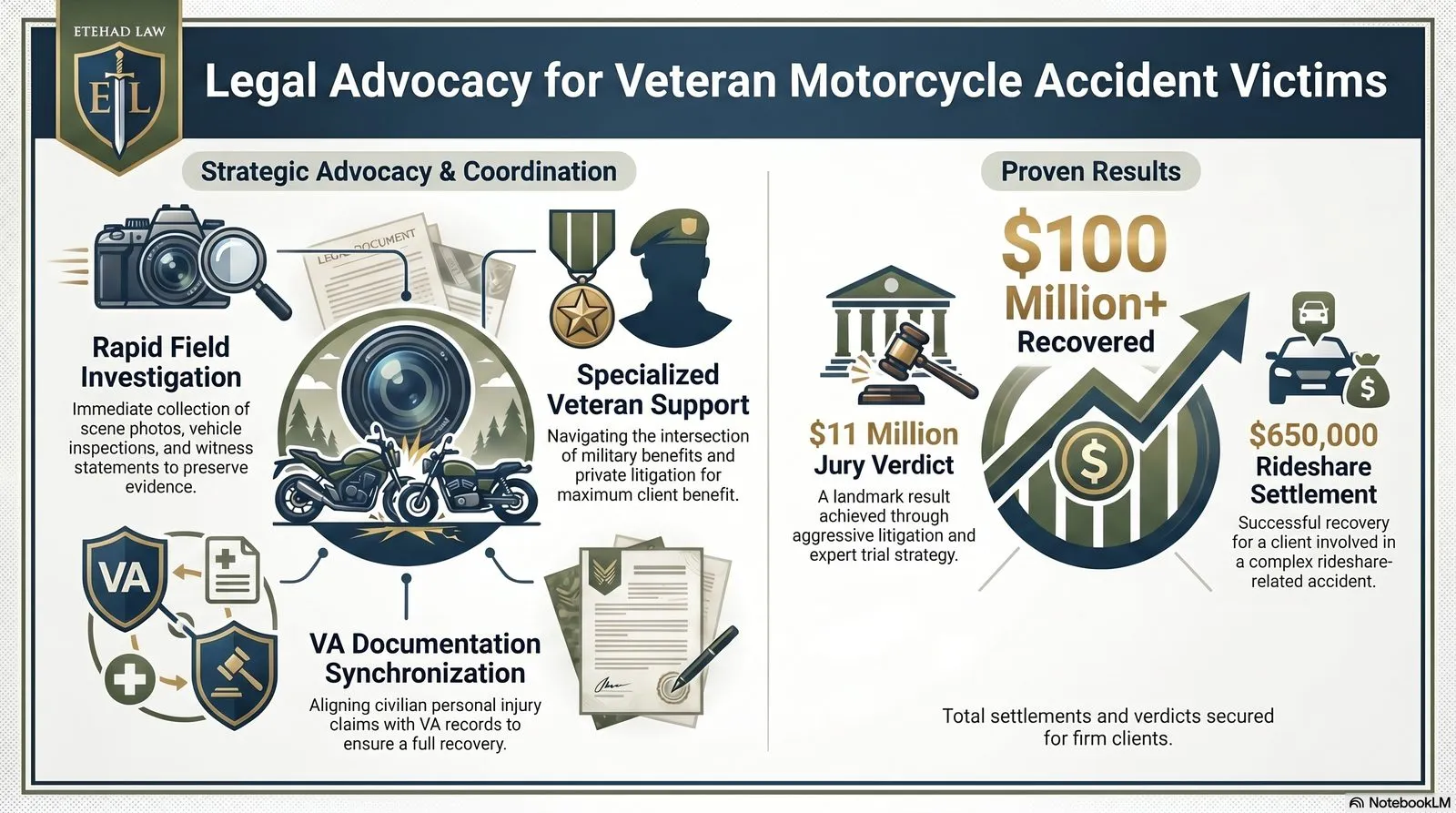
A California attorney with deep motorcycle accident experience, like a motorcycle accident lawyer in Beverly Hills at Etehad Law, does far more than file paperwork. Work begins with rapid investigation: scene photos, vehicle inspections, witness statements, and the certified police report and a settlement position built from disciplined documentation and readiness for litigation.
For an army veteran motorcycle settlement, coordination of the civilian PI claim with the VA documentation chain is the difference between a partial recovery and a full one. Etehad Law, led by founding attorney Simon P. Etehad, has spent 30+ years protecting California injury victims, service members, civilians, and survivors of fatal collisions.
Etehad Law has secured more than $100 million in settlements and verdicts for California personal injury clients, including motorcycle outcomes such as a $650,000 confidential rideshare settlement, a $554,287 jury verdict, and a $500,000 settlement in a disputed-liability case. Broader vehicle-injury recoveries include an $11 million jury verdict in a 70%-fault auto case and a $2.3 million pre-trial settlement in a motor vehicle crash. Results vary, and past results do not guarantee, warrant, or predict future cases.
Ready to Pursue Both Recovery Paths After Your Motorcycle Accident?
A motorcycle crash should not force a veteran to choose between fair civilian compensation and the VA benefits earned through service to the country. Etehad Law has spent more than three decades protecting injured Californians, and we know how to keep both recovery tracks moving in parallel. Acting quickly protects the evidence, the statute of limitations, and the documentation chain the VA will later assess.
Our attorneys handle California motorcycle settlements and broader litigation with the rigor high-stakes cases require, from initial investigation through any court proceedings. Contact us today or reach our experienced motorcycle accident lawyers at our Beverly Hills office for a free case evaluation. We will assess the challenges your case presents, identify every source of potential compensation, and act on your behalf to recover what you are owed.
Frequently Asked Questions
Etehad Law’s 30+ years of California personal injury experience and our work across veteran-adjacent claims let us answer the questions injured riders ask most often. The answers below cover timing, eligibility, statutes, and the practical factors that shape outcomes. Talk to a lawyer about your specific facts before relying on a general answer.
How Long Does an Army Veteran Motorcycle Accident Settlement Take in California?
Most cases resolve in nine to eighteen months, with severe-injury or disputed-liability matters running longer. Timing depends on medical stabilization, the insurer’s posture, and whether a personal injury lawsuit is filed. Cases that proceed to court take longer but often produce stronger results.
Can a Veteran Receive VA Disability Benefits and a Civilian Motorcycle Accident Settlement?
Yes. These are independent recovery paths. Pursuing a civilian motorcycle accident claim does not usually disqualify a veteran from receiving VA disability compensation. The two systems use separate eligibility rules and rarely offset each other.
What Is the Average Motorcycle Accident Settlement in California?
There is no single average because outcomes depend on the extent of injuries, fault allocation, and available insurance. For example, cases involving broken bones and short recovery may settle in the tens of thousands, while catastrophic-injury cases reach seven and eight figures. The full extent of damages and the at-fault policy limits drive the number.
Does Active Duty Affect the Statute of Limitations for a Motorcycle Accident Claim?
Yes. The Servicemembers Civil Relief Act (50 U.S.C. §3936) tolls California’s two-year statute during active-duty service, giving deployed service members extra time to file once they return.
What Are the Most Common Injuries in Military Motorcycle Accidents?
Lower extremity injuries account for about 30% of non-fatal motorcycle accidents per CDC data, often including shattered femurs and compartment syndrome. Other frequent injuries are broken bones, road rash, traumatic brain injuries, spinal cord damage, and neck whiplash.
How Is Fault Determined in a California Motorcycle Accident?
Fault is determined under California’s pure comparative negligence rule (Li v. Yellow Cab, 1975). Police reports, scene evidence, witness statements, and crash reconstruction help assess each party’s share. Even a partially at-fault rider can recover damages reduced by their percentage.
Does the VA Take Money Back From a Civilian Motorcycle Accident Settlement?
Your monthly VA disability compensation is not repaid out of a civilian settlement, because it is a service-connection benefit rather than a lien-based reimbursement. The distinction to watch is medical care. When the VA treats crash injuries, federal law at 38 U.S.C. §1729 lets the government recover the reasonable cost of that treatment from a third-party recovery, similar to a health-plan lien. That reimbursement claim applies only to the care provided, not to your disability rating, which continues regardless of the civilian outcome. An attorney identifies any VA or federal interest early and structures the settlement so those amounts are addressed correctly.
What Happens If the At-Fault Driver Was Uninsured or Underinsured?
California requires only modest liability limits, so a serious motorcycle injury often exceeds the at-fault driver’s coverage. If you carry uninsured or underinsured motorist coverage on your own auto or motorcycle policy, it can pay when the other driver has no insurance or too little to cover your losses. These claims are governed by California Insurance Code §11580.2 and usually require prompt written notice to your own insurer. Because many uninsured-motorist disputes go to arbitration rather than a jury, and the insurer still contests value, preserving the policy, the police report, and your medical records early protects the claim.
Can the Family of a Veteran Killed in a Motorcycle Crash Recover Compensation?
California’s wrongful death statute, Code of Civil Procedure §377.60, allows a surviving spouse, domestic partner, children, and certain dependents to recover funeral costs, lost financial support, and the loss of the veteran’s companionship. A separate survival action under CCP §377.30 can recover the losses the veteran experienced before death. On the federal side, survivors of a service member who dies from a qualifying traumatic injury may qualify for TSGLI, and Dependency and Indemnity Compensation is available to eligible survivors through the VA. As with injury claims, the civilian and VA paths are decided under separate rules.
How Does a Pre-Existing Service-Connected Condition Affect My Claim?
A prior service-connected injury does not block recovery. Under California’s eggshell-plaintiff principle, an at-fault driver is liable for aggravating a condition the victim already had, even if a healthier rider would have been hurt less. On the benefits side, 38 U.S.C. §1110 and the VA’s aggravation rules can support a higher disability rating when a crash worsens a service-connected condition, including a crash that happened off duty. The deciding factor is medical documentation that separates the new harm from the baseline condition, which is why treating physicians should note any aggravation directly in your records.
What Deadlines Apply If a Government or Military Vehicle Caused the Crash?
Crashes involving a government vehicle follow shorter, stricter deadlines than ordinary claims. If a California state or local government vehicle was at fault, Government Code §911.2 requires a government tort claim within six months of the accident before any lawsuit can proceed. If a federal vehicle or federal employee caused the crash, the Federal Tort Claims Act requires an administrative claim filed with the responsible agency within two years. Missing either deadline usually ends the case, and both run well ahead of the general two-year injury statute, so identifying who owned the other vehicle early matters a great deal.
What Evidence Most Strengthens a Veteran’s Motorcycle Accident Case?
The cases that resolve well pair a certified police report with scene and vehicle photographs and a gap-free medical record that ties each injury to the crash. For a veteran, service treatment records and any VA documentation linking the accident to a service-connected condition add a second evidentiary layer that civilian riders do not have. Preserved physical evidence such as a damaged helmet, along with independent witness statements, helps counter the insurer’s habit of blaming the rider. Crash reconstruction and treating-physician opinions then turn those records into a documented damages figure that supports the full settlement value.
Legal disclaimer
This article is for informational purposes only and does not constitute legal advice. Past results do not guarantee, warrant, or predict future outcomes. Pursuing a personal injury claim requires consultation with a licensed attorney about your specific facts. Etehad Law provides representation in California. You do not create an attorney-client relationship with the firm until you sign a written agreement.
You may also like
 Accident and Injury
 California Personal Injury Statute of Limitations
Learn the California statute of limitations for personal injury claims, key filing deadlines, exceptions, and why you should act quickly.
Read More » Expert Opinion
 What is a Vehicle Black Box and How Can It Help Your Case?
Uncover the role of your car black box in legal cases. Insights from Personal Injury Attorney in Beverly Hills await. Check to…
Read More » Expert Opinion
 Will Posting on Social Media Tank Your Case?
How social media posts can affect a legal case, the dos and don'ts while a claim is open, and what insurers look…
Read More »
