


Yes, you can sue an unlicensed contractor in California, and state law can give homeowners important remedies. California Business and Professions Code §7031 allows a person who hired an unlicensed contractor to seek recovery of compensation paid for work requiring a license.
At Etehad Law, we represent injury victims on a contingency fee basis, meaning you pay no attorney fees unless we recover compensation for you. Our firm has recovered more than $100 million in settlements and has earned a 5-star rating based on more than 240 Google reviews. Our case results include an $11 million-plus jury verdict and numerous policy-limit recoveries in motor vehicle and premises liability cases. If you were injured in an accident, contact us today for a free consultation to pursue the maximum compensation.
This article explains when a contractor must have a license and what happens when they work without one. We will also cover recovering money paid, potential liability, complaints to the Contractors State License Board, and other options available to homeowners.
Can an Unlicensed Contractor Be Sued in California?

Yes, but it depends on the work performed and the contractor's license status during that work. California generally requires a contractor's license when a project requires a building permit. This typically involves employee labor, or reaches the applicable labor-and-materials threshold.
This makes checking the contractor's valid license more than a formality. The important question is whether the contractor was properly licensed when the work at issue was actually performed. The Contractors State License Board can provide license records, including documentation showing whether someone lacked a license during a particular period.
California Business and Professions Code §7031(a) also puts a significant restriction on an unlicensed contractor seeking payment. Generally, a contractor cannot maintain an action to collect compensation for work requiring a license unless they were duly licensed throughout the relevant work.
The rule can work in the opposite direction for a property owner. Under §7031(b), a person who used an unlicensed contractor's services may be able to bring an action to recover compensation already paid.
Still, these cases are not as simple as checking a license number and filing a lawsuit. The type of construction work, the contractor's license history, the written contract, payments, and circumstances surrounding the project can all matter. If you're considering legal action, reviewing the contractor's records and the work performed with an attorney can help clarify your options.
What Happens If You Paid an Unlicensed Contractor?
Paying an unlicensed contractor does not necessarily mean the homeowner has no options. California law provides a remedy known as disgorgement in certain situations.
Under Business and Professions Code §7031(b), a person who hired an unlicensed contractor may be able to recover compensation already paid. The rule applies when the contractor performed work that legally required a license. This remedy can be helpful even when the contractor finished the project as completing the construction work does not automatically erase the licensing violation.
Still, disgorgement is not available in every dispute. The circumstances surrounding the contractor's license, the work performed, and the applicable statutory requirements can affect whether a claim succeeds.
Does the Quality of the Work Matter?
California's licensing laws create an unusual form of protection for homeowners. Typically, a homeowner may seek disgorgement even when the construction work was not completely defective.
In other words, the issue is not always whether the contractor did a poor job. The contractor's failure to satisfy the licensing requirement can itself become legally significant.
California courts have addressed this principle in cases involving §7031. Ahdout v. Hekmatjah, for example, illustrates how the statute can operate even when the dispute involves more than the quality of the finished work.
That distinction matters for homeowners considering legal action. A contractor's work may appear satisfactory, yet the contractor's licensing history can still deserve close attention.
Before pursuing disgorgement, homeowners should examine the specific facts of the project. An attorney can review the contractor's license status, payments, contract, and work performed to determine whether the statutory remedy may apply.
What Can You Sue an Unlicensed Contractor For?
A dispute with an unlicensed contractor can involve more than unfinished construction work. Depending on the circumstances, California law may provide several avenues for recovering money or addressing losses caused by the project. These include:
Money Paid to the Contractor
Money already paid may be especially important in an unlicensed contractor dispute. Depending on the statutory requirements, §7031(b) may allow a homeowner to seek disgorgement of compensation paid for work that required a contractor's license.
That can include an initial deposit, progress payments, or other payments made under the contract. The fact that the contractor completed some or all of the project does not automatically eliminate a potential disgorgement claim.
Defective or Incomplete Work
The contractor's work may create a separate source of financial loss. A homeowner might face repair bills when construction was defective or expenses when promised work was never completed.
Those losses could include the cost of correcting construction problems. They might also involve replacing defective materials or hiring another contractor to finish the project.
Property Damage
Construction mistakes can sometimes cause damage beyond the original work. Water intrusion, structural problems, or other damage to the home can create additional expenses.
For example, negligent construction could lead to water damage that requires extensive repairs. Whether those losses can be recovered depends on the facts and applicable California law.
Other Potential Damages
Some disputes involve expenses connected to permits or correcting work that does not comply with applicable requirements. Other consequential losses may also be recoverable when California law allows them.
A homeowner may also have a claim involving fraudulent representations or misrepresentation if the facts support it. For example, deliberately claiming to hold a valid contractor's license could become important evidence.
Not every homeowner will be entitled to every category of damages listed here. The available remedies depend on the project's circumstances, the contractor's license status, the losses involved, and the legal basis for the claim.
What If the Unlicensed Contractor Says You Still Owe Them Money?
A contractor may still demand payment after completing part of a project. If the contractor lacked the license required for that work, California law can significantly limit their ability to collect.
Under the Business and Professions Code §7031(a), an unlicensed contractor generally cannot sue to recover payment for work that required a license. The contractor must have been properly licensed while performing the work at issue.
That makes the contractor's license status especially important. It is not enough to show that the contractor had a license at some point. A suspension, improper classification, or lapse during the project could change the analysis.
Homeowners should keep the contract, invoices, payment records, and messages exchanged with the contractor. Checking the contractor's licensing history through the Contractors State License Board can also help establish what happened.
What If You Didn't Know the Contractor Was Unlicensed?
A homeowner does not necessarily lose California's licensing protections simply because they did not know about the contractor's status. The contractor's licensing history can matter even when the homeowner genuinely believed they had hired a licensed professional.
That said, checking a contractor's license before work begins is still a sensible step. The Contractors State License Board provides information that can help homeowners verify a contractor's current license status.
Statements made by the contractor may become important if a dispute develops. Keep advertisements, written contracts, text messages, emails, and other communications where the contractor discussed their license.
If the contractor claimed to be licensed when that was not true, those representations could become relevant evidence. The specific facts will determine what claims or remedies may be available.
How Do You Know If Your Contractor Was Unlicensed?
Finding out whether a contractor held a valid license is usually the first place to start. The California Contractors State License Board (CSLB) license database lets homeowners check a contractor's licensing history.
Search for the contractor using their license number or other available details. Check the license classification too, since a license must cover the type of work the contractor performed.
Pay attention to the dates. A license that is active today does not necessarily mean the contractor was properly licensed when your project took place.
Look for any suspension, expiration, or other licensing issues during the relevant period. Save copies of the information you find in case the contractor's license status later becomes part of a legal dispute.
If you are unsure what the records mean, consider seeking legal advice before taking action. The timing and classification of the license can be just as important as whether the contractor has a license now.
What Evidence Do You Need to Sue an Unlicensed Contractor?
Before filing a lawsuit, gather documents that show what the contractor promised, what happened during the project, and what you paid. A clear paper trail can also help establish the contractor's licensing status and the losses caused by the work.
Some of the evidences to always have are:
- Written contract
- Estimates and proposals
- Change orders
- Invoices and receipts
- Bank or payment records
- Text messages
- Emails and voicemails
- Photos and videos
- Permits or lack of permits
- Inspection reports
- Repair estimates
- Expert evaluations
- CSLB licensing records
- Advertising and business cards
- Evidence of license misrepresentation
- Project timeline
What Should You Do Before Suing an Unlicensed Contractor?
Before filing a lawsuit, take a little time to build your record. The steps below can help preserve your position and give you a clearer picture of what happened.
1. Stop Making Payments When Appropriate
Do not keep paying simply because the contractor is demanding more money. If you are unsure whether withholding payment could affect your rights, speak with an attorney before making that decision.
2. Document the Work
Take clear photos and videos of unfinished, defective, or unsafe construction. Try to preserve the property's condition until it has been properly documented.
3. Verify the Contractor's License
Check the contractor's CSLB records and save the relevant licensing information. Look at the dates carefully because the contractor's status during your project may matter.
4. Get an Independent Inspection
Consider having a qualified professional inspect the work. An independent assessment can help identify construction problems and estimate what correcting them may cost.
5. Preserve All Communications
Keep texts, emails, invoices, receipts, voicemails, and other project records. Avoid deleting conversations simply because they seem unimportant.
6. Speak With an Attorney Before Signing a Release
Be cautious if the contractor offers a refund or asks you to sign paperwork ending the dispute. An attorney can review the proposed agreement before you give up potential claims.
Should You File a Complaint With the CSLB?

Filing a complaint with the California Contractors State License Board (CSLB) can be useful when a contractor violates California's licensing laws. The CSLB can investigate complaints, take administrative action, and pursue enforcement when the circumstances support it.
A complaint can create an official record of the contractor's conduct. Depending on the situation, the contractor could face citations, fines, or other enforcement measures.
However, a CSLB complaint is not the same thing as a lawsuit. The CSLB's role is primarily regulatory, while recovering money may require a separate legal action.
The CSLB also cautions that it cannot guarantee restitution and has limited authority over unlicensed contractors. If recovering money is your main goal, the CSLB directs consumers toward small claims court or an attorney, depending on the amount and circumstances.
Can You Sue an Unlicensed Contractor in Small Claims Court?
Small claims court can be an option when the amount in dispute falls within California's current small claims limits. It may work well for homeowners with a relatively straightforward dispute and enough documentation to explain what happened.
Bring the evidence that tells the story of the project. Contracts, payment records, photographs, CSLB records, inspection reports, repair estimates, and communications with the contractor can all be useful.
A judgment can establish that the contractor owes you money. It does not necessarily mean you will collect immediately, so the contractor's ability to pay can still matter.
More complicated disputes may call for an attorney instead. That can be particularly important when the claim involves substantial losses, several responsible parties, or complicated questions about California's licensing laws.
The CSLB points consumers toward small claims court or an attorney when seeking restitution. The right option depends on the amount involved and the circumstances surrounding the construction project.
How Long Do You Have to Sue an Unlicensed Contractor in California?
There is no single deadline for every lawsuit involving an unlicensed contractor. The time limit can change depending on the legal claim, when the problem occurred, and when the homeowner discovered it.
For example, California generally gives four years to sue for a breach of a written contract. An oral contract generally has a two-year deadline, while property damage claims generally have three years.
Construction defect claims can involve different rules. California courts recognize a four-year period for certain apparent construction defects and a 10-year outside limit for certain latent defects, measured from substantial completion.
Latent defects create another layer of complexity because the problem may not be obvious when the project ends. The applicable deadline can depend on when the defect was discovered and the specific legal theory behind the claim.
Fraud and misrepresentation claims can have their own limitation periods as well. That is why homeowners should identify the legal basis for the claim before assuming a particular deadline applies.
The timing can become even more complicated when a homeowner is pursuing disgorgement under California's contractor licensing laws. A homeowner should not assume that the deadline for a contract or construction defect claim automatically applies to a §7031 claim.
The safest approach is to investigate the contractor's license history, contract, payments, and construction problems as soon as possible. California's courts warn that limitation periods are fact-specific and can be difficult to calculate.
Waiting can make evidence harder to find and may allow an applicable deadline to expire. If you are considering legal action against an unlicensed contractor, getting legal advice early can help identify which deadlines apply to your situation.
What If the Contractor Abandoned the Project?
An unfinished construction project can leave a homeowner with more than an incomplete job. You may also be facing new expenses, safety concerns, and uncertainty about what to do next.
Start by photographing the unfinished areas and any problems left behind. Try not to remove, repair, or alter important evidence before documenting the property's condition.
An independent contractor or qualified professional can inspect the work. Their assessment may help identify unfinished work, defects, and what it could cost to put things right.
Keep your original contract and payment records together. Emails, text messages, invoices, and conversations about the contractor leaving the project can also become important.
Once you understand the remaining work and likely costs, consider the legal remedies available to you. The appropriate option may depend on the contract, the contractor's license status, and the losses involved.
What If the Contractor Performed Work Without Permits?
Permits help local authorities determine whether certain construction meets applicable building and safety requirements. Skipping required permits can create problems that continue after the contractor has left.
Unpermitted work may require inspection or correction later. Depending on the project, that could mean additional expenses for the homeowner.
The absence of permits can also become relevant evidence in a dispute. Permit records may help establish what work was approved and whether required approvals were obtained.
Do not ignore work that appears unsafe or does not comply with applicable requirements. Having the property assessed promptly can help identify problems before they become more difficult or expensive to address.
Can an Unlicensed Contractor Keep the Money They Were Paid?

This may not necessarily be the case. California law may allow a homeowner to recover compensation already paid to an unlicensed contractor for work that required a license. This remedy is known as disgorgement under Business and Professions Code §7031(b).
In simple terms, disgorgement can require an unlicensed contractor to give back money received for qualifying construction work. The contractor completing the project does not automatically prevent a homeowner from pursuing this remedy.
The details matter, however. The contractor's licensing status during the work, the type of construction performed, and other facts can determine whether §7031 applies.
Disgorgement is also different from other losses. Repair expenses, property damage, or costs caused by defective construction may involve separate legal claims.
Homeowners should therefore avoid assuming that every project automatically qualifies for a full refund. Reviewing the contractor's license records, contract, payment history, and project details can help clarify the available remedies.
Unlicensed Contractor vs. Licensed Contractor
The difference is more than whether someone has a license number. Licensing affects oversight, payment rights, and the protections available when a construction dispute arises. Check out the table below:
| Issue | Licensed Contractor | Unlicensed Contractor |
|---|---|---|
| Required license | Holds the license required for the work being performed. | May be performing work without the license required by California law. |
| Licensing requirements | Generally meets applicable licensing requirements for the work and classification. | May be operating outside applicable licensing requirements. |
| CSLB oversight | Generally operates within the Contractors State License Board licensing system. | CSLB's authority over unlicensed activity is more limited. |
| Ability to collect payment | Generally can seek payment when otherwise legally entitled to it. | Business and Professions Code §7031 can restrict the ability to recover payment for work requiring a license. |
| Consumer remedies | Remedies depend on the contract, work performed, and circumstances. | Additional statutory protections, including potential disgorgement, may apply. |
| Insurance or bond protections | Required protections may apply depending on the contractor and project. | Those protections may be different, limited, or unavailable. |
| License verification | Homeowners can check the contractor's license number, classification, and status. | Homeowners may discover that no required license existed during the project. |
| Legal consequences | Violations can still create legal problems if licensing rules are not followed. | Unlicensed contracting can lead to significant statutory and regulatory consequences. |
Issue
Licensed Contractor
Unlicensed Contractor
Required license
Holds the license required for the work being performed.
May be performing work without the license required by California law.
Licensing requirements
Generally meets applicable licensing requirements for the work and classification.
May be operating outside applicable licensing requirements.
CSLB oversight
Generally operates within the Contractors State License Board licensing system.
CSLB's authority over unlicensed activity is more limited.
Ability to collect payment
Generally can seek payment when otherwise legally entitled to it.
Business and Professions Code §7031 can restrict the ability to recover payment for work requiring a license.
Consumer remedies
Remedies depend on the contract, work performed, and circumstances.
Additional statutory protections, including potential disgorgement, may apply.
Insurance or bond protections
Required protections may apply depending on the contractor and project.
Those protections may be different, limited, or unavailable.
License verification
Homeowners can check the contractor's license number, classification, and status.
Homeowners may discover that no required license existed during the project.
Legal consequences
Violations can still create legal problems if licensing rules are not followed.
Unlicensed contracting can lead to significant statutory and regulatory consequences.
Are You Dealing With An Unlicensed Contractor in California?
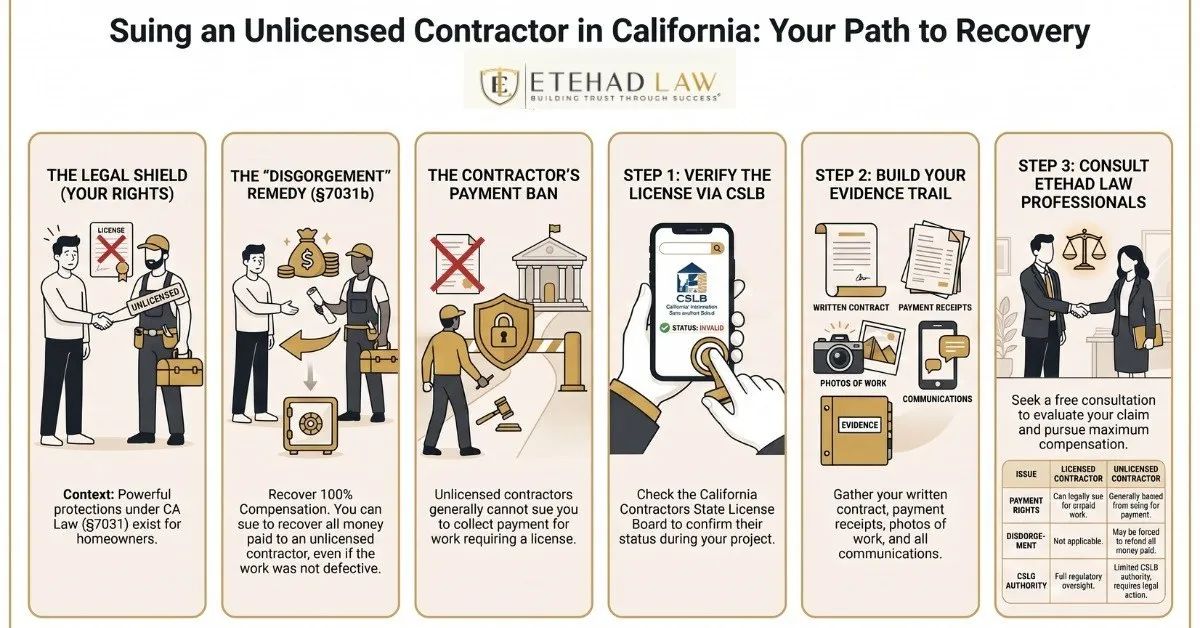
Discovering that your contractor was unlicensed can raise serious questions about your project and your money. California law gives homeowners certain protections, including potential remedies for payments made to contractors who lacked a required license.
The right next step depends on what happened, how much you paid, and the contractor's license history. Do not assume that a finished project means you have no options, or that every licensing violation guarantees a particular recovery.
If you are dealing with an unlicensed contractor, Etehad Law can review your situation and explain the legal options available to you. With over 30 years of experience, our team can help you assess the evidence, understand your rights, and determine whether legal action makes sense. Contact Etehad Law today to schedule a free consultation.
Frequently Asked Questions
The answers below address some of the issues California homeowners commonly encounter.
Can You Sue An Unlicensed Contractor in California?
Yes, California homeowners may be able to sue an unlicensed contractor, depending on the circumstances. Business and Professions Code §7031 may provide remedies when required licensing was missing.
Can I Get My Money Back From An Unlicensed Contractor?
Possibly, as California law may allow a homeowner to recover compensation paid for work requiring a license. This remedy, known as disgorgement, depends on the contractor's licensing status and other facts.
Can An Unlicensed Contractor Sue Me for Payment?
Generally, §7031(a) restricts an unlicensed contractor from suing to recover payment for work that required a license. The contractor's license status during the specific work is therefore important.
What If I Didn't Know My Contractor Was Unlicensed?
Not knowing about the missing license does not necessarily prevent you from using protections available under California law. You should still preserve evidence showing what the contractor told you about their licensing.
Does An Unlicensed Contractor Have To Refund My Money?
An unlicensed contractor may have to return compensation received for work requiring a license under California's disgorgement rules. Whether that remedy applies depends on the project's specific circumstances and licensing history.
Can I Sue An Unlicensed Contractor for Defective Work?
Potentially, yes, depending on the nature of the construction problems and your available legal claims. Repair costs, property damage, or other losses may be treated separately from a disgorgement claim.
Can I Report An Unlicensed Contractor To The CSLB?
Yes, homeowners can file complaints with the California Contractors State License Board (CSLB). The agency may investigate and take appropriate administrative or enforcement action.
Can I Sue An Unlicensed Contractor in Small Claims Court?
Small claims court may be appropriate when your dispute falls within California's current monetary limits. The CSLB also directs consumers seeking restitution toward small claims court or an attorney, depending on the circumstances.
How Long Do I Have To Sue An Unlicensed Contractor in California?
There is no single deadline for every dispute involving an unlicensed contractor. The applicable period can depend on whether the claim involves a contract, construction defect, fraud, disgorgement, or another legal theory.
What Evidence Do I Need To Sue An Unlicensed Contractor?
Useful evidence can include the contract, payment records, photographs, communications, inspection reports, repair estimates, and CSLB licensing records. Documents showing when the work occurred can also help establish whether the contractor was properly licensed at the relevant time.
Legal Disclaimer:This article provides general information about California contractor licensing laws and is not legal advice. Every construction dispute is different, so speak with a qualified California attorney about your specific circumstances before taking legal action.
You may also like
 Accident and Injury
 California Personal Injury Statute of Limitations
Learn the California statute of limitations for personal injury claims, key filing deadlines, exceptions, and why you should act quickly.
Read More » Expert Opinion
 What is a Vehicle Black Box and How Can It Help Your Case?
Uncover the role of your car black box in legal cases. Insights from Personal Injury Attorney in Beverly Hills await. Check to…
Read More » Expert Opinion
 Will Posting on Social Media Tank Your Case?
How social media posts can affect a legal case, the dos and don'ts while a claim is open, and what insurers look…
Read More »
