


If you are wondering about the role of a professional malpractice attorney, it is to protect individuals who have been harmed by a professional’s negligence and help them pursue justice. In our experience, a professional malpractice attorney investigates what happened, proves liability, navigates complex legal procedures, and seeks fair compensation for the financial and personal losses caused by malpractice.
For more than 30 years, Etehad Law has represented clients harmed by professional malpractice — including medical malpractice, legal malpractice, and other forms of professional negligence. Our attorneys investigate what went wrong, hold negligent professionals accountable, and fight for the compensation our clients deserve. Our firm has recovered more than $100 million in settlements and holds a 5.0 Google rating based on 267 reviews. If you believe a negligent professional caused you harm, contact us today for a free consultation.
In this guide, we explain the role of a professional malpractice attorney and how legal representation can strengthen your case. We also discuss the common types of malpractice claims, the evidence needed to prove negligence, California’s filing deadlines and damage rules, the compensation available, and what you should expect from your attorney at every stage of the process.
Key Takeaways
Professional malpractice happens when a licensed professional — such as a doctor, attorney, or accountant — fails to meet the accepted standard of care and causes measurable harm. To win, you must prove four elements: duty, breach, causation, and damages. California sets strict deadlines: medical malpractice claims generally must be filed within one year of discovery and no later than three years from the injury (Code of Civil Procedure §340.5), while most legal malpractice claims fall under a one-year/four-year deadline (§340.6). Acting quickly preserves evidence and protects your right to recover.
Types of Professional Malpractice

Medical malpractice is one of the most frequently litigated forms of professional malpractice. It occurs when a healthcare provider’s negligent care results in injury, illness, or wrongful death. Common examples include surgical errors, delayed diagnoses, medication mistakes, birth injuries, and improper treatment. Physicians in California are licensed and disciplined by the Medical Board of California, and conduct that falls below professional standards can constitute unprofessional conduct under Business and Professions Code §2234. These cases often require medical records, expert witness testimony, and evidence showing that the provider’s negligence directly caused the patient’s injuries.
Another common category is legal malpractice, which occurs when an attorney fails to provide competent legal representation. Examples include missing filing deadlines, failing to prepare a case properly, mishandling settlement negotiations, or creating conflicts of interest that harm the client. California attorneys owe their clients specific duties under Business and Professions Code §6068 and are regulated by the State Bar of California. To succeed, the plaintiff must generally prove that the attorney’s negligence caused measurable financial or legal harm.
Accounting malpractice is a third recognized category, arising when a certified public accountant provides negligent auditing, tax, or financial advice that causes a client to suffer losses. California CPAs are licensed by the California Board of Accountancy, and claims for this kind of professional negligence are generally governed by a two-year deadline under Code of Civil Procedure §339.
Professional negligence can also arise in the workplace. Employment-related malpractice may involve professionals or employers who violate legal obligations through discriminatory practices, retaliation, negligent advice, or other conduct that causes employees to suffer damages. If you believe your workplace rights have been violated, consulting an employment attorney in Los Angeles can help you understand your legal options and determine whether legal action is appropriate.
Regardless of the type of malpractice, the consequences can be significant. Victims often face additional medical expenses, lost income, emotional distress, damaged professional opportunities, and other financial losses. Resolving these cases usually requires gathering records, witness statements, expert testimony, and other key evidence to establish negligence and prove the full extent of the damages suffered. In our experience, seeking legal guidance early allows attorneys to evaluate the claim thoroughly, preserve critical evidence, and pursue the most effective resolution through settlement negotiations or litigation when necessary.
How To Identify Malpractice
The first step is to determine whether a professional owed you a duty of care. This duty usually exists when there is a doctor-patient relationship, an attorney-client relationship, or another recognized professional relationship requiring competent services.
Next, identify whether the professional’s conduct fell below the accepted standard of care. Under California’s civil jury instructions published by the California Courts, a professional is negligent when they fail to use the level of skill, knowledge, and care that other reasonably careful professionals would use in similar circumstances. A poor outcome alone does not automatically mean malpractice occurred.
Then, determine whether the negligent conduct caused actual harm. You must be able to show that the professional’s actions directly resulted in an injury, financial loss, emotional distress, or another measurable form of damage.
After identifying the potential negligence, gather as much evidence as possible. This may include medical records, legal documents, witness statements, emails, invoices, photographs, and any other records that explain what happened. Thorough documentation often becomes key evidence during settlement negotiations or litigation.
The next step is to obtain expert opinions. Most medical malpractice cases require expert testimony to establish the applicable standard of care and explain how the healthcare provider failed to meet it. Other professional malpractice cases may also require expert witnesses to evaluate whether the professional acted reasonably under similar circumstances.
Finally, consult a professional malpractice attorney as soon as possible. An attorney can evaluate your case, preserve important evidence, explain the applicable statute of limitations, and advise you on the best legal options. Early legal guidance also helps ensure that critical deadlines are not missed.
As Simon P. Etehad explains, “Identifying malpractice requires more than recognizing a mistake. It requires proving that a professional breached a duty of care and that the breach directly caused measurable harm.” An experienced attorney can help determine whether you have a viable malpractice claim and guide you through the legal process.
Role Of A Professional Malpractice Attorney

A professional malpractice attorney does much more than file a lawsuit. In our experience, the attorney serves as your advocate, investigator, negotiator, and legal representative from the beginning of your case until its resolution. According to the American Bar Association, legal matters often involve complex procedures and strict deadlines, making experienced legal representation essential for protecting a client’s rights.
The first responsibility of a professional malpractice attorney is evaluating the strength of your claim. During this stage, the attorney reviews the facts, identifies the parties involved, and determines whether the professional owed you a duty of care. They also assess whether negligent conduct caused actual harm and whether the evidence supports pursuing a malpractice claim.
Once the case has been evaluated, the attorney begins gathering evidence. This often includes medical records, legal documents, witness statements, professional correspondence, financial records, and other key evidence. We recommend preserving every document related to the incident because strong evidence is the foundation of a successful malpractice case.
Another important responsibility is working with expert witnesses. Medical malpractice cases frequently require medical experts to explain the accepted standard of care and how a healthcare provider failed to meet it. Other professional malpractice cases may require legal professionals, financial experts, or specialists who can explain how the defendant’s conduct fell below professional standards.
A professional malpractice attorney also develops legal strategies tailored to your case. This includes identifying every potentially responsible party, calculating damages, complying with the applicable statute of limitations, and preparing for settlement discussions or litigation. Careful planning often strengthens a client’s position throughout the legal process.
Negotiating with insurance companies is another critical responsibility. Insurance carriers may attempt to settle malpractice claims quickly for less than their full value. An experienced attorney evaluates settlement offers objectively and negotiates for compensation that reflects medical bills, additional expenses, lost income, emotional distress, non-economic damages, and other losses.
Although most malpractice cases settle before trial, attorneys prepare every case as though it may proceed to court. This preparation includes organizing evidence, preparing expert testimony, presenting legal arguments, and protecting the client’s interests throughout trial proceedings. Strong trial preparation often leads to more favorable settlement negotiations.
As Simon P. Etehad explains, “A professional malpractice attorney’s job is not only to prove negligence but also to ensure every aspect of the client’s loss is fully understood and properly valued.” At every stage of the process, your attorney works to hold negligent professionals accountable while pursuing the full and fair compensation you deserve.
How to Prove Malpractice: The 4 Essential Elements
Proving malpractice requires more than showing that a mistake occurred. In our experience, the plaintiff must establish four essential legal elements before a court can hold a professional legally liable. We recommend understanding each element because the success of your malpractice claim depends on proving all four.
Step 1: Establish a Duty of Care
The first step is proving that the professional owed you a duty of care. This duty usually arises from a recognized professional relationship, such as a doctor-patient relationship or an attorney-client relationship. Once that relationship exists, the professional has a legal obligation to provide services that meet the accepted standard of care.
Step 2: Prove a Breach of Duty
Next, you must show that the professional breached that duty of care. This means demonstrating that the healthcare provider, attorney, or other professional failed to act as a reasonably competent professional would have under similar circumstances. In many malpractice cases, expert testimony is necessary to explain how the professional’s conduct fell below the accepted standard.
Step 3: Show That the Breach Caused Your Injury
A breach of duty alone is not enough. You must also prove that the professional’s negligence directly caused your injury or financial loss. This legal element, known as causation, connects the negligent conduct to the harm you suffered. Medical records, expert witnesses, witness statements, and other key evidence often play a critical role in establishing this connection.
Step 4: Demonstrate That You Suffered Damages
Finally, you must show that the malpractice resulted in actual damages. These damages may include medical bills, lost income, future medical expenses, emotional distress, pain and suffering, additional expenses, and other economic or non-economic losses.
Once these four elements have been established, your attorney can begin pursuing compensation through settlement negotiations or litigation. The legal process typically starts with filing a malpractice lawsuit, followed by discovery, where both parties exchange documents, take depositions, gather evidence, and obtain expert testimony. This thorough process helps ensure that every relevant fact is examined before the case proceeds to trial or reaches a negotiated settlement.
Filing Deadlines and Damage Rules in California
California law sets strict deadlines, known as statutes of limitations, for filing a professional malpractice claim. Missing these deadlines can permanently bar your right to recover, which is one of the most important reasons to speak with an attorney early.
For medical malpractice, Code of Civil Procedure §340.5 generally requires a lawsuit to be filed within one year after the patient discovers the injury, or within three years of the date of injury, whichever occurs first. For legal malpractice, Code of Civil Procedure §340.6 generally sets a deadline of one year after the client discovers the negligence, or four years, whichever comes first. Claims involving accountants and many other professionals are often governed by the two-year deadline in Code of Civil Procedure §339. Because exceptions can shorten or extend these periods, an attorney should review your specific circumstances.
California also limits certain damages in medical malpractice cases. Under the Medical Injury Compensation Reform Act, Civil Code §3333.2 caps non-economic damages such as pain and suffering. As amended by Assembly Bill 35, that cap increases on a set schedule each year, so the amount that applies depends on when your claim arose. Economic damages — including medical bills, future care, and lost income — are not capped. An experienced professional malpractice attorney can explain how these rules affect the value of your case.
Challenges In Malpractice Cases
Below, we explain the various challenges you can face when pursuing a malpractice case, and how a professional malpractice attorney can help:
| Challenge | Why It Matters | How an Attorney Helps |
|---|---|---|
| Proving Negligence | The plaintiff must prove the professional breached the accepted standard of care. | Attorneys gather evidence, consult expert witnesses, and demonstrate how the professional’s conduct was negligent. |
| Establishing Causation | It can be difficult to prove the negligence directly caused the injury or financial loss. | Attorneys use medical records, witness statements, expert testimony, and other key evidence to establish causation. |
| Obtaining Strong Evidence | Important records, communications, and documents may be difficult to obtain or preserve. | Attorneys issue document requests, secure records, interview witnesses, and preserve critical evidence early. |
| Expert Witness Requirements | Most malpractice cases require qualified experts to explain the applicable standard of care. | Attorneys work with respected medical professionals, legal experts, and other specialists to strengthen the claim. |
| Insurance Company Defenses | Insurers often dispute liability, minimize damages, or argue the professional acted reasonably. | Attorneys handle settlement negotiations, challenge weak defenses, and advocate for full and fair compensation. |
| Complex Legal Procedures | Malpractice claims involve strict deadlines, procedural requirements, and extensive documentation. | Attorneys ensure filings are completed accurately and on time while managing every stage of the legal process. |
| Calculating Long-Term Damages | Victims may underestimate future medical expenses, lost income, and intangible losses. | Attorneys evaluate both economic and non-economic damages to pursue compensation that reflects the full extent of the harm suffered. |
| Preparing for Trial | If settlement discussions fail, the plaintiff must be prepared to present a strong case in court. | Attorneys develop litigation strategies, organize evidence, prepare expert witnesses, and represent clients throughout trial proceedings. |
Settlement And Litigation
Many professional malpractice cases are resolved through settlement rather than trial. In our experience, settlement negotiations allow both parties to avoid the time, expense, and uncertainty associated with litigation. According to the United States Courts, most civil disputes are resolved before reaching trial, making negotiated settlements a common outcome in complex legal matters.
Settlement discussions often begin after the discovery phase, when both sides have reviewed the available evidence. By this stage, attorneys typically have access to medical records, witness statements, expert opinions, and other key evidence needed to evaluate the strengths and weaknesses of the case. Strong evidence frequently places plaintiffs in a better position during settlement negotiations.
During these discussions, a professional malpractice attorney works to recover compensation that reflects the full extent of the client’s losses. This may include medical bills, lost income, future medical expenses, emotional distress, non-economic damages, and other financial losses resulting from the professional’s negligence. We recommend carefully evaluating every settlement offer before accepting it because early offers may not reflect the full value of a claim.
If the parties cannot reach a fair agreement, the malpractice lawsuit may proceed to litigation. During trial, each side presents evidence, examines witnesses, cross-examines expert witnesses, and makes legal arguments before a judge or jury. The plaintiff must prove that the professional owed a duty of care, breached that duty, caused the injury, and that measurable damages resulted.
Although trials can be time-consuming, they sometimes become necessary when liability is disputed or settlement negotiations reach an impasse. In our experience, attorneys who prepare every case as though it will go to trial are often in a stronger position to negotiate favorable settlements while remaining ready to advocate aggressively if litigation becomes necessary.
What To Expect From Your Attorney During The Case
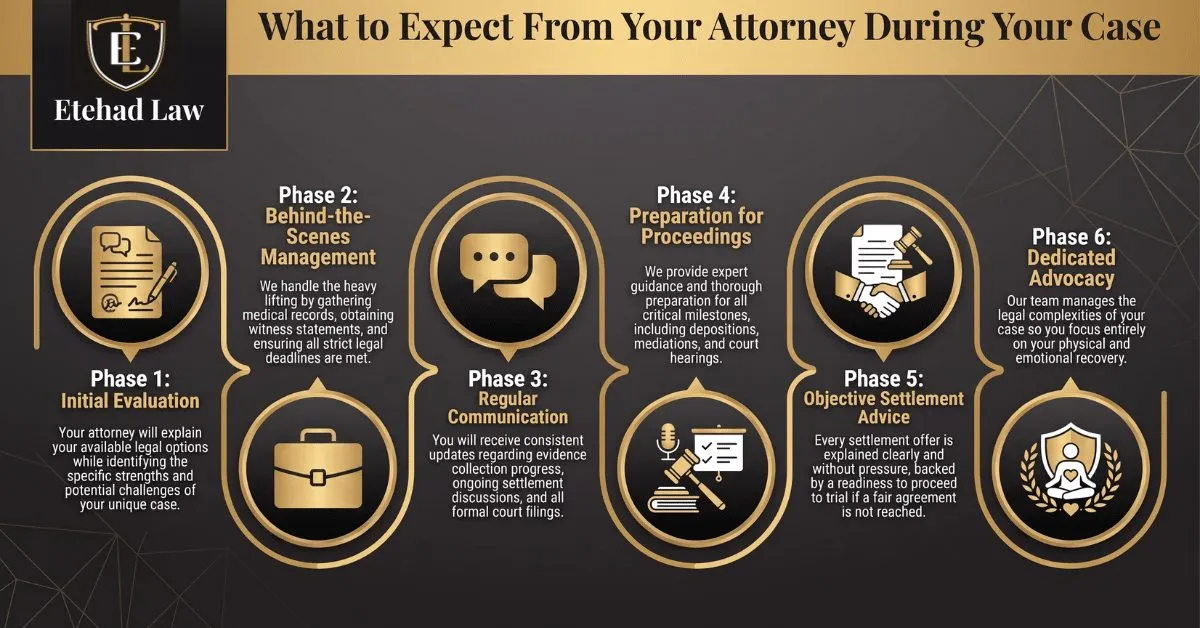
Your attorney should begin by evaluating your claim and explaining your legal options in clear, straightforward language. They will review the facts, identify potential strengths and challenges, and advise whether pursuing a malpractice claim is appropriate under the circumstances.
Throughout the case, you should expect regular communication about important developments. Your attorney should provide updates on evidence collection, settlement discussions, court filings, and any significant decisions affecting your claim. We recommend asking questions whenever something is unclear because understanding the process helps you make informed decisions.
Your legal team will also handle much of the work behind the scenes. This includes gathering medical records, witness statements, expert opinions, and other key evidence needed to support your case. They will communicate with insurance companies, opposing attorneys, and expert witnesses while ensuring important deadlines are met.
As your case progresses, your attorney will help you prepare for every stage of the legal process. If you need to participate in a deposition, mediation, or court hearing, your attorney will explain what to expect and help you feel prepared before each proceeding.
Settlement discussions are another important part of the attorney’s role. Your lawyer should explain every settlement offer, discuss its advantages and disadvantages, and provide objective guidance without pressuring you into accepting or rejecting an offer. If a fair settlement cannot be reached, your attorney should be prepared to represent you confidently throughout litigation and trial proceedings.
Above all, you should expect your attorney to advocate for your best interests. From protecting your legal rights to pursuing fair compensation, your attorney’s goal is to manage the legal complexities of your case while allowing you to focus on your recovery and moving forward.
Ready to Speak With a Professional Malpractice Attorney?
Professional malpractice can have lasting consequences, affecting your health, finances, career, and peace of mind. In our experience, taking legal action early gives you the best opportunity to preserve evidence, protect your rights, and pursue the compensation you deserve. Whether your claim involves medical malpractice, legal malpractice, or another form of professional negligence, experienced legal guidance can make a meaningful difference.
At Etehad Law, we have more than 30 years of experience representing clients in complex malpractice cases. Our attorneys carefully evaluate every claim, gather the evidence needed to prove negligence, negotiate aggressively with insurance companies, and are fully prepared to advocate for you in court if necessary. We are committed to holding negligent professionals accountable while pursuing the full and fair compensation our clients deserve. Contact us now for a free consultation.
Frequently Asked Questions
Professional malpractice claims often involve complex legal concepts and procedures. Below are answers to some of the most common questions clients ask about malpractice lawsuits and legal representation in California.
What Is the Statute of Limitations for Professional Malpractice in California?
It depends on the type of professional. Medical malpractice claims are generally governed by Code of Civil Procedure §340.5, which sets a one-year discovery deadline and a three-year outside limit. Legal malpractice claims usually fall under §340.6, with a one-year/four-year deadline, and claims against accountants and many other professionals are often subject to the two-year deadline in §339. Because exceptions apply, you should confirm the deadline with an attorney as soon as possible.
Is There a Cap on Damages in California Malpractice Cases?
In medical malpractice cases, Civil Code §3333.2 caps non-economic damages such as pain and suffering, and that cap rises each year under Assembly Bill 35. Economic damages, including medical bills, future care, and lost income, are not capped. Most other professional malpractice claims, such as legal or accounting malpractice, are not subject to this cap.
What Are the Four Elements Needed to Prove Malpractice?
To prove malpractice, you must establish a duty of care, a breach of that duty, causation, and actual damages. Your attorney typically uses records, expert testimony, witness statements, and other evidence to prove each of these elements.
Do I Need an Expert Witness to Prove Professional Malpractice?
In most cases, yes. Courts generally require testimony from a qualified expert to establish the accepted standard of care and explain how the professional failed to meet it, because these questions fall outside the everyday knowledge of a jury. Your attorney identifies and works with credible experts in the relevant field to support your claim.
What Is the Average Payout for a Malpractice Lawsuit?
There is no average payout that applies to every malpractice lawsuit because settlement amounts vary based on the facts of each case. Compensation typically depends on factors such as the severity of the injury, medical expenses, lost income, non-economic damages, and the strength of the evidence.
How Much Does It Cost to Hire a Professional Malpractice Attorney?
Many personal injury and malpractice attorneys, including Etehad Law, work on a contingency fee basis. That means you generally pay no attorney’s fees unless your case results in a settlement or award, and an initial consultation is typically free. This arrangement allows injured clients to pursue justice without paying legal fees up front.
Legal Disclaimer
This article is for informational purposes only and does not constitute legal advice. Reading this content does not create an attorney-client relationship with Etehad Law. Professional malpractice law is complex, and every case turns on its own facts, so individuals should consult a qualified attorney regarding their specific legal rights, deadlines, and options. Statutes and case law change over time, and past results do not guarantee future outcomes.
You may also like
 Accident and Injury
 California Personal Injury Statute of Limitations
Learn the California statute of limitations for personal injury claims, key filing deadlines, exceptions, and why you should act quickly.
Read More » Expert Opinion
 What is a Vehicle Black Box and How Can It Help Your Case?
Uncover the role of your car black box in legal cases. Insights from Personal Injury Attorney in Beverly Hills await. Check to…
Read More » Expert Opinion
 Will Posting on Social Media Tank Your Case?
How social media posts can affect a legal case, the dos and don'ts while a claim is open, and what insurers look…
Read More »
